


Alan White, Ph.D., Barbara Manard, Ph.D., Deborah Deitz, BSN, Terry Moore, MPH, RN, Donna Hurd, MSN, Christine Landino, MSW, MPH, Jennie Harvell, M.Ed.
Abt Associates, Inc.
This report was prepared under contract #282-98-0062 between the U.S. Department of Health and Human Services (HHS), Office of Disability, Aging and Long-Term Care Policy (DALTCP) and Abt Associates. For additional information about the study, you may visit the DALTCP home page at http://aspe.hhs.gov/daltcp/home.shtml or contact the ASPE Project Officer, Jennie Harvell, at HHS/ASPE/DALTCP, Room 424E, H.H. Humphrey Building, 200 Independence Avenue, SW, Washington, DC 20201. Her e-mail address is: Jennie.Harvell@hhs.gov.
1.0 Policy Context and Study Description
The quality of nursing home care is a major concern for state and federal policymakers, and regulators as well as consumers and industry representatives. This concern has prompted many public policy initiatives intended to improve the quality of care.
1.1 Policy Context
The traditional approach to ensuring adequate quality of nursing home care is regulatory--through the long-term care (LTC) survey and certification process. The Omnibus Reconciliation Act (OBRA) of 1987 strengthened federal requirements for the LTC survey and enforcement requirements, establishing a set of minimum standards that nursing homes must meet in order to gain (and retain) Medicare and Medicaid certification. The Centers for Medicare and Medicaid Services (CMS), formerly the Health Care Financing Administration, contracts with state survey agencies to monitor compliance with these standards through annual facility surveys, and states are primarily responsible for regulating the quality of nursing homes. The Federal Government pays 100 percent of the costs of Medicare skilled nursing facility surveys and 75 percent of the costs of Medicaid nursing facility surveys.
Despite the survey process, quality of care in nursing homes continues to be a concern, and the effectiveness of the survey process continues to be debated.1 Enforcement regulations have been criticized by providers and consumer advocates alike as either too stringent or not stringent enough. Many critics say the problem is the lack of consistency in how the survey, certification, and enforcement processes are implemented--that wide intra and inter-state variation exists in the number and type of deficiencies issued, scope and severity ratings assigned, and penalties imposed.2
Some states have established programs to improve nursing home quality through information and guidance to nursing homes on ways to improve quality of care--both generally and in relation to a facility's particular problems. In some states, these programs are intended to "raise the bar" by providing technical assistance to facilities so that they can perform at levels that exceed regulatory standards.
Similarly, the Federal Government has recently implemented nursing home quality improvement programs provided by the Quality Improvement Organizations (QIOs, formerly known as Peer Review Organizations) under contract to CMS. The CMS effort also includes a public reporting component. As of November 2002, CMS made available, through the QIOs, technical assistance to nursing homes in all states and began posting quality measures for nursing homes, in addition to other facility-level information, for nursing facilities nationwide through the Nursing Home Compare website (http://www.medicare.gov/NHCompare/Home.asp).
The impetus for this recent federal initiative is similar to that of some of the states-- to stimulate the nursing facilities to improve performance through the provision of technical assistance and to furnish consumers with comparative information with which to make an informed choice about initial or continued residence in a given facility. How these federal nursing home quality improvement efforts will interact with state TA programs has not yet been determined.
1.2 Study Description
The purpose of this study is to inform state and federal policymakers about the characteristics, objectives, and implementation of the quality improvement programs states have implemented. A particular study goal is to provide information to states that may wish to develop such programs in their state.
Originally, the study was to focus solely on Technical Assistance (TA) programs that provide on-site consultation, training, and/or sharing of best practices with nursing facility staff. Eight states (Florida, Maryland, Maine, Michigan, Missouri, Texas, Virginia, and Washington) currently have active TA programs.3 The design and focus of these TA programs vary across states, but they share several defining characteristics:
-
TA staff provide on-site consultation, training, and/or sharing of best practices with nursing facility staff. The on-site consultation may also include reviews of resident medical records and guidance on how facilities can use the CMS quality indicators or other data to monitor care quality. While many TA staff are surveyor trained, in most states, they typically do not focus on regulatory issues. Rather, they help facilities identify problems and work to help make improvements when needed.
-
TA programs emphasize a collaborative approach between facilities and the TA staff, which often contrasts with the frequently adversarial relationship between facilities and LTC surveyors.
-
TA programs are non-punitive, and results from the visit are typically not shared with the survey and certification agency unless serious violations are observed.
-
Most of the TA programs in operation are paid for entirely with state funds, although some combine state with federal funding.
Our study focus expanded, however, as our research revealed state-initiated quality improvement initiatives in addition to TA. In addition to providing TA, some states also train nursing home providers on compliance with regulations and other topics, and make information available to consumers through public reporting of information.
To select states to be included in this study, we collected basic information about the quality improvement programs in states through a combination of discussions with stakeholders and a review of relevant written information. The study focused on a group of states that had state-initiated quality improvement programs that included aspects of technical assistance and that were not reimbursement or payment related. The states we ultimately selected were Florida, Iowa, Maine, Maryland, Missouri, Texas, and Washington.4 All except Iowa have formal TA programs in place. Iowa was added because it had particularly interesting other quality improvement initiatives.5
Our data are from structured discussions with key stakeholders in each study state. Key representatives from the state agency responsible for the quality improvement programs were contacted to arrange face-to-face meetings with stakeholders. Participants in these discussions included state Survey and Certification Agency Directors and staff; Directors of Quality Improvement Projects and staff; state Medicaid Agency Directors; representative(s) of for-profit and not-for-profit nursing home associations; nursing home providers; and consumer advocacy representatives and the state's long-term care Ombudsmen. Most discussions lasted about two hours. Our research team encouraged the organization, agency, or nursing facility involved to include as many of their staff as they thought would be interested or have valuable information to share. In several states, the research team was able to observe a portion of a TA survey visit on site. Typically at least two researchers participated in each site visit--one researcher would guide the discussion; the other would take notes on participants' responses.
The discussions focused on the following topics:
- Description of the quality improvement project(s);
- Policy environment leading to its (their) introduction;
- Program design;
- Program goals;
- Program evaluation;
- Facility involvement;
- Funding amount and source;
- Perceived program effectiveness;
- Desired federal role in state-initiated quality improvement programs; and
- Advice for other states considering similar programs.
Appendix A contains summary reports documenting each state visit.
We found a range of philosophical influences combining to shape quality improvement efforts in particular states. Major influences include state legislatures, personal involvement of individual state legislators in long-term care issues, campaigning by consumer advocacy organizations, complaints from the industry about "over-regulation" by both state and Federal Governments, and a considerable body of research documenting the inadequacy of care delivered to residents of U.S. nursing facilities.6 These issues are often interrelated--an interrelation that serves as the catalyst for a state's decision to embark on its own quality initiative.
-
California, Indiana, North Carolina, Ohio, and Wisconsin plan to implement TA programs, but these programs had not yet started at the time we were collecting data for this report.
-
Michigan and Virginia were not included in the study because of the limited number of facilities that have participated in their TA programs.
-
Despite the absence of a technical assistance program, the project's Technical Advisory Group believed that the study should include Iowa, as its programs may be substitutes for a technical assistance program and may include quality improvement models that other states may wish to replicate, potentially improving our study's ability to provide guidance to states considering implementing quality improvement projects. Iowa's quality improvement programs involve a wide variety of efforts including an internet web-based Nursing Home Report Card, recognition programs for exemplary practices and performance on licensure and certification surveys, training for providers and surveyors, feedback on surveys/surveyors and an alternative survey process for state-only licensed facilities meeting certain criteria. (See Appendix A for more details).
-
For example, a 2002 report from the Office of the Inspector General concluded that "problems with quality of care continue to exist in nursing homes. The study found that the number of quality-of-care deficiencies has increased in recent years, as has the number of nursing home workers excluded from the Medicare and Medicaid programs as a result of patient abuse or neglect (OEI, 2002). A 2001 report prepared by the U.S. House of Representatives Special Investigations Division found that more than 30 percent of nursing homes had been cited for abuse violations between 1999 and 2001.
2.0 Approaches to Ta Programs: Motivation and Program Design
We were interested in two particular question related to program design: (1) the motivation for states to implement a TA program rather than some other type of quality improvement initiative; and (2) the extent to which states used a formalized design approach to guide development of their TA programs.
2.1 Choosing the TA Route
Although each state had its own set of reasons for designing and implementing its particular quality improvement programs, a similar driving force seemed typically to be behind the decision to implement a TA program--dissatisfaction with the survey process--stimulating a desire to "try something new" or focus attention on quality in a way other than regulation. This was particularly true for states with a TA program focused on improving care practices, and the cases of Missouri and Maryland illustrate this point.
The impetus in Missouri came from a set of pilot tests run in 1999 to study the impact of using advanced practice nurses to improve resident outcomes through technical assistance. This research showed that providing feedback on quality through reports and education was insufficient to improve clinical practices and resident outcomes.7 It found, further, that a stronger intervention of expert clinical consultation coupled with comparative feedback was needed to improve resident outcomes. Missouri also noted that TA visits were beneficial because they (1) recognize that facility staff are stretched to the limit, making it difficult for them to keep current on the latest clinical information; and (2) provide support to facility staff who want to do a good job, but need some ideas and encouragement (see Appendix A for more details on the Missouri TA program).
The impetus for Maryland's quality improvement programs, enacted in 2000, was a series of events and activities both within and outside the state over the preceding ten years. In 1989, the media reported on deplorable conditions in a Maryland nursing facility and subsequent scandals and multiple nursing facility closures over the next three years precipitated a 1999 General Accounting Office (GAO) study that found the complaint investigation process was unacceptably slow (the GAO made similar findings in other states). In 1999, the negative personal experiences of several influential state senators with respect to Maryland nursing homes, along with damaging testimony before the state legislature by Maryland Department of Health and Mental Hygiene/Office of Health Care Quality (OHCQ) staff on the issue of complaints, was influential in leading the legislature into tying passage of a nursing home funding bill to creation of a Nursing Home Task Force to study quality and oversight in Maryland.
The Task Force began meeting during the summer of 1999 and presented their recommendations in January 2000. In May 2000, a broad Nursing Home Reform Package was enacted in Maryland that did not focus simply on strengthening regulations and sanctions, but also included provisions specifically addressing quality improvement such as the addition of a technical assistance program through a required "Second Survey".
7. See Rantz MJ, Popejoy L, Petroski GF, Madsen RW, Mehr DR, Zygart-Stauffacher M, Hicks LL, Grando V, Wipke-Tevis DD, Bostick J, Porter R, Conn VS, Maas M (2001). "Randomized clinical trial of a quality improvement intervention in nursing homes. The Gerontologist 41(4), 525-538.
2.2 Approaches to Program Design
The literature on quality improvement strategies includes several potential design frameworks or paradigms for use in designing an effective quality improvement program.8 While differing in detail, all include a series of logical steps to (1) assess or identify the nursing facility quality problem at hand; (2) evaluate or analyze the issue in order to determine the best approach to resolving it; (3) create a plan for implementing the program design or activity intended to improve the problem; (4) define the interaction between TA staff and the survey agency; and (5) evaluate whether the intervention as designed and implemented actually resulted in quality improvement.
In an effort to categorize the quality improvement programs in the study states, we looked at the extent to which each program had been developed with this general sequence of steps in mind. We found only two states (Texas and Missouri) that had followed such a strategy in full, with rigorous program designs that included an evaluation component. Other state programs were developed through an essentially ad hoc process.9
-
The Plan, Do, Study, Act cycle of improvement (also referred to as Shewart's Cycle for Learning and Improvement) is one that is commonly cited by organizations, such as CMS's Quality Improvement Organizations, that conduct continuous quality improvement activities. Another (see Massoud, 2001) specifies a different set of steps: identify, analyze, develop, and test/implement. Yet another uses the standard steps of the nursing process: assessment planning, implementation, reassessment, and evaluation.
-
Maine did create what it called a "vision" for what quality improvement programs should look like, though this was developed too recently to be relevant for the Maine programs included in this study.
3.0 Ta Programs in the Study States: Overview and Critical Decisions
This chapter provides brief overviews of the six technical assistance programs we studied, and the critical decisions program designers and implementers must make. Chapter 4 places these TA programs within the wider context of state quality improvement programs more generally.
3.1 The TA Programs in Brief
All of the technical assistance programs we reviewed, with the exception of programs in Washington and Maine, have been in existence for less than two years. It is important to keep in mind that the relatively short life of these programs, combined with the fact that many of them were introduced at the same time as other quality improvement initiatives, limits our ability to draw firm conclusions about how program characteristics relate to quality of care outcomes.
Florida (Quality of Care Monitoring Program): The Quality of Care Monitoring Program was established in 2000, and is part of and administered by the Florida Agency for Health Care Administration (AHCA). AHCA also includes the state survey and certification agency. The Quality of Care Monitoring Program was designed to create "a positive partnership between the state regulatory agency and nursing homes and ultimately yield improved quality of care to residents." Technical assistance is provided by Quality Monitors who make quarterly, mostly unannounced, visits to facilities, and offer educational resources and performance intervention models designed to improve care. Quality Monitors also interpret and clarify state and federal rules and regulations governing nursing facilities, and seek to identify conditions that are potentially detrimental to the health, safety, and welfare of nursing home residents. The role of the monitors has expanded since the program was first implemented, to include a number of more regulatory-related processes. Quality Monitor staff now review compliance with minimum staffing and risk management requirements; preside over facility closures; and train new surveyors. Funding for the Florida technical assistance program is split between state general revenues and a portion of punitive damage awards that are set aside to improve nursing home quality.
Maryland (State Technical Assistance Unit--Quality Assurance Survey): The State Technical Assistance Unit was established in 2000, to monitor compliance efforts and provide information about best practices. The unit performs required, unannounced, annual Quality Assurance Survey (the so-called "Second Survey") at each Maryland nursing facility. The Quality Assurance Survey Unit Team, which is separate from and independent of the survey staff, consists of five nurses, one dietician, and a manager. The Second Survey is intended to be collegial and consultative rather than punitive, and its separation from the survey and certification process is intended to preserve confidentiality. Funding for the Maryland Quality Assurance Survey is obtained from state general revenues.
Washington (Quality Assurance Nurses): The Washington state Quality Assurance (QAN) program has been implemented since the late 1980s. QAN visits are made to all nursing homes in the state. In addition to providing technical assistance (or "information transfer," as the state calls it), 31 nurses conduct reviews of MDS accuracy; operate as surveyors, both conducting regular surveys and occasionally serving as complaint investigators; conduct discharge reviews to determine if resident rights are maintained when discharged/transferred; and serve as monitors of facilities in compliance trouble. The Washington State QAN program is unique in that it is the only state that has implemented a nursing home technical assistance program as part of it Medicaid "medical and utilization review or quality review" program (for further discussion of this financing mechanism see Chapter 5). Under this funding authority the state received a 75 percent federal match rate.
Maine (Consultant Nurse for Problem Behavior Residents): The technical assistance program in Maine is the smallest program in our study. In existence since 1994, the program in Maine consists of a single nurse, who provides statewide consultation and educational in-services to any facility on problem resident behaviors. The goals of the program are to (1) help facilities provide better services and reduce the risk of abuse and neglect, especially for those residents with problem behaviors who are more at risk; and (2) reduce the number of residents discharged because a facility cannot deal with their behavior. Maine financially supports the Consultant Nurse program by drawing on funds from fines collected through the imposition of civil money penalties (CMPs).
Missouri (Quality Improvement Program for Missouri): The Quality Improvement Program for Missouri was developed, and is implemented and operated by the University of Missouri-Columbia Sinclair School of Nursing. The location of Quality Improvement Program at the University of Missouri supports and underscores the independence of the program from the State Survey Agency. The Quality Improvement Program has seven nurses who provide confidential consultation to assist nursing homes with their quality improvement programs. The Quality Improvement Program is not mandatory. Since the program began in 2000, 45 percent of the nursing homes in Missouri have elected to receive this assistance. Funding for the program comes from the Missouri Department of Health and Senior Services and is financed through a combination of nursing home bed taxes, annual licensing fees, and fines collected through CMPs.
Texas (Quality Monitoring Program): The TA Quality Monitoring Program in Texas was implemented only in April 2002 and is a mandatory program for all nursing homes. The Quality Monitoring team includes registered nurses, pharmacists, and nutritionists, who conduct unannounced and unsolicited visits to facilities. Quality monitoring visits are scheduled based on a determination of the level of risk at each facility. Quality Monitors conduct individual resident and facility-level reviews to assess the quality and appropriateness of care in selected areas (e.g., restraint use, incontinence care, and toileting plans). The Texas Quality Monitoring Program is unique in that it has developed evidence-based protocols for quality improvement. Within the Quality Monitoring program, there is also a rapid response team, made up of one or more quality monitors. The Rapid Response Teams sometimes make unannounced to facilities that have been identified as being particularly problematic. They also visit facilities that request their assistance. The funding for the first two years of the Texas Quality Monitoring program was $2.7 million, with the program funded with 50 percent state funds and 50 percent federal funds.10 In order to fund its share of this program, the State transferred 50 FTEs from the survey to this new program. As part of the legislation that established the Quality Monitoring program, an additional 32 FTEs were transferred from actual survey work to other components of the state's Quality Outreach Program, including the state's Rapid Response teams, provider education, and liaison with providers.
Table 1 provides more detail on these state TA programs. Additional details on the programs in each study state can be found in Appendix A.
10. See Chapter 5 for more information on the provisions of the Social Security Act that Texas used to secure federal funds for its Quality Monitoring program.
3.2 Critical Decisions in the Design and Implementation of TA Programs
States have a series of critical decisions to make as they develop and implement a TA-type program to improve nursing facility quality of care. Our discussion here reviews how our study states made these decisions. In so doing we highlight the range of choices the study states made and the implications of those choices for program operation, focus, and likely impact.
Program Focus: Improving Care Practice or Regulatory Compliance
The focus of a state's TA program is a fundamental choice that influences all the subsequent program design decisions. States tended to choose one of two directions. One group of states created programs that focused on direct promotion of quality improvement through efforts to assist facilities in improving their care practices. In the other group of states, the focus of the TA programs promoted quality through an emphasis on monitoring compliance with survey and certification requirements. Programs in this second group of states do offer technical assistance to facilities on quality related issues beyond the scope of the survey and do not have the punitive aspects of the survey process. However, they tend to focus more on monitoring care and regulatory compliance than on helping facilities to improve their care processes.
The distinction between the foci of the two groups of states was conspicuous, and state representatives, providers, and consumer advocates talked extensively about the orientation of the TA program. Although not explicitly stated by any of the stakeholders with whom we spoke, several statements taken together made it clear that some states believe that emphasizing monitoring and enforcement of survey requirements can and does raise the level of care quality. For example, in Washington, a state with a TA program that emphasizes regulatory compliance, virtually all of those with whom we spoke--state personnel, providers and consumer representatives--reported that one of the best things about the state's QAN program was its close ties to the survey. These stakeholders expressed a belief that TA programs should emphasize regulatory compliance, and be linked with survey activities and staff. Other states viewed such linkages as conflicting with what they saw as the primary aim of the TA program, through the provision of an alternative to the survey process. In states that focused on improving care practices, the belief was that when the focus was on improving quality of care for residents, regulatory compliance would logically follow (rather than the other way around).
Programs with a Focus on Directly Improving Care Practices
The majority of our study states (Maine, Maryland, Missouri, and Texas) have chosen to focus their TA programs directly on helping nursing facilities to improve their care practices, using an approach that is separate from the LTC survey process.
-
The Second Survey in Maryland assists facilities to develop and maintain quality improvement processes. No deficiency citations are made during this visit, although facilities may be required to develop a plan of correction for serious problems.
-
Staff in Missouri's Quality Improvement Program provide clinical consultation based on helping facilities to improve their performance on the quality indicators developed by the Center for Health Systems Research and Analysis (CHRSA). Visits are made upon facility request and have no ties to the survey agency. Staff are not survey trained and do not offer advice on issues related to regulatory compliance.
-
Texas TA staff make visits to determine the appropriateness of care based on evidence-based practice models. The goal is to engage facilities to identify and focus on facility systems issues that are barriers to the provision of quality care. Initial visits are scheduled based on a facility's risk for a bad survey and are announced. Subsequent visits are unannounced with frequency dependent on performance in prior visits.
-
The Consultant Nurse in Maine provides on-site visits as requested by facilities, during which the nurse meets with staff and assists the facility to develop an effective care plan. Facilities are not held accountable for implementing the TA nurse's recommendations.
Programs with a More Regulatory Focus
The focus of the TA programs in Washington and Florida is more on promoting regulatory compliance.
-
Washington's program is focused in part on facility compliance with LTC survey requirements and utilizes protocols that identify areas of inquiry based on cited survey deficiencies. The visit is seen, by TA staff and by facilities, as an opportunity to inform facilities of potential compliance issues and of statewide (or nationwide) enforcement issues that can be expected on the LTC survey. Quality Assurance Nurses have five functions: (1) sharing information with facilities that "may be of assistance to the facility in meeting long-term care requirements"; (2) conducting reviews of MDS accuracy (related to the State's casemix payment system) in those facilities; (3) conducting discharge reviews; (4) operating as surveyors both conducting regular surveys and occasionally serving as complaint investigators; and (5) serving as monitors of facilities that are in compliance trouble.
-
The primary stated goal of the Quality Monitoring Program in Florida is to monitor the care provided to nursing home residents. The TA staff interpret and clarify state and federal rules and regulations governing facilities, and also offer educational resources and models designed to improve care. They also provide support to LTC surveyors, including compliance reviews of staffing and risk management programs, as well as training new surveyors.
While the primary focus of the types of programs (i.e., those with a focus on improving care practices vs. those with a focus on promoting regulatory compliance) is clear, there is a certain overlap between these two types of programs. For example:
-
Maryland's TA staff (with a more improvement of care processes focus) advise facilities on implementing quality improvement activities that are part of regulations recently enacted by the state legislature. In May 2000, the state of Maryland's regulations were modified to require that facilities implement a Quality Assurance Plan that includes procedures for evaluating residents with a change in clinical status, ongoing monitoring of all aspects of resident care, addressing resident and family complaints, and reporting and investigating accidents, incidents, abuse and neglect. Thus, a goal of the Maryland TA program is to ensure that facilities comply with the new regulations.
-
Similarly, the Quality Monitors in Florida review and report to the State Survey Agency facility compliance with risk management regulations and state staffing requirements, but also see their role as providing information and guidance on best practices.
Relationship Between the Survey and TA Programs
Close Ties
In two of our study states we found close relationship between the TA program and the state survey agency.
-
Washington's TA staff work within the LTC survey agency, and share findings with surveyors. The TA staff conduct LTC surveys as well as complaint investigations, and monitor facilities that are in compliance trouble. TA staff may also write deficiency citations during a quality monitoring visit, although this is rare.
-
In Florida, the Quality Monitoring staff work within the survey agency. While they report to the State Survey Agency central office rather than the local field survey office as the LTC surveyors do, TA staff attend survey field office staff meetings and coordinate with the field office when performing surveyor functions. While Florida's TA staff do not conduct annual certification surveys, they are required to perform surveyor functions such as monitoring facilities that are closing or in immediate jeopardy. TA staff also provides on-site training for new survey staff. Because of their multiple roles, Florida TA staff must make clear upon arrival to facilities as to which of their functions they are performing that day. On occasion, TA staff find it necessary to caution facility staff that information shared with them on a particular visit is in effect being shared with a surveyor.
"Relative" Independence
In some of the study states there was relatively more independence or separation between the TA program and the state survey agency.
-
In Maryland, the TA staff work within the LTC survey agency, but are separate from and independent of the survey team.
-
Maine's TA nurse technically works within the survey agency but physically works from her home office. A copy of her reports, which goes to her supervisor in the survey agency, is available to LTC surveyors.
-
In Texas, legislation specifically mandates that the TA program be separate from the survey process. However, surveyors do access TA site visit reports on the Intranet prior to their survey visit.
Total Separation
In our study states, Missouri was the only one state in which there was total separation between the TA program and the State Survey Agency.
-
Missouri's QIPMO staff work completely outside the LTC survey agency. The QIPMO staff are not surveyors, not survey trained, and not currently or in the past affiliated with the survey agency. The state agency responsible for the LTC survey provides only broad oversight and has virtually nothing to do with the day-to-day operation of the TA program. The survey agency receives summary reports of TA activity, which give numbers of facilities visited but no facility names. Survey agency staff take a strong stance in maintaining their role as monitors and regulators and distancing themselves from any consultative role. Surveyors appear to defer to the TA nurses on clinical issues, and the TA nurses do not get involved in enforcement/regulatory issues.
Reporting of Findings from TA Visits to the Survey Agency
Study states fell into two groups here. In more than half of them (Florida, Maryland, Missouri, Texas) TA findings are not formally reported to long-term care survey staff. Hardly surprisingly, the states that have steered clear of regulatory-based TA fall into this group.
No Formal Reporting to the Survey Agency
Maryland TA staff do not share findings with the State Survey Agency unless very serious violations (i.e., situations where conditions in the facility are causing residents actual harm or placing them in immediate jeopardy.) At the time of our visit, TA staff reported this has only happened once. The regular process when violations are identified during a TA visit is to have the Quality Assurance team bring these to the attention of the nursing home staff and require a plan of correction.
In Missouri, TA visits are also confidential (except in the rare cases of immediate jeopardy or actual harm to residents). No details are reported to the survey agency (not even which facilities were visited). State law mandates that the TA nurses report any situations where there is actual harm or immediate jeopardy. They must inform the facility about the issue of concern; and then must contact the LTC survey agency to discuss it. TA staff report that such a situation has never come up.
In Florida, TA staff do not share information gathered during the TA visit with surveyors, but they will bring concerns about facilities that are performing poorly to their supervisors within the state survey office, as well as report on non-compliance related to staffing and risk management. TA staff are advised to call the state hotline to report instances of immediate jeopardy.
Formal Reporting to the LTC Survey
In Maine, copies of the TA reports go to the TA supervisor (who works in the survey office) and are available to surveyors. In Washington, TA staff report all serious violations to, and share all findings with survey staff. In Texas, Quality Monitor reports are available over the IntraNet to surveyors and are reviewed as part of preparation for surveys.
Requiring TA Staff to have Surveyor Training
States span the spectrum on the issue of whether TA staff should have surveyor training. In Maryland and Washington, TA staff are required to have surveyor training, while Maine and Missouri have purposely chosen not to hire surveyors. In Florida and Texas, surveyor training is not required but some TA staff who were previously surveyors have been hired as part of the quality improvement program.
States Requiring Surveyor Training
Some states use TA staff that have either survey expertise and/or surveyor training.
-
In Florida, when the quality improvement legislation was initially enacted, Quality Monitors were recruited from the best surveyors in the state agency, with the new position considered a promotion. When subsequent legislation changed the program, increasing the number and responsibilities of quality monitors, the required qualifications were also altered. The monitors must still be nurses, but they do not have to have long-term care experience or be former surveyors. They must, however, take and pass the Surveyor Minimum Qualifications Test (SMQT). The state has had problems attracting nurses from facility positions, because the pay scale for state jobs is significantly lower than that offered by facilities.11
-
Maryland TA staff are all former surveyors. Indeed, the lead TA team member was selected because of his experience in quality assurance gained in the military and his reputation as a tough but fair surveyor.
-
Washington TA staff are masters-prepared nurses. Not all of them have LTC experience but all have survey training.
States Not Requiring Surveyor Training
Some states do not require that TA staff have either survey expertise and/or training.
-
Maine's TA nurse has no survey training or experience or any advanced degree, but has extensive experience in the field, with strong clinical and psychiatric skills.
-
Missouri TA staff are gerontological clinical nurse specialists, some with advanced degrees, selected for their clinical expertise and general lack of knowledge of the regulatory process. This TA program emphasizes that the key to effectiveness is to select expert nurses who can help facilities change their belief systems.
-
In Texas, former surveyors hold some of the TA positions, but surveyor training is not a prerequisite.
11. Originally, TA staff went through the risk management training offered by the University of South Florida, However, risk management training was not provided for those hired when subsequent legislation increased the number of Quality Monitors.
Facility Participation in TA Programs
Mandatory Programs
In all our study states except Maine and Missouri, TA initiatives were mandatory for all Medicare and Medicaid certified long-term care facilities in the state. This decision is legislatively imposed in some states, such as Florida. In other states, such as Washington, the mandate is part of state utilization review requirements, which necessarily apply to all Medicaid facilities but not Medicare only facilities. In Maryland, there is no legislation specifically mandating a quality related survey, but state regulations require two annual surveys to be performed for each facility, and the state has chosen to focus its "Second Survey" on quality improvement activities that include technical assistance and sharing of best practices.
The frequency of TA visits in states with mandatory programs varies. In Maryland, TA visits are performed yearly at each facility. In Texas, all facilities have at least one TA visit per year with additional visits prioritized to target those considered likely to be at risk for a poor survey, based on factors such as quality indicator data and previous survey results. Facilities can also request a site visit if they need guidance about an area of care. Florida also ties the frequency of visits to quality concerns. Florida's original legislation was similar to Texas, calling for annual TA visits to all facilities, with more frequent visits to troubled facilities. Current legislation mandates quarterly visits to all facilities and continues the policy of providing additional visits to poorly performing facilities. In Washington state, Quality Assurance Nurses are required by regulation to visit each Medicaid nursing facility at least quarterly.
Voluntary Programs
The two states with voluntary TA programs in the study are Maine and Missouri. These programs focused on quality improvement through consultation focused on helping facilities to improve their care practices rather than through regulatory compliance.
In Missouri, TA visits are provided by nurses employed by the University of Missouri and are voluntary, confidential, and consultative. The consultative focus allows TA nurses to emphasize standards of care and to work with facility staff on improvement efforts that are specific to their facility and resident needs. In 2001, there were 459 site visits in 212 different facilities. This included 164 nursing homes, 20 intermediate care facilities, and 85 residential care facilities (note that some facilities fell into multiple categories). Since the program began in mid-2000, about 270 of the 600 (45 percent) nursing facilities in Missouri have participated in the TA program.12
Missouri's QIPMO program encourages facility participation through the efforts of the staff to publicize the program. The TA staff in Missouri believes that their involvement in support group activities helps increase provider awareness of and interest in the TA program. TA staff coordinates and facilitates monthly MDS Coordinator support group meetings. These meetings aim to (1) improve MDS coding accuracy, (2) enhance job satisfaction for MDS Coordinators and (3) increase overall staff retention rates. In addition, the program receives referrals from surveyors.
Maine's TA program provides behavioral consultation statewide to any long-term facility upon request. Its focus is on improving resident outcomes through a combination of consultative and educational support. There are 126 nursing facilities in Maine, with 7,309 residents reported as of Spring 2001. Maine's TA nurse reports visiting 181 residents from July 2000 through June 2001, and 169 residents from July 2001 through June 2002. No records have been kept to indicate the number of facilities that have been visited.
In Maine, nursing home providers appreciate that the TA is free, that it is not connected to the LTC survey, and involves all facility staff in the process. Some referrals come through the Ombudsman caseworker, who contacts the TA nurse directly or suggests that the facility contact her. But the majority of referrals come from facilities themselves. The TA nurse describes the goals of her services as "to assist staff in dealing more effectively with difficult behaviors by giving them a better understanding of the resident and why the behaviors are occurring, making recommendations, involving them in team problem solving where their input is valued, and providing them the education that will enable them to do their jobs more effectively and safely--as well as improving quality of care and ultimately quality of life for the resident."13 She prioritizes responses to facility requests based on the severity of the problem. Visits are generally made within two weeks of the request.
-
This is a much higher participation rate than the much smaller programs in Michigan and Virginia, which also have voluntary TA programs but were not included in the study.
-
Laura Cote. Description of Behavior Management Consultation. September 2002.
Focus of TA Visits
The focus of TA visits varied across states.
-
The focus of Florida's quality monitoring visits includes both improving care practices and risk management. During visits, monitors seek to identify, at an early stage, any conditions that are potentially detrimental to the health, safety, and welfare of nursing home residents. These conditions are identified based on quality indicators or based on issues that the facility has identified as a problem. Since May 2002, quality monitors have also been given the responsibility to assess the operations of state-required internal quality improvement, risk management programs and adverse incident reports. They also coordinate with the state's Field Office Managers in visiting facilities that are being financially monitored, closing, or in immediate jeopardy, to ensure the health and safety of residents.
-
The Maine TA program has a narrow focus, targeting only residents with behavior problems. Facilities request the assistance of the state's TA nurse to assist staff in dealing more effectively with difficult behaviors by giving them a better understanding of the resident, why the behaviors are occurring, and making recommendations regarding the care of the resident.
-
In Maryland, the TA visit (i.e., the Second Survey) includes quality assurance, technical assistance, and sharing of best practices. A standardized tool has been developed for the Second Survey that examines the facility's ability to internally monitor falls, malnutrition and dehydration, pressure ulcers, medication administration, accidents and injuries, changes in physical/mental status, quality indicators, and other important aspects of care. A TA visit in Maryland requires two days, with about six hours spent in resident medical record review to reconcile what the staff is saying with what has been recorded in the charts. The remaining time is spent reviewing the facility's quality assurance plan, and interviewing residents and key staff.
-
The focus of Missouri QIPMO visits is often based on information from the facility's "Show-Me" Quality Indicator Reports, which show facility performance over the past five quarters for each CHSRA quality indicator in comparison to other facilities in the state.14 TA nurses review the Show-Me reports to identify potential problem areas at the facility, and also use the reports as the basis for a review of MDS coding errors, specific clinical conditions, current practice guidelines and standards or care. In-service education on a variety of MDS-and clinical care-related topics is the focus of some visits.
-
A core feature of the Texas Quality Monitoring program is a set of highly structured protocols and assessment instruments that Quality Monitors use during their visits to determine if care is being provided in accordance with evidence-based best practices. TA visits may include observations of and interviews with nursing facility residents. Quality Monitors provide information regarding best practices and how to achieve them, give feedback to facilities regarding the degree to which the facility is providing care consistent with best practice protocols, and help the facility identify system changes that could result in greater use of best practices.
-
In Washington, the focus of technical assistance visits is issues identified by the state's Quality Assurance Nurses (QANs) in advance of their visit. These issues are identified based on a review of casemix audit information, quality indicators, survey results, complaints, and/or discharge issues. For example, a review of casemix audit information might identify a facility with a high rate of pressure ulcers. Based on this information, the QAN visit may include a review of resident records, observation of the skin care provided to residents, and interview with staff and residents that focus on the facility's skin integrity protocol.
14. See Appendix B for an example of the Missouri Show-Me QI report.
The Nature of the TA Intervention
Dissemination of Best Practices
"Best practices" as applied to nursing facilities is a general term that refers to a range of activities centered on identifying excellence in clinical practice. The methods by which the study states identify best practices and disseminate this information, and the audience for whom they are intended, vary significantly.
Study states varied in terms of what was describe as best practices--in how best practices are defined, where they originate, and how these practices are used by the state's other quality improvement programs. Some states define a best practice as an expert-derived protocol that should be adopted by facilities to raise standards of practice. Others define a best practice as an innovative idea originating at the facility level that was seen as potentially valuable to other facilities. Still other states use both definitions. Examples of Best Practice protocols disseminated by study states are included in Appendix C.
In Texas, a panel of academic, clinical, and medical experts were used to develop evidence-based clinical practice guidelines that are a core feature of the Quality Monitoring Program. The initial focus has been limited to a small number of areas (e.g., restraint use, incontinence care, hydration). The intent is for the assistance provided by TA staff to reflect the consensus of pooled experts, not the opinion of an individual TA nurse or the survey agency. Quality Monitors provide information regarding best practices and how to achieve them, give feedback to facilities regarding the degree to which the facility is providing care consistent with the best practice protocols, and help the facility identify system changes that could result in greater use of best practices. The best practices are also posted on the QM Website (described in more detail in section 4.2.)
TA staff in Maryland, Florida, Washington, and Missouri also disseminate best practice information. In these states, however, this consists of information that the TA staff has collected from personal reading, interactions with other facilities, and personal networking. None of the information has been formally endorsed by the state or collected together and posted in a single location.
-
The Maryland TA staff carry with them a binder full of examples of documentation guidelines and "best practices" collected from various sources and facilities. They disseminate copies of these forms and guidelines, networking between facilities is encouraged, but specific advice is not rendered.
-
The Florida TA staff share materials with facilities on several topics including wound care, fall prevention programs, copies of federal and state regulations, interpretive guidelines of the regulations, and guides for water temperatures. The materials that the Quality Monitors share with nursing home providers are obtained from variety of sources including published literature, websites, and personal experience. The Quality Monitors also recommend particular videos or other training materials, provide website addresses, and pass along "best practice" information they have seen at other facilities. However, Quality Monitors are careful to keep suggestions very general, forcing the facility to select the processes appropriate to the needs of their residents.
-
In Washington, the TA staff advises facilities to network with one another but avoid telling them how to fix problems. In Washington, the TA intervention is based upon the subjective judgment of individual TA staff about the quality of care being rendered, though this judgment is influenced by use of protocols that guide the TA staff member to review specific clinical issues, depending upon the situation.
-
Missouri TA nurses bring along many resource materials and provide guidance on a variety of topics to the facilities they visit. Though the Missouri TA program emphasizes use of evidence-based clinical advice, its TA staff also provide subjective advice to facilities, based upon their own experience. All TA staff in this state carry with them extensive reference material, including practice guidelines from the Agency for Healthcare Research and Quality (AHRQ) and the American Medical Directors Association (AMDA).
-
The Maine TA nurse provides education to nursing facility staff that is intended to help staff to understand why problem behaviors are occurring and to allow them to do their jobs more effectively and safely. The state's TA nurse has also developed a number of in-service training programs related to residents with behavior problems.
TA Staff Composition
Florida, Missouri, Washington and Maine require their TA staff to be registered nurses (though not necessarily experienced in long-term care). Only Texas and Maryland's TA teams mimic the survey teams' composition, which includes other disciplines as well as nursing.
Visit Structure
The structure of the TA visits varies widely across states and in some states across geographic region within a state. The latter is true of Maryland, where the TA visit is still evolving, and in Washington, where TA staff have the flexibility to organize the visit according to the specific issues to be addressed that day. The facility personnel they meet with also vary. TA staff may meet with the facility risk manager (Florida), for example, or QA coordinator (Maryland), as well as with other members of the facility quality assurance team (e.g., social workers, nurses, therapy, administration) during each visit. Texas has a formal debriefing session (or exit conference) that TA staff conduct with each facility visited. Visit length also varies, by state and by issue being addressed on-site. For example, a Maine TA visit lasts about four hours. A Maryland visit takes two days, with about six hours spent in resident medical record review to reconcile what the staff is saying with what has been recorded in the charts. The remaining time is spent reviewing the QA plan, and interviewing key facility staff. Staff may be interviewed to assess the facility's concurrent review process (a requirement related to QA plan). In Florida, the TA staff nurse places signs in facilities she is visiting, inviting residents and families to speak with her. The Maryland, Texas, and Washington TA visits may involve resident interview and observation, as well.
3.3 Summary
Participants noted that there are both positive and negative aspects of having the TA program affiliated with the state survey program. TA staff who also function as surveyors are perceived as having greater authority, more regulatory knowledge, and better able to effect positive changes in resident care. Regulatory-related information given by TA staff who also function as a surveyor is expected to be more consistent among TA staff and between TA staff and surveyors. Sharing TA reports with survey staff may help inform and focus both survey and TA efforts.
However, housing the TA program within LTC survey agencies, having TA staff function in both TA and survey roles, and/or sharing information between the TA and survey programs gives rise to understandable provider concerns. In states with close ties between survey and TA staff, providers were less willing to be involved with the TA program. They reported being less forthright during visits, and less willing to give honest feedback on TA evaluation forms, given that the same TA staff might be performing their agency's next survey or complaint investigation. In addition, in states where TA staff acted in both roles, many participants noted that TA staff are sometimes diverted to survey tasks, reducing both the regularity and frequency of TA visits.
Whether TA staff should have surveyor training depends, in part, on whether or not there is a significant regulatory component to the TA program. In states where the TA program is closely linked to the survey agency, TA staff obviously need surveyor training. Interestingly, in states where TA staff do not perform survey tasks but have been recruited from the survey agency, discussants commented that former surveyors often have trouble "changing hats." In states that are unambiguously focused on quality first, clinical expertise is seen as more important than knowledge of regulations. However, facilities in these states say it bothers them when TA staff are unable to provide interpretive regulatory guidance. We also learned that some providers were overwhelmed by the amount and complexity of the TA information provided, particularly in states where evidence-based practice was a goal (Texas and Missouri).
The frequency of visits is also another design decision states must make. Providing quarterly visits to all facilities in a state, as Washington and Florida are required to do, is a Herculean task given current TA staff levels. In fact, in both states, state officials and some providers reported they were not receiving quarterly visits. Some Washington providers said that TA visits occur much less frequently than quarterly, and state program administrators agreed that certain geographic regions have experienced fewer visits due to the demands of the LTC survey and certification schedule. In Florida, high TA staff turnover and the increasing demands on TA staff time for survey-related tasks were blamed for the quarterly TA schedule slipping in some regions.
According to providers and other stakeholders we talked with during our visits, several factors probably contribute to facilities not participating in voluntary TA programs: (1) Some nursing home chains have their own quality improvement program and they feel that additional consultation is unnecessary and/or potentially confusing. (2) Some facilities do not understand the purposes and goals of the program, or are not aware that the program exists. (3) Some facilities associate TA with the LTC survey process and do not wish to be subjected to what they assume will be additional scrutiny. (4) Some facilities are focused only on survey and certification and lack interest in a program whose goals are not focused on improving survey results. (5) Some facilities do not have the resources either to devote to non-mandated quality improvement efforts or to allow staff to benefit from TA activities.
The nature of the TA intervention varied across, but was intended promote what each state defined as best practices. Interventions disseminated by the states included: evidenced-based care practices, expert opinion and information gathered by TA staff, and/or facility-nominated best practices.
These programs are too new, and the data are insufficient, for any conclusion to be drawn as to which approach is more effective in promoting quality (which all agree is the ultimate goal). Only Missouri, and to a lesser extent Maryland, had made any attempt to evaluate their programs at the time of our visit, and no state has tested the effectiveness of one approach over another.15 On the one hand, states that focus primarily on regulatory compliance have, in effect, increased the number of times the state agency is in the facility evaluating facility performance. This gives the state greater knowledge of day-to-day facility operations, but may not improve the relationship between providers and the regulatory agency, which historically has been troublesome in many states. On the other hand, states that focus primarily on improving nursing home care practices encourage consultation between monitors and providers, allowing facility staff to enter into collaborative relationships with state staff. These collaborative relationships may enhance problem recognition and solving. Providers, especially those not part of a larger network, appreciate the expertise and knowledge that can be provided by TA staff, who are not part of the potentially adversarial survey and certification process.
15. For more details on the results of Missouri's evaluation, see Chapter 6.
4.0 the Wider Context of State-Initiated Quality Improvement
In addition to the TA programs reviewed in Chapter 3, the states we studied all had initiated additional state-initiated quality improvement efforts. In addition to technical assistance programs, the four most commonly initiated practices included:
- dissemination of information to the public about the quality of the state's long-term care facilities;
- dissemination of best practice guidelines (in addition to best practice information disseminated by the quality improvement/technical assistance programs discussed in section 3.2);
- programs that recognize and reward facilities doing exemplary work; and
- additional training for nursing home providers.
This section presents information on each of these four program categories, including the differing approaches states have taken to implement them, the nature of their interaction with TA programs, the perceived positive and negative aspects of each program, and their potential impact on quality. Readers interested in learning more about these programs, as well as the other activities listed in Table 2, are directed to the state reports included in the Appendices at the end of this document.
4.1 Public Reporting
Over the past several years, a number of initiatives aimed at giving consumers and other members of the public access to information about nursing home quality have been implemented. In November 2002, as part of its Nursing Home Quality Initiative, CMS began posting on its Nursing Home Compare website [www.medicare.gov/NHCompare/Home.asp] information for each Medicare and Medicaid certified nursing home. The information includes indicators of each facility's performance as measured by ten quality measures. The Nursing Home Compare website benchmarks the facility's performance on these indicators against all nursing home providers in a state and nationally. The Nursing Home Compare website also includes provider-reported staffing information and was recently expanded to include complaint information.
In addition to public reporting efforts by CMS, 20 states have instituted their own public reporting initiatives.16 Of the seven states reviewed for this project, four (Florida, Iowa, Maryland, Texas) have developed a public reporting system. Each of these states makes the data accessible over the Internet. (Internet website addresses and examples of the data reported by these states are shown in Appendix D.) The public reporting systems in these states vary in the type and degree of posted information. Each is intended to provide information to assist consumers in understanding the quality of care provided in each Medicare or Medicaid certified facility in that state. In Florida, Iowa, and Texas, the websites allow access to information about survey results, giving users the ability to drill down to increasingly detailed data about each nursing home--including lists of deficiencies on the most recent survey and a summary of the facility's regulatory compliance history.
-
Texas bases quality ratings on information from three sources: MDS-based quality indicators, survey deficiencies, and the complaint system. Texas groups and compares providers of similar services (e.g.; community nursing homes are compared only to other community nursing homes, while hospital-based nursing homes are compared only to other hospital-based homes). Quality ratings are presented using a "Consumer Reports" type representation, with a circle ranging from fully darkened to fully open, indicating one of five levels of "quality." The website also provides information on facility ownership, number of beds, and special services offered.
-
Maryland uses the MDS-based quality indicators developed by the Center for Health Systems Research and Analysis (CHSRA) to compare all facilities across the state. Maryland ranks facilities into three groups: the top 20 percent of all facilities, the bottom 10 percent, and the 70 percent in between. The website in Maryland also includes data on resident characteristics such as gender, age, and functional status.
-
Nursing home quality information on the Florida website is created from an algorithm, based on the scope and severity of survey deficiencies from the previous 45 months, and compares facilities within geographic areas. Florida ranks its nursing homes by assigning each facility one to five stars. In Florida, several stakeholders voiced approval of the star assessment system, which they felt provided more helpful information than CMS's Nursing Home Compare site. Florida's website also includes information on facility ownership, number of beds, and special services offered. In addition, Florida includes on its website the "Nursing Home Watch List" that identifies all facilities in bankruptcy or certified with a conditional status (indicating that a facility did not meet, or correct upon follow-up, minimum standards at the time of an annual or complaint inspection).
-
Iowa's site allows users to view all surveys and complaint investigations since June 1999, including those under appeal. This includes full inspection reports, including detailed write-ups of deficiencies and the facility responses or Plans of Correction. The website in Iowa also shows any best practices for which the facility has been recognized.
16. Nursing Home Quality: A National Overview of Public Reporting Programs January 2002 Rhode Island Department of Health, Health Care Quality Series Number 11.
Interaction with TA Programs
The public reporting systems in Florida, Maryland, and Texas are used to help inform quality improvement efforts discussed in Chapter 3.
-
Texas prioritizes issues for its TA program based, in part, on information on facilities' quality indicator scores.
-
Florida uses the Nursing Home Watch List to identify a nursing home priority list for additional quality monitoring visits beyond the mandatory quarterly visits.
-
The Maryland TA program reviews quality indicator scores, with facilities expected to create targets for quality indicator performance based on that information.
Positives and Negatives of Publicly Reported Information
Stakeholders with whom we spoke discussed the positive and negative implications of publicly reporting information on nursing home quality. State officials believe the greatest benefit of publicly available nursing home quality reports is to help nursing home residents, their families, and informal caregivers make informed decisions when selecting a nursing home or evaluating the care provided in a particular facility. Some stakeholders in most of the states indicated that the report cards had increased consumer access to public information. However, consumer advocates noted that consumers frequently do not know that the reports exist, may not have Internet access, or may not be proficient in navigating the Internet. There has been no analysis of how often report cards actually influenced decisions about nursing home placement.
-
In Florida, advocates noted that hospital discharge staff, rather than a family member who had taken the opportunity to review quality ratings, made most nursing home placements.
-
Particularly in states with lots of rural areas with a low population density (e.g., Iowa, Maine, Missouri, Texas), there are some parts of the state in which there may only be one facility within a reasonable distance of family members, rendering the report card of little value for facility selection.
Some stakeholders also expressed concern that websites may not be designed to optimize consumer access to, and use of, these sites. Some provider associations suggested that more collateral materials should be included on websites to aide consumer understanding of the information posted. States reported difficulties in balancing the provision of sufficient information to assist consumers in making more informed decisions, while not overloading consumers with data. For example:
-
In Iowa, the Ombudsman said consumers were misled because the website included complaints alleging poor care that were later found to be unsubstantiated.
-
Florida officials said they decided to post only regulatory compliance information on their website, out of concern that the Quality Indicators were too confusing to residents and families.
The websites were also reported to provide easy access to information on nursing home quality to advocates, the provider industry, legislators, and other public policy makers. The websites in Florida, Iowa, Texas and Maryland each includes a disclaimer that the information on their website should not be used as the sole basis for nursing home selection. However, some stakeholders expressed concern that users of these websites do not sufficiently explore the meaning of posted information. For example,
-
Consumer advocates and providers in Florida believe that users rarely looked behind the summary star rating to see the back-up information, even though it is available on-line.
-
In Iowa, facilities voiced concern with the posting of survey results that are under appeal. Provider associations said that even when deficiencies are later overturned, the damage from the initial posting can be difficult to reverse. Many providers in the state are opposed to the posting of complete, unedited Statement of Deficiencies survey findings on the state's public reporting system. They believe that the state should include additional information to aide consumer understanding of the information posted, perhaps with some type of summary rating like that used in other states.
While some stakeholders indicated that the information reported on a state's website was generally current and accurate, others expressed concern that some websites were designed to collect old information while other sites simply could not be kept current. For example:
-
In Florida, report card scores are derived from 45 months of survey results. The developers who created the scoring algorithm said this is important to avoid giving inaccurate ratings to facilities that cycle in and out of compliance. But providers complained that deficiencies corrected long ago are unjustly depressing their current scores. Florida providers (as well as consumers) were also distressed by the fact that report cards have not been updated according to the original quarterly schedule.
-
In Iowa, there is concern about the posting of survey findings going back as far as 1999 are included on the state's public reporting system, believing that this can punish providers for deficiencies that have long been corrected. In Iowa, the policy is to post survey results two days after they are mailed to facilities and, if they are appealed by the facility, to mark them as such on the website.
Consumer representatives were concerned that a good rating on a report card--or even a bad one--could misinform consumers. For example, some advocates in Florida believe that giving the worst facilities in the state even a one-star rating was misleading. In Texas, the lowest ranking indicates facilities that have the 'most disadvantages' with respect to quality indicators or a 'substandard quality of care' with respect to survey findings, so this is less of a concern.
Many providers indicated that greatest benefit of the public reporting was the ability afforded to them to use a good quality rating as a marketing tool. Providers in several states said the reports allow good nursing homes an opportunity to receive the praise they deserve and distinguish them from poorer performing facilities.
While CMS and some of the states have posted nursing home performance information for the last several years, providers expressed concern about the impact of posting this information on the availability and costs of nursing home liability insurance. Providers and their associations in Iowa, Florida, and Texas reported that some liability insurance companies were choosing not to write policies for facilities with a higher number of deficiencies or that have poor quality indicator scores, and others have increased rates to the point where facilities report they can no longer afford this insurance. While the survey deficiency information has always been public, the availability of this information on state public reporting systems makes it easier and less costly for insurers to identify poor performing facilities. The states of Iowa, Florida, and Texas have convened task forces to examine the liability insurance issue.
Potential Impact on Quality
In the study states, state officials expressed their hope that public reporting of deficiencies will improve quality by stimulating competition and sparking change in facility culture. Of the states we studied, however none have formally evaluated the impact of their public reporting programs on quality of care. Maryland plans to perform an analysis on the impact of their public reporting initiative, and the state has made some modifications to the public report based upon feedback.
Doubts were already being voiced in several states we visited, however, about the potential effectiveness of public reporting to effect change. As discussed above, some stakeholders questioned whether the report cards could have an impact on consumer decisions, since the public is not sufficiently aware that the report cards exist. In most states, agency staff are able to measure how many people use the website, although they cannot identify whether these are consumers, policymakers, researchers, or others. Further, as suggested above, additional education may be necessary to raise consumer awareness of the report cards and promote consumer use of available nursing home quality information more generally.
Another factor that may limit the impact of report cards on quality improvement is that nursing home placement choices are limited in some states. However, some providers and other stakeholders voiced the opinion that access to quality reports is increasingly important in states where falling nursing home bed occupancy rates are expanding consumer choice.
Of most fundamental importance is the concern is that public reporting of inadequately risk adjusted quality indicators could limit access for heavy care patients even at the best performing facilities. For example:
-
In Maryland state officials said that some members of the nursing home industry have complained that they are being penalized for admitting heavier care residents.
-
In Texas, some stakeholders were concerned that providers are refusing to admit certain types of residents that may negatively impact the provider's quality measurement score.
Although public reporting has been promoted as a means for facilities to identify problem areas and target initiatives aimed at improving quality of care, none of the providers we spoke with identified it as such. Some stakeholders expressed concern that it is primarily the facilities already considered to be top-performing that will make necessary changes, while a certain percentage of providers in each state simply do not have the resources to initiate or sustain these improvement programs. In Florida, for example, consumer advocates noted that some facilities have been on the Watch List many times, and that this does not appear to have provided sufficient motivation for those facilities to do a better job. Nonetheless, some stakeholders with whom we spoke suggested that public reporting is a necessary, but, not sufficient step to improve nursing home quality.
4.2 Best Practice Dissemination Programs
As discussed in section 3.2, study states varied in terms of what each described and promoted as "best practices" and how these practices are incorporated into their quality improvement/technical assistance programs. In addition to best practice dissemination through the TA program, many of the study states also initiated additional activities to recognize and disseminate information about best practices in nursing homes in their state.
-
The state of Missouri has a best practices program, that is separate from its quality improvement/technical assistance program, and is implemented by Central Missouri State University. A statewide committee, comprised of provider representatives and Ombudsmen, reviews applications from facilities that believe they offer a "best practice" program. The committee selects those facilities that meet certain criteria. The facilities and their practices that are selected are published and disseminated by the University.
-
Maine disseminates best practices developed by experts as well as those developed at the facility level through a series of educational workshops for facilities mandated by the legislature. In one day long workshop, for example, an expert LTC surveyor educated participants on the current regulations in the morning session, and a panel of facility representatives discussed their innovative ideas in the afternoon session. Ideas were solicited from every facility in the state on the clinical topic area chosen for the session. Nursing home providers praised the program as providing a regulatory update, and providing "real-life examples" through facility participation.
-
In Iowa, facilities are encouraged to share best practices with the survey agency during the annual certification process. The state survey agency reviews facility-advanced practices and acceptance of a best practice leads to its posting on the website--there were over 300 postings. Although facilities were pleased with any positive recognition, several concerns were noted. Some critics felt the practices posted do not always represent exemplary care. Consumer advocates were fearful that the posting of a best practice gives the impression that the facility is performing well in all care areas on a consistent basis. And some in the state do not approve of regulatory agency involvement, however limited, in the recognition and approval process--saying it brings the regulatory agency too close to entities they are supposed to be regulating. In response to several instances where facilities recognized for a best practice were later involved in compliance problems, the state has changed the emphasis of its Best Practice program to recognize facility practice, not the facility itself.
-
Texas has developed an internet site, QMWeb, that contains the best practice protocols used in the TA program and links to other sources of information to help practitioners improve the quality of nursing home care and better understand key elements of the TA program. Every best practice included on the website has been submitted to one or more clinical peer reviewers for comment. Topics are grouped as ethical issues, geriatric syndromes, organization and administrative practices, prescribing practices, and preventive practices. The website includes detailed background information on best practice topics, resident assessment/evaluation guides, step-by-step guides for care implementation, listings of state and federal licensure and certification tags, on-line presentations for viewing, additional resources and an extensive bibliography. For example, the "resident-centered evaluation and care planning for restraint-free environments" section provides background information on the use of restraints in Texas from the 2000 Statewide Assessment, links to resources regarding approaches to reducing restraint use, and information regarding best practices regarding restraint use derived from a detailed review of the literature. It also contains a copy of the structured assessment form used in the Quality Monitor Program to assess appropriate restraint use in facilities as well as a 23 page summary of key empirical studies and a 36 minute online streaming media presentation in which the literature review and development of the best practice protocol is discussed.
Potential Impact on Quality
As with public reporting, none of the study states has made any systematic attempt to measure the impact their best practices programs have had on quality. During discussions with providers and state program staff we received several comments on their potential impact, however.
-
Based on anecdotal feedback, Iowa believes that the majority of facilities have at least looked at the best practices on the state's website, and that some facilities have adopted the best practices of other facilities.
-
Stakeholders noted that the impact of the Central Missouri State University's separate best practice program is likely to be limited, given the low level of facility participation.
-
Texas's best practice website is closely linked to the TA program, making it difficult to evaluate independently. In speaking with stakeholders, however, we did receive feedback criticizing the best practice information presented to providers as excessive.
4.3 Training/Joint Training Programs
As discussed in section 3.2, all study states include informal provider education during facility visits as one component of the technical assistance offered caregivers and administrators, and all but one include provision of some type of formalized training in their quality improvement efforts. This section describes state-initiated training programs that are directed at improving the quality of nursing home care that are separate from their quality improvement/technical assistance programs (as described in section 3.2).
Determining the topics for training is done by different methods in different states. A common approach is for states to select training topics simply by identifying areas where providers were perceived to be experiencing the greatest difficulties. In some states (e.g., Texas), at least part of the training is focused on areas that are most frequently cited as deficient. In some states, political pressures created the impetus for specific training initiatives (e.g., the Alzheimer's training program in Florida--see below). Generally, most states reported that training sessions are well attended, even though they are mostly voluntary.
Two of the states visited, Iowa and Texas, have made provision of joint training to providers and surveyors a key part of their quality improvement program. Examples of training programs used by study states can be found in Appendix E. When joint training is offered, the goals include an effort to provide a common knowledge base for surveyors and providers. Participants in these joint training programs reported that having both surveyors and providers in the same room has met with some resistance from both sides and may have had a chilling effect on discussion. Despite this, many said they believe joint training is essential, so that both providers and surveyors receive the same information--and that such sharing, even though stressful at the time, may ultimately help improve the surveyor-provider relationship, leading to better communication during the survey process.
In addition to the joint training described above, the Texas Ombudsman and his staff, who already have a presence in facilities, are conducting training on resident centered care. The issue of restraint use was chosen as a focus of this training because it is a long-standing issue with consumer advocates, because restraint use is notably high in Texas and currently a major concern of the Texas Department of Health, and because the Texas Department of Insurance identifies restraint use as a risk factor for liability issues. The program is intended to dispel myths about perceived benefits of restraints in resident safety and to help educate staff and families about alternative options. Program content has been coordinated with the best practice protocols developed for the Quality Monitor program. The program is set up in three modules: training all ombudsmen volunteers (60 staff oversee the 850 volunteers), followed by those volunteers training facility administrators and key staff, and then the volunteers/staff educate families on the topic area.
There is no mandatory requirement for facilities to participate. The goal of the program is to have 10 percent of facilities adopt the program by August 2003. Texas will compare the use of restraints in nursing homes before and after its joint training. The training program will be considered a success if restraint use is decreased in 10 percent of the facilities that participated in the joint training program. It will not be possible, however, to separate the effects of this training from other quality improvement efforts in the state.
Florida requires that all nursing home employees expected to have direct contact with residents with Alzheimer's Disease and related dementias receive a state approved training program. To provide this training, Florida employs a train the trainer model where one individual in each facility is trained by staff from the University of Southern Florida (USF) and then becomes the staff person responsible in that nursing home for training all other staff who may have contact with residents with Alzheimer's Disease and related dementias. USF has also developed a compact disc aimed at training licensed practical nurses in dementia-related care issues and also disseminates best practices via the web. Providers reported that they found the training program most helpful for nursing aides and for facilities that do not have a specific dementia care unit. Some expressed the opinion that facilities should be able to choose for themselves the training that would most benefit their facility. Some providers said mandatory training felt more like a "big brother is watching" regulatory approach than a valuable educational program.
Maine, a state with many rural facilities spread over a wide geographic area, brings training to the facilities. The single nurse who staffs the TA program developed this approach. While participating in a facility closure, she observed that educational programs available to long-term care staff were generally held outside the facility, requiring a facility representative to travel to the program and then carry the information back to the staff. She envisioned a program that would provide educational and support services in the environment of the residents and the direct care staff. She has developed seven such in-service programs, which she conducts at facilities on request. Topics include Practical Hints for Caregivers of Alzheimer's Disease and Elopement Risk Factors and Prevention. These programs are very popular and are often scheduled six months ahead. The state Licensing and Certification Division reported that 90 percent of all homes in the state sent staff to one of the workshops held in the past two years. Discussant comments on provider training tend to be positive, expressing the idea that the sharing of knowledge should at least provide facilities with useful information related to quality improvement.
Potential Impact on Quality
No state included in our study has yet done any formal analysis to of the impact of state sponsored training programs. Anecdotally, nursing home administrators and clinical staff reported that training combined with regulatory interpretation and practical applications in nursing home care improved quality. Providers reported making changes in their caregiving practice after participating in a seminar in which a surveyor provided interpretation of regulations, followed by a panel discussion and presentations by facilities of their best practices in that particular clinical area. Some stakeholders said they thought training was a critical but insufficient element of good quality care.
4.4 Facility Recognition Programs
Two of the states we studied (Florida and Iowa) have developed and initiated reward and recognition programs as part of their quality improvement efforts. The goal of these programs is to recognize facilities doing exemplary work. Examples of Facility Recognition Programs can be found in Appendix F.
Florida and Iowa use a similar process for selecting facilities for quality awards. Residents, family members, members of resident advocacy committees, or other health care facilities can make nominations for the awards. In Florida, nominations can be also made by the state Agency for Health Care Administration, provider organizations, ombudsman, or any member of the community. Nominations are presented to a governor-appointed committee that includes the state's long-term care ombudsmen and other consumer advocates, and health care provider and direct care worker representatives. Both states make efforts to eliminate conflict of interest among committee members.
Both states specify criteria that must be met for a provider to receive a "recognition" award. Nominees must provide a description of the facility's best practices and the resulting positive resident outcomes, or the unique or special care or services (nursing care, personal care, rehabilitative or social services) provided by the facility to enhance the quality of life for its residents. Performance data (e.g., the facility's "report card" or assigned "quality of care rank" within the applicant's geographic region) are used in determining the facility's quality.
Florida facilities must meet a number of additional rigorous criteria to qualify for the quality award including: strict standards of performance on survey inspection results (i.e., no Class I or Class II deficiencies within the previous 30 months of application), no history of complaints, high level of family involvement, satisfied consumers as measured by an assessment of consumer satisfaction, low staff turnover rates, and the provision of in-service training. Further, facilities are required to demonstrate financial soundness as evidenced by a formal financial audit. Many stakeholders believe that this latter criterion eliminates most facilities from consideration because most facilities may unable to afford such an audit and providers that have been the subject of bankruptcy proceedings (or whose parent organization have been the subject of bankruptcy proceedings) during the preceding 30 months are disqualified.
In both states, following selection of the finalists by the awards panel, onsite reviews are made to verify the accuracy of the information on the nomination form. When the awards are confirmed, the governor presents a certificate to the facility administrator in a recognition ceremony. Some consideration has been given to providing additional rewards to award-winning facilities, such as an extended survey cycle, but these have not been implemented due to federal policies mandating that nursing facilities be surveyed every 12 to 15 months.
Despite Florida's more detailed and complex requirements for consideration, a similar percentage of facilities in both states (between one and two percent) have received the quality awards. Iowa's numbers are limited because the state legislation permits only two facilities from each congressional district to be recognized as award winners each year.
In addition to the quality award described above, Iowa also presents a Certificate of Recognition to any facility that receives a deficiency-free survey. The certificate is intended to acknowledge the "hard work and dedication" of the facility's staff in meeting the established standards of care, and is considered a way of providing positive feedback to providers with good survey results.
Positive and Negative Responses
In general, the response to the quality award programs has been positive. State nursing home regulators assert that the awards provide facilities with incentives to focus on quality improvement and create a benchmark for others to strive to meet. Providers, who appreciate any program that rewards good facilities, see the awards as a powerful marketing tool that can boost revenues and possibly reduce liability insurance costs. Advocates welcome any type of information that can help consumers make informed decisions about nursing home placement.
However, a number of concerns were also voiced about the award programs:
-
Early in the process, issues about the composition of the award panels were brought up either by providers concerned about conflict of interest, or by consumer advocates who felt under-represented. These issues needed to be dealt with before the panels could effectively operate. The states now report those concerns have been addressed, but there are still complaints in Florida that the process of selecting facilities is not completely unbiased.
-
In Florida, providers believe that the criteria for a financial audit are so restrictive that they practically eliminate the majority of facilities. They said small, independent homes, in particular, were effectively eliminated because they could not afford to submit independently audited financial statements, which can cost thousands of dollars. Advocates and state regulatory staff remained adamant, however, that the financial requirements are crucial for determining a facility's ability to provide quality care to residents.
Some stakeholders expressed the idea that some eligible providers do not even apply, since the criteria are so stringent and the rewards so limited. For example, providers in Florida complained that the application process was very burdensome and lacked valued incentives such as an extended survey cycle, immunity from lawsuits, or increased reimbursement.
-
Some stakeholders questioned whether the criteria used effectively measure quality of nursing home care. Some expressed concern that the criteria actually excluded some of the best homes, while others believe nursing homes that provide only mediocre resident care were considered candidates. In Iowa, these concerns gained force when some facilities awarded the Governor's Quality Awards subsequently had problems on later surveys, and this resulted in bad publicity for the facilities, the state, and the program. In addition stakeholders in Iowa expressed concern that its Deficiency Free Certificates of Recognition also gives a false sense of security to consumers.
Potential Impact on Quality
Whether the quality recognition programs have any effect on promoting quality resident care remains unanswered. Both the programs are relatively new and neither state has performed any formal analysis of their impact on quality. Interestingly, however, most stakeholders express the opinion that the programs are unlikely to affect quality. "Window dressing " and "a warm fuzzy for providers" were typical of the comments received. Many with whom we spoke were concerned that the programs focused on high-performing facilities instead of the facilities most in need of assistance concerned. One stakeholder noted, "Only 5 percent of facilities are eligible--we worry about the other 95 percent."
Some stakeholders voiced the opinion that the awards, like a good rating on the facility report card, are a marketing tool which becomes increasingly relevant when bed occupancy is lower. When occupancy rates are lower, consumers may have more choice about where to go, and, thus, providers may compete by improving quality.
5.0 Funding Mechanisms for Quality Improvement Programs
Typically, states are focused on "quality assurance" activities in nursing homes--that is monitoring and enforcing compliance with nursing home requirements. Most states have avoided nursing home quality improvement activities, particularly technical assistance programs, in large part, due to the limited availability of federal funds for quality improvement and confusion about what funding sources may or may not be used to support such programs.
This chapter reviews the current funding mechanisms used by states to fund state initiated quality improvement including technical assistance programs. It also provides a guide to potential funding sources for states considering quality improvement programs, by describing current and possible future legislation that may provide for federal funding for such programs. We start this discussion by reviewing the requirements for and limits on the Medicare and Medicaid survey and certification programs.
5.1 Federal Funding for Survey, Certification, and Enforcement
Funding for Survey, Certification, and Enforcement
CMS pays for Medicare and Medicaid nursing home survey, certification, and enforcement activities using a price-based budgeting process. Under the price-based methodology, national standard measures of workload and costs are used to project individual state workloads and budgets. Payments to states are based on allowable costs up to a ceiling of 115 percent of the national average. If states exceed this average, their payments are frozen at the previous year's level for that facility, unless the state can successfully justify the causes for costs exceeding 115 percent.17 At the time of our study, no states have argued that their costs in excess of the 115 percent ceiling should have been allowable.18 The federal budget for fiscal year 2003 includes almost $250 million for state survey and certification activities.
-
In 2001, the average number of hours required per survey was 108. Across states, the average ranged from 66 hours per survey in Maine to 195 hours in Delaware. Based on last year's budget, any state taking more than 131 hours would be frozen at the previous year's funding levels. (Source: Interview with Steven Pelovitz, Director, Survey and Certification Group, Center for Medicare and Medicaid Services).
-
Source: Discussion with Steve Pelovitz, Director of CMS Survey and Certification Group, January 2002.
Survey Requirements--Sections 1819 and 1919(g)
The Social Security Act specifies the federal requirements for monitoring compliance of Medicare and Medicaid nursing home providers under Sections 1819 and 1919(g). Compliance with these statutory requirements and implementing regulations is assessed using a survey, certification and enforcement process defined in statute and regulation. Medicare and/or Medicaid certified nursing homes are surveyed at least once every 15 months.
The Federal Government is required to conduct surveys of Medicare SNFs. The Federal Government contracts with state survey agencies to perform this activity and pays 100 percent of the allowable state survey costs for Medicare SNFs (Section 1864(b)). In addition, as permitted by statute, the Federal Government contracts with states to conduct Medicaid surveys. The federal law requires that the Federal Government pay states 75 percent of survey, certification, and enforcement costs for Medicaid facilities (Section 1903(a)(2)(D)).
CMS restricts the amount of technical assistance that surveyors can provide. According to a December 2002 program memorandum (see Appendix G), surveyors "should not act as consultants to nursing homes…" but should "provide information to the facility about care and regulatory topics that would be useful to the facility for understanding and applying best practices in the care and treatment of the long-term care residents." This information exchange is not considered by CMS to be consultation with the facility, but rather "a means of disseminating information that may be of assistance to the facility in meeting long-term care requirements."
In addition, the memorandum refers to Section 2727 of the CMS State Operations Manual (see Appendix G), which states: "It is not the surveyor's responsibility to delve into the facility's policies and procedures to determine the root cause of the deficiency or to sift through various alternatives to suggest an acceptable remedy. When the State Agency conducts a revisit, it is to confirm that the facility is in compliance with the cited deficiencies, not whether it implemented the suggested best practices, and has the ability to remain in compliance." Reference information regarding best practices may be provided to "assist facilities in developing additional sources and networking tools for program enhancement," but surveyors are instructed not to "act as consultants to nursing homes."
Guidance on the types of allowable survey and certification activities that may be eligible for a federal matching payment is found in the State Operations Manual (Section 4100-4109). There is no provision that explicitly permits use of federal survey and certification funds for any technical assistance or quality improvement programs like the programs in the states that we visited.
Educational Programs--Sections 1819 and 1919(g)(1)(b)
As part of the statutory Medicare and Medicaid nursing home survey and certification requirements, each state must "conduct periodic educational programs for the staff and residents (and their representatives) of [nursing facilities] in order to present current regulations, procedures, and policies under this section." Technical assistance programs that include a regulatory focus may be considered such "educational programs." For Medicaid, a 75 percent federal match is available for approved costs. The Federal Government pays 100 percent of the costs of such programs for Medicare SNFs.
Nursing Home Enforcement--Sections 1819 and 1919(h)
Federal law enumerates several remedies that may used to promote compliance with nursing home requirements. In Medicaid, the remedies range from penalties to incentives for high quality. Some of the Medicaid remedies may be applicable to state initiated quality improvement programs. These are discussed below.
Medicaid Civil Monetary Penalty (CMP) Funding--Section 1919(h)(2)(A)(ii)
States collect CMP funds from Medicaid nursing facilities and from the Medicaid part of dually certified skilled nursing facilities (SNFs) not in compliance with federal conditions of participation. Federal CMP funds are collected from Medicare-only facilities and the Medicare portion of dually participating nursing facilities. The Social Security Act (Section 1919(h)(2)(A)(ii)) provides that CMP funds collected by a state from nursing homes19 must be applied to the protection of the health or property of residents of nursing facilities that the state finds to be deficient.20 CMS has given states flexibility in determining the appropriate uses of CMP funds as long as those funds are used "in accordance with the law and in a consistent manner." (Source: August 8, 2002 Memorandum from Steve Pelovitz, Director of CMS Survey and Certification Group, to State Survey Agency Directors, see Appendix G).21
Some states have used CMP funds for their technical assistance or other quality improvement programs. CMP funds must be applied to residents in facilities that have been found deficient. CMS has given states flexibility in determining when a facility must have been deficient to be eligible for a CMP-funded program. According to the August 2002 program memorandum:
"The law does not specify when a facility must have been determined to be deficient to qualify for benefits under a state project funded by CMPs. Most nursing facilities have had one or more deficiencies either recently or in the past. Rather than setting forth rigid criteria on when it is that a facility must have been deficient to be an eligible target for the application of CMP revenues, we believe that the best course is to offer states maximum flexibility to make this determination. Apart from this, we believe that projects funded by CMP collections should be limited to funding on hand and should be relatively short-term projects."
These CMP funds are state, not federal, funds. States may use the state-share of CMP collected from Medicaid-only certified nursing facilities and from the Medicaid part of dually participating facilities for any project that directly benefits facility residents in facilities that have been found deficient.
These CMP funds could be used to prevent continued noncompliance by nursing facilities through educational or other means including the development and dissemination of videos, pamphlets, or other publications providing best practices. Other uses could include the use of consultants to provide expert training to deficient facilities.
CMP funds collected from Medicare-only facilities, the Medicare part of dually-participating facilities, and the federal share of state collected CMPs are returned to the Treasury.
-
This includes CMPs assessed against nursing facilities for non-compliance with federal requirements, individuals who make false statements in a resident assessment (or who cause another person to make such false statements, and individuals who notify a nursing facility of when a standard survey is scheduled to be conducted.
-
This includes payment for the costs of relocation of residents to other facilities, maintenance of operation of a facility pending correction of deficiencies or closure, and reimbursement of residents for personal funds lost."
-
This memorandum is available on-line at http://cms.hhs.gov/medicaid/ltcsp/sc0242.pdf.
Incentives for High Quality Care in Medicaid--Section 1919(h)(2)(F)
The Social Security Act describes the enforcement tools that may be used to promote compliance with requirements. One tool, for which federal funding is available, are state established public recognition programs to recognize facilities that provide the highest quality of care provided to Medicaid residents. According to the statute, "a state may establish a program to reward, through public recognition, incentive payments, or both, nursing facilities that provide the highest quality of care to residents..." The law indicates that expenses incurred in such incentive programs, "shall be considered to be expenses necessary for the proper and efficient administration of the state plan under this title." These costs are eligible for a 50 percent federal match.
5.2 Federal Funding Sources for TA and Other Quality Improvement Programs Being Used by Study States
There are other Medicare and Medicaid provisions that could provide federal funding for TA or other quality improvement programs. These provisions are described below.
Medical and Utilization or Quality Review--Section 1903(a)(3)(C)(i)
This section provides for a 75 percent federal match for the costs incurred "for the performance of medical and utilization or quality review by a utilization and quality control peer review organization." This section covers activities performed by state Quality Improvement Organizations (QIOs), which have similar characteristics to the TA programs in several study states (see Chapter 8 for more details on this program), and is used by Washington state to secure matching funds for its technical assistance program which is operated as part of the state's medical utilization program.
Funding for Skilled Professionals and Support Staff--Section 1903(a)(2)(A)
This provision provides for a 75 percent federal match for costs "attributable to compensation or training of skilled professional medical personnel, and staff directly supporting such personnel, of the state agency or any other public agency." Iowa uses this provision to maximize federal funding for its public reporting, joint training, and provider recognition programs.
Funding for Nurse Aide Training--Section 1903(a)(B)
This provision allows a 50 percent federal match of the costs associated with nurse aide training and competency evaluation programs, regardless of whether the programs are provided in or outside nursing facilities. Florida uses this provision to maximize federal funding for the Florida Alzheimer's Training Program for nurse aides who are employed by or have an offer of employment in a nursing home.
5.3 Potential Funding Sources not being Used by Study States
State Consultative Services--Section 1902(a)(24)
This section provides that funding is available to nursing facilities (and other provider types) for "consultative services by health agencies and other appropriate agencies of the state" to assist them in qualifying for payment under the Medicare and Medicaid programs, or establishing the fiscal records needed to determine payment on "account of care and services furnished to individuals." This provision could be used to support programs, for example, related to the MDS (e.g., training in completing the MDS accurately). A 50 percent federal match rate is available for such consultative services. This section of the Social Security Act was not used to obtain federal funding by any of our study states.
Assuring Service Delivery in the Best Interest of Medicaid Recipients--Section 1902(a)(19)
According to this section, Medicaid state plans must "provide such safeguards as may be necessary to assure that eligibility for care and services under the plan will be determined, and such care and services will be provided, in a manner consistent with simplicity of administration and the best interests of the recipients." This section provides a 50 percent federal match and potentially could be used to fund state-established web pages or other sources of consumer information on nursing homes, although we are not aware of any states that have actually received federal funding for such efforts under this section.
Proper and Efficient Administration of the State Plan--Section 1903(a)(7)
This provision allows federal funding, subject to 1919(g)(3)(B) for 50 percent of the amounts expended by states (as approved by the Secretary) for the proper and efficient administration of the state plan.
Information, Counseling, and Assistance Grants--Section 4360 of OBRA '90
This provision permits states to receive funding for grants for programs related to providing education to Medicare beneficiaries. The law indicates that the purpose of such grants is to provide "information, counseling, and assistance relating to the procurement of adequate and appropriate health insurance coverage" to Medicare beneficiaries including providing "information that may assistance in obtaining benefits …under titles XVIII and XIX…" One potential use of these grant funds may be for public reporting systems that provide consumers with information regarding nursing homes.
The FY 2002 appropriation for this program was $12.5 million. State allocations are made using a formula that takes into account the number of beneficiaries in rural areas and the number of Medicare beneficiaries relative to the state's total population. For large states (e.g., Florida and California) the average grant award is about $500,000. For smaller states (e.g., North Dakota and Missouri) the grant award is about $125,000. None of the study states indicated using this section to secure federal funds for their quality improvement programs.
5.4 Funding Sources Used for Identified Quality Improvement Programs
In general, in the states that we studied we found that federal survey funds had not been used for technical assistance programs but had been used for other types of quality improvement activities. As discussed in Chapter 3, only two of the technical assistance programs in our study--the programs in Washington and Maine--receive any federal funding. The funding sources and amounts for each of our study state's technical assistance, best practice, training, and facility recognition programs are discussed below.
-
Florida: Florida's technical assistance program is funded by state general revenue funds. The total cost of the program is about $1.65 million--this includes $1,395,911 for the quality monitors and $261,000 for other expenses. The legislation authorizing the quality monitor program also increased licensing fees for facilities (from $35 to $50 per bed), and this increase covered part of the costs of the TA program.22 Costs for other Florida quality improvement programs that were funded under Senate Bill 1202 (2001) are as follows: nursing home risk management and quality assurance program: $2.1 million in FY 2001-02 and $1.54 million in FY 2002-03. (This includes costs of about $450,000 for data system development) and staff costs; Nursing Home Care Alzheimer's training: $10.5 million in FY 2001-02 and $6.8 million in FY 2002-03; surveyor training: $66,000 (in both FY 2001-02 and FY 2002-03). The risk management program is paid for entirely by state funds, but federal funds cover more than 50 percent of the funding for the state's Alzheimer's Training Program, under which dementia-specific training is provided to staff who care for residents with Alzheimer's Disease.23
- Iowa: Iowa's public reporting, joint training, and provider recognition programs receive a 75 percent federal matching payments under Social Security Act 1903(a)(2)(A). The costs for the state's programs are as follows:
- The Nursing Home Report card costs about $105,000 per year, including costs related to programming, web maintenance, electronic licensing fees, and scheduling software.
- The Joint Surveyor/Provider Training sessions costs approximately $50,000 per year.
- The Governor's Award program costs $5,000 per year, Deficiency-Free Certificates, $500 per year, and the Survey Questionnaire costs about $50,000 per year.
-
Costs for Iowa's Best Practices program (the state's Quality-Based Inspections program) are estimated at $15,000 per year. This program remains small, focusing only on facilities that do not participate in Medicare or Medicaid because of the inability to obtain a waiver of the federal survey frequency requirement (i.e., surveys are to occur on average every 12 months, and no later than 15 months).
-
Maryland: The $400,000 annual cost of the state's technical assistance program is funded entirely by state general funds. The state's Department of Health and Mental Hygiene has also established a health care quality account funded by civil money penalties paid by nursing homes. Expenditure of the funds can be made for any purpose that will directly improve quality of care in nursing facilities. In Summer 2002, there was $230,000 in the state account and $1,300,000 in the federal account. The state's other quality improvement programs have no impact on the state survey agency's budget, according to the state survey agency's director.
-
Maine: The cost of this program is less than $100,000 and covers the salary for a single technical assistance staff member and administrative support. These costs are part of the Licensing and Certification budget, which receive a 75 percent federal match under Social Security Act 1903(a)(2)(A). The state's best practices program has received about $5,000 in funding from state CMP fines.
-
Missouri: The major source of funding for Missouri's technical assistance program is the state's nursing facility quality improvement fund.24 Nursing homes are taxed based on the number of residents in the facility and a portion of the tax is required to be spent on quality improvement programs. Additional funds for the technical assistance program come from annual nursing facility licensing fees and state CMP fines. It seems unlikely that this state would have funded any technical assistance efforts if not for two requirements: (a) the state is mandated to have a quality improvement program, and (b) the funding cannot revert to the general fund if not spent on quality improvement. For the 2001-2002 fiscal year, the University of Missouri received a $625,947 grant for its technical assistance program. This was less than the $743,424 for 2000-2001, but an increase over the $492,258 received in 1998-1999.
-
Texas: The technical assistance and other quality improvement programs enacted as part of the Long-Term Care Facility Improvement Act of 2001 (State Senate Bill 1839) are financed by a combination of state and federal funds, and a facility licensing fee. According to the state's fiscal analysis, the cost of the new initiatives implemented as a result of this legislation is estimated at $1.3 million in FY 2002 and approximately $1.1 million thereafter.25 This includes the costs associated with the state's best practice and training programs, which are part of the state's Quality Monitoring program. The $330,000 one-time cost associated with implementing the quality assurance early warning system was eligible for a 75 percent federal match, under Section 1903(a)(3)(C).
-
Washington: The state receives a 75 percent federal match for its technical assistance program because this program is operated as part of its "medical and utilization or quality review" as provided in section 1903(a)(3)(C)(i). Annual costs for the program are about $2.8 million.26
-
According to analysis by the State Senate, licensure fees were expected to cover $783,000 of the costs of the quality monitoring program for FY 2001-02 and $721,000 for FY 2002-2003.
-
Source: Senate Staff Analysis and Economic Impact Statement,http://www.leg.state.fl.us/data/session/2001/Senate/bills/analysis/pdf/2001s1202.ap.pdf.
-
Licensing fees or bed taxes can only lead to quality improvement to the extent that the nursing facility payment rate is sufficient to meet basic nursing facility needs. A potential concern is that these fees or taxes may not be used to improve quality but instead are used to shift costs from states to the Federal Government.
-
Source: Texas Legislature On-Line web site, (http://www.capitol.state.tx.us/cgi-bin/tlo/textframe.cmd?LEG=77&SESS=R&… B&BILLSUFFIX=01839&VERSION=1&TYPE=F).
-
This includes the costs for the 75 percent of time that QAN nurses dedicate to QAN activities (The remaining 25 percent of their time is allocated to the survey.)
5.5 Proposed Legislation Affecting Funding for Quality Improvement Programs
Two bills are currently in the U.S. Congress that, if passed, will provide additional authorization for funding state initiated technical assistance programs.
Nursing Home Staffing and Quality Improvement Act of 2001 (H.R.118)
The Nursing Home Staffing and Quality Improvement Act, introduced in the House Committees on Ways and Means and Energy and Commerce, would authorize the Secretary of the Department of Health and Human Services (HHS) to provide grants to states for the purpose of improving the quality of care furnished in nursing homes operating in the state.
The bill would provide financial assistance for recruiting, retaining, or training nursing staff. State technical assistance programs may qualify for funding under these grant programs, since the legislation would permit funds to be used for bonuses to nursing homes that meet state quality standards; and for any other nursing home staffing and quality improvement initiative approved by HHS. Under the bill, Title XI of the Social Security Act would be amended to establish a Nursing Facility Civil Money Penalties Collection Account that would be used for awarding grants under the Act.
This bill was introduced in January 2001. In February 2001, it was referred to the House Subcommittee on Health, and there has been no further action on it since then.
Medicare and Medicaid Nursing Facility Quality Improvement Act of 2002 (H.R.4030)
This legislation, introduced in March 2002 by Rep. Dave Camp (MI), would amend the Medicare and Medicaid statutes to modify the federal survey and certification process for nursing facilities. The bill would allow states to apply for waivers to the survey and certification requirements specified in Section 1819(g) of the Social Security Act. These states would develop
"innovative quality measurement and oversight systems that differ from those presently required by federal law." According to the language of the bill, waiver requests are to be approved if they demonstrate "significant potential for improving the quality of care, quality of life, and safety of residents." According to the bill, up to eight states could receive authorization to create such alternative systems. The bill would eliminate rules that prohibit surveyors from making recommendations to improve nursing care. The legislation does not include authorize a specific funding amount or source.
The bill (H.R.4030) has 15 co-sponsors and has been endorsed by both the American Association of Homes and Services for the Aging (http://www.aahsa.org/public/ press_release/PR221.htm) and the American Health Care Association (http://www.ahca.org/brief/nr020322.htm).
In April 2002, the bill was referred to the House Subcommittee on Health in the Committee on Energy and Commerce, for a period to be determined by the committee chairman, and there was no action on this legislation between April 2002 and May 2003.
6.0 Effectiveness of Technical Assistance Programs
A rigorous assessment of the effectiveness of state-initiated technical assistance programs is not possible at this time for several reasons:
-
Most programs have been in effect for only brief periods and have not had time to collect the type of information necessary for a rigorous impact analysis.
-
None of the technical assistance programs we reviewed were implemented in a vacuum but in combination with other quality improvement initiatives, making it difficult to isolate specific impacts of technical assistance programs.
-
There is no consistency among the study states on how quality improvement is defined and measured, and no consensus in the literature about what quality measures are most appropriate.
In addition, while states expressed a general interest in measuring effectiveness of their quality improvement efforts, most have not developed a systematic evaluation plan and have been unable to identify acceptable criteria for measuring the impact. Although, intuitively, states believed that TA has a positive impact, uncertainty about an appropriate measure, along with the unknown influences of other ongoing programs, may mean that the impact of these TA programs on quality is never known.
As an example, Florida said they have considered looking at changes in deficiencies, but have not been able to arrive at a suitable measure. A decrease in the number of deficiencies cited, a decrease in overall scope and severity, or a decrease in the number of citations have been considered as possible measures but none has been proven as reliable measures. The known inconsistency of survey results on these and similar measures adds to the state's reluctance to use any of them. Florida is also aware of the impact staff turnover has had on program effectiveness and sustainability, making them hesitant to begin an evaluation that does not take turnover into account.
6.1 Previous Studies of the Impact of Nursing Home Quality Improvement Programs
Previous studies have provided mixed evidence regarding the effectiveness of nursing home quality improvement programs similar to the TA programs that we studied. A CMS study (1998) evaluated two nursing home quality improvement programs that were accompanied by reasonably strong evaluation designs. One program, an extremely labor intensive intervention to reduce incontinence, resulted in a reduction in incontinence rates, but these gains were not sustained after the external research staff stopped providing feedback to the participating nursing homes. The study found evidence that the other intervention, the Ohio Pressure Ulcer Prevention Initiative, was not effective. A Commonwealth Fund evaluation of the Wellspring quality improvement model27 found several positive outcomes (e.g., improvement on federal survey and lower staff turnover), but there was no clear evidence of improvements in clinical outcomes based on Minimum Data Set (MDS) quality indicators. These results suggest that it may be difficult to change the organizational and care practices within nursing homes that impact resident outcomes.
However, it is not possible to tell whether the mixed results of these previous evaluations are the result of an actual inability of the programs to result in improvements in quality or an inability of the available data to measure changes that may have actually occurred. A major challenge in measuring the effectiveness of any nursing home intervention is the difficulty in constructing valid quality measures. Absent any primary data collection, the two data sources that are available for measuring program effectiveness are the MDS and survey deficiency data. Both of these data sources have significant limitations for measuring quality of care, making it nearly impossible to draw definitive conclusions about the impact of specific interventions. These data limitations also limit the ability to compare the relative impact of nursing home programs with a quality improvement focus vs. those that focus on the survey and certification process.
The MDS has two potentially significant types of limitations:
-
The MDS may not contain the items that would be required to measure quality adequately because is not a comprehensive clinical documentation system. Harris et al (2003) notes that the construction of quality indicators and quality measures from MDS data elements is constrained by the availability of data within the MDS; the availability of data within the MDS is constrained by the limited clinical content within the MDS.
-
The MDS data may not be accurate. Several studies have identified serious accuracy problems with MDS data. Abt Associates (2001) reported that MDS error rates average 11.6 percent for all MDS items. Similarly, a study conducted by the Office of the Inspector General (OIG) (2001) found errors on 17 percent of the MDS data elements.
As noted by Walshe (2001), differences in deficiency rates across states (or regions within states) and changes in deficiency rates across time may reflect real differences in quality of care.28 But they also may be the result of differences in the stringency, scope, or implementation of the survey process.29 It is not possible to disentangle these two effects. According to an OIG report (1999), inconsistency in the survey process results from unclear guidelines that may contribute to different interpretations by surveyors when citing deficiencies, differences in the level of supervisory review for survey reports, and high turnover among surveyors.
Due to these data limitations, little is known about the effectiveness of either TA programs or the survey and certification process, or about whether quality is improved more by investments in quality improvement or enforcement programs.30
-
The Wellspring quality improvement model it is very labor intensive and incorporates with additional resources about every intervention that plausibly could impact quality. It has two primary goals: (1) To make the nursing home a better place for residents to live by improving the clinical care provided to residents and (2) To create a better working environment by giving employees the skills that they need to do their jobs. (See http://www.cmwf.org/programs/elders/stone_wellspringevaluation_550.pdf.)
-
Nationally, the average deficiency rate for nursing homes surveyed in 2001 was 6.2 per nursing home; this ranged from 2.9 deficiencies per nursing home in Vermont to 11.2 deficiencies in California (Source: OIG, 2003).
-
An OIG review of 310 survey reports reveals that different deficiency tags are being used to cite the same problem. In five of the six standard surveys we observed, the OIG found inconsistency across surveyors in how deficiencies were cited, and also found differences across states in how many deficiencies they will cite for a single problem of non-compliance.
-
While the CMS study found clear evidence of some important improvements in nursing home quality that resulted from the changes to the survey and certification process that were introduced as part of OBRA 87, this improvement is not relevant for assessing whether the marginal impact of additional resources is higher for enforcement-oriented or quality improvement programs (i.e., whether the marginal impact on quality is higher for TA or enforcement programs).
6.2 Formal Assessment of TA Impact Among Study States
Missouri is far ahead of other states in using systematic data to measure the impact of its TA program. Missouri's TA program began in 1999, when a pilot test demonstrated that providing written reports to nursing facilities on their quality improvement status was not enough to motivate changes in processes that would improve resident outcomes. The researchers who performed the pilot test noted that on-site expert TA, particularly when delivered as a series of on-going visits, was most effective in changing resident outcomes.
Since the program's inception, staff have used the MDS-based quality indicators developed by the Center for Health Systems Research and Analysis (CHSRA) to measure the impact of their TA program on resident quality of care and quality of life. Although the quality of MDS data has improved, as familiarity with the tool has increased and data edits have been implemented by individual states and CMS, there is still considerable confusion around the coding of some items. Recognizing the potential for problems in the MDS data early on, Missouri developed standardized training materials for the MDS and mandates that anyone offering MDS training in the state utilize those materials. Their TA nurses also provide monthly support groups for MDS coordinators, as a forum to clarify issues regarding MDS coding.
In addition to analyzing median quality indicator scores, the program staff analyze trends for the 90th and 95th percentile, so that the effectives of the program in improving outcomes for low-quality facilities can be understood. Analysis of data since the implementation of the TA program across all facilities participating in the program demonstrated improvement in 16 quality indicators, declines in only six.31 The following are the indicators that have improved:
- Behavioral symptoms (for both high and low-risk residents);
- Prevalence of depression;
- Prevalence of depression with no treatment;
- Cognitive impairment;
- Prevalence of occasional or frequent bladder or bowel incontinence without a toileting plan;
- Fecal impaction;
- Dehydration;
- Prevalence of bedfast residents;
- Decline in late loss ADLs for low-risk residents;
- Decline in range of motion, overall and for both high-risk residents;
- Decline in range of motion for low-risk residents;
- Antipsychotic/hypnotic use;
- Hypnotic use more than two times in last week;
- Prevalence of little or no activity;
- Pressure ulcers for both low-risk residents; and
- Pressure ulcers for high-risk residents.
Several quality indicators have gotten worse in Missouri since the implementation of QIPMO, including behavior problems for high-risk residents, patients receiving nine or more medications, range of motion training/practice, and antipsychotics use in the absence of an appropriate diagnosis. Preliminary investigations by QIPMO staff suggest that these declines may reflect MDS coding issues rather than actual decline of care.
Maryland is the only other state that has attempted to formally evaluate the impact of quality on a select number of indicators. According to Maryland Department of Health and Mental Hygiene/Office of Health Care Quality (OHCQ), the eventual evaluation will look at complaint rates, correlations between deficiency citations and areas targeted for facility quality improvement, and facility satisfaction with the Second Survey.
31. Missouri program staff have not compared outcomes for TA participants vs. non-participants because such a comparison would confound programmatic effects vs. selection effects, due to the non-random selection of facilities.
6.3 Informal Assessment of TA Impact Among Study States
During state site visits, the research team asked about the perceived impact of the TA program in each state on the quality of life or quality of care of the residents. Only one state was able to report any empirical analysis of the outcome of their efforts. Thus, most of the information we present in this section is anecdotal, gathered during our discussions with stakeholders.
State program staff and stakeholders were also asked to describe aspects of the program that worked well, aspects that could be improved, sustainability, and lessons learned. Combining this information helped us understand how the programs had been able to effect change in facility systems or processes related to quality improvement--although it was typically difficult to attribute those changes solely to the TA program. Here we describe respondents' impressions of how the various TA programs have improved resident outcomes, which factors make them effective, and what difficulties they see as inherent in measuring program effectiveness.
Ongoing Feedback Mechanisms
The informal feedback TA programs received from facility staff generally took the form of a paper questionnaire given to facility staff at the end of a TA visit, asking facilities to provide information rating the performance of the TA staff and how helpful the visit had been. Some facility staff in Florida and Washington, where TA staff also function as surveyors, told the research team that they are hesitant to give any negative feedback on these questionnaires for fear that the staff member making the TA visit might be conducting their next LTC survey or complaint investigation. Texas was the only state that reported using the Internet for feedback on its program. In Washington, the survey staff holds quarterly forums with executives from the nursing home industry to discuss issues related to quality. Maryland state officials reported using the information collected as feedback on the TA program's first year to establish the focus for the second year's visits.
Informal Assessment of Impact on Quality of Care and Quality of Life
Maine, Texas, Florida, Maryland and Washington all reported anecdotal comments on the impact of their TA program on resident quality of life and quality of care issues. For long running TA programs like Maine's and Washington's, participants made relatively strong statements on the impact of their programs. Maine's program was praised by every participant as improving the quality of life for the affected residents. Providers believed that the quality of life for the residents referred to the behavioral consultation program was definitely improved, because staff were able to provide better care to a difficult population. Anecdotal feedback from survey staff, the ombudsman, and facilities indicated that the consultations have led to changes in plans of care that have had positive results for both residents and staff. LTC survey staff from the state indicated that, based on informal feedback, the education and support given to staff has decreased medication use among the residents and the number of discharges due to behavioral issues.
In Washington, program staff reported that they believe the TA program is positively affecting outcomes and quality because of informal feedback they receive from providers and stakeholders. Providers and ombudsmen with whom we held discussions noted ways in which they thought the TA program positively affected quality. For example, one provider stated that a good TA nurse can help facilities prioritize quality problems and can help new Directors of Nursing and facility staff to improve quality. An Ombudsman stated that the TA program has a positive effect because it promotes taking care of problems at an early stage. Many respondents viewed good performance on the survey as indicating better quality and indicated that TA visits helped facilities perform better on the survey.
Comments on programs implemented more recently were more tentative, especially in Texas, with many respondents adopting a "wait and see" attitude.
On the positive side, in every state there were participants who said the TA program was helpful, was a good resource for clinical and/or regulatory information, had taught or helped providers improve a skill, and represented a welcome change from the traditional adversarial relationship between provider and LTC survey staff. Providers reported that in many cases they value the consultative advice provided, saying that for some it has changed the relationship between the state and providers for the better. Participants reported learning investigative and analytic skills from TA that they are then able to use to review current facility processes. The shift in focus from deficiencies to quality improvement is also seen as positive. Some survey agencies even reported that providers have fewer complaints about the survey process.
Negative comments are more specific to the individual state program. Lack of consistency between surveyor and TA information was noted as a problem in Washington and Florida. In Florida particularly, providers noted that TA staff hired when the program was initially legislated were former surveyors receiving a promotion, but that those brought in as part of subsequently legislated program changes were not experienced in long-term care, geriatric clinical issues, or the regulations--and thus were less helpful to providers. Florida providers also noted that the value and usefulness of the TA program, which reflects program staff and leadership, appears to vary considerably by region. Both Florida and Washington discussion participants reported problems with the frequency and regularity of TA visits. In each state, visits are mandated to occur on a regular basis, but sometimes do not, leading to distrust of program staff and perceptions of reduced effectiveness. In both these states, TA staff are also utilized for surveyor tasks. Lastly, in Missouri and Texas, providers said they are occasionally overwhelmed by the amount and complexity of information provided by the TA program. Missouri TA staff are advanced practice nurses employed by the university school of nursing, who utilize clinical studies as guidance for providers. In Texas the TA staff promote expert evidenced based practice guidelines developed by academic, clinical, and medical experts. Respondents in Texas reported being often uncertain how to use all the information and for how much of it they will be held accountable.
The Florida and Washington programs, as noted, both involve TA staff functioning in multiple roles. Washington's TA staff act as surveyors on occasion and Florida's TA staff monitor facilities that are closing or in immediate jeopardy. In these states, facilities said they need to be aware of these differing functions and that, depending on the situation, the role of the TA and relationship with the facility may change. These seeming areas of overlap between TA and enforcement are seen by some to have a positive impact on quality, adding "teeth to be able to penalize facilities that don't perform." But others see them as negatively impacting the relationship and any atmosphere of openness between the facility and agency staff. Respondents from states where TA staff performed multiple roles made the point that where there are competing demands on staff who perform both roles, the TA role is often the one that suffers. More work is needed to evaluate which strategies most effectively change the culture of care giving.
7.0 Suggestions from Study States to Others Considering Quality Improvement Programs
We asked providers, state program administrators, and consumer representatives in each of our study states for general guidance advice they would offer other states considering quality improvement programs. We also asked for specific suggestions based on lessons they learned in relation to programs initiated in their states. The following list summarizes general guidance from state administrators to states considering developing a QI initiative:
-
Take time to study other quality improvement models before designing and implementing any new program.
-
Developing an adequate evaluation component is particularly important in the current environment of fiscal constraints, which increasingly requires programs to demonstrate their worth through hard evaluation evidence.
-
Look for creative ways to balance punitive and non-punitive programs.
-
Never underestimate the need to obtain industry and legislative buy-in.
-
Disclose program goals and be upfront with facilities when launching quality improvement programs.
-
Take a multi-faceted approach in improving nursing home quality, since it remains unclear what specific aspects of TA and similar efforts work best.
7.1 TA Programs
Many respondents offered advice related to the structure and function of TA programs, particularly regarding the relationship between TA and survey. The majority of respondents reported that they believe the TA programs are worthwhile and have a positive impact on facility quality of care. However, they varied in their opinions regarding which facilities should be targeted to receive technical assistance. Some consumer advocates said TA programs should focus primarily on small independent facilities that have fewer of their own resources from which to draw. Other stakeholders thought TA programs should either be mandatory for all providers or should focus primarily on poor performers.
Strong, but by no means unanimous, opinions were expressed about whether states should maintain separation between their TA programs and their LTC survey and certification process. States that had preserved that separation felt strongly that it is critical to the fundamental purpose of TA--i.e., to help facilities improve the care they deliver. Stakeholders from both the state survey agencies and the TA programs holding this view emphasized that any blurring of the lines between survey and TA could cause providers to become skeptical about confidentiality, and to fear that information shared during TA sessions will be reported to surveyors. They felt that this lack of confidentiality has the potential to chill the relationship between technical assistance staff and facilities, resulting in a loss of candor on the part of facilities and, as a result, lost opportunities for TA assistance.
In contrast, most program staff and many providers that we talked to in states with closely tied TA/survey programs recommended that TA staff also function as surveyors for reasons that are discussed in section 3.2, namely that the association with survey causes TA staff to have greater authority, more regulatory knowledge, and therefore a better ability to effect positive changes in resident care.
In several states, respondents, representing both TA programs and facilities, stressed how important the quality and personality of TA staff is to the success of their efforts. To be effective, it was generally agreed, staff members should be experienced in long-term care and sufficiently flexible to work collaboratively with facility staff. It was also agreed that the standards used and the training given to TA staff must be consistent to avoid subjective consulting across facilities.
7.2 Other Quality Improvement Initiatives
Administrators of quality improvement programs in study states also offered some specific advice for state officials interested in developing other QI initiatives:
Awards and Recognition Programs and Best Practice Initiatives. Participants thought it important to ensure that there is a consumer advocate position on the selection panel, and that this position is well defined so it does not default to "an industry representative who has a relative in a nursing home." They also recommended that the selection panel visit any facility nominated for an award, to validate nomination criteria and make sure the facility is in fact "doing something special" and not merely meeting minimum criteria. Stakeholders said it was important that the selection process be seen as objective--so that the award, in turn, is seen as truly recognizing outstanding quality. Stakeholders recommended that consideration be given to the criteria used to select facilities for awards. States advised caution about setting criteria too low or evaluating facilities over too short a period to ascertain whether the facilities chosen were maintaining good practice on a consistent basis. This is important to avoid the inevitable bad publicity and diminished consumer trust that result when facilities singled out for recognition later experience quality problems.
Training Initiatives. Several stakeholders advocated that the most effective training programs were those that included both interpretation of regulations and practical examples of integration of care principles. Some also recommended joint training for providers and LTC surveyors. This admittedly leads to some discomfort in both groups, but it provides an effective medium for dialogue between providers and surveyors, has the potential to promote greater understanding and cooperation, and ensures that both groups receive the same information. This, in turn, decreases the problem of different interpretations of the guidance offered. With respect to education more generally, some participants noted the need to educate (a) the public about realistic expectations regarding nursing home care outcomes and (b) facilities to better manage the expectations of patients and families.
Public Reporting Programs. Comments by some stakeholders suggest skepticism about consumer use of public report cards on nursing home quality. Nonetheless, in states that invest in public reporting, it became apparent during our discussions that a balance must be struck between providing enough information to consumers to assist them in making more informed decisions and overloading them with information and data that becomes too cumbersome to decipher. One solution recommended by several states is to develop a scoring system that incorporates multiple quality measures (e.g., survey and deficiency information and/or quality indicators). The advantage of such a system is that it reduces information overload and is easy for the consumer to understand. States caution, however, that the accuracy of these scoring systems as predicators of real quality is subject to considerable dispute and has not been empirically validated. States also advised caution regarding the potential negative impact on access, if facilities begin turning away heavier care residents patients because they fear their "consumer report cards" will be adversely affected by scoring systems that do not take sufficient account of facility differences in types of patients (and their differing care needs).
8.0 Suggestions from Study States to the Federal Government
During the case studies we asked stakeholders if there were any suggestions they wished to offer the Federal Government with respect to nursing home quality improvement. The comments we received applied to perceived federally imposed barriers to state-initiated quality improvement programs, and to federal policies related to regulation, staffing, and quality.
In general, the states said they wanted to improve their relationships with the Federal Government. Officials in one state described the relationship between CMS and the state as "hostile." Providers in that state were especially upset by their belief that a deficiency-free state survey often triggered a federal survey. They encouraged the Federal Government to implement a policy that rewards good nursing homes with less frequent surveys and to focus resources on poorly performing facilities. Officials in another state said the Federal Government should be more flexible in allowing states to be innovative and to make their own attempts to improve quality. Stakeholders across states expressed a desire to either implement or expand technical assistance programs or other quality improvement initiatives--but believe that federal funds for such initiatives needs to be expanded.
8.1 Federal Program Provisions
CMS Public Reporting Initiative and Quality Improvement Organization (QIO) Involvement
Washington State was a pilot state for the recent federal piloting of national public reporting of quality measures (QMs). Respondents there had very mixed opinions of the QM public reporting, though general agreement among those who commented was that "quality indicator" rather than "quality measure" was a more accurate descriptor for the measures, since those interviewed did not believe that the QMs are the only aspect of quality that should be considered when making judgments about facility quality.
Some consumers in Washington were also skeptical of the QM initiative, saying that the QMs are too clinical and that they did not believe there was good correlation between performance on QMs and "real quality." Consumers also argued that the Federal Government should do more to assure that there is more consumer (resident) representation on federal quality initiatives such as the QM and QIO projects.
Officials in another state believed that information on CMS Nursing Home Compare website was too general and that the website needed to post more details to be really helpful to states. They thought it would be preferable to post all CHSRA QIs for each nursing home. Program staff in one state thought that CMS should post five years of survey and complaint data plus selected QIs. Respondents were also concerned about timeliness of data, since it heavily impacts the value of the posted information to consumers.
Regarding the new QIO initiative, many respondents from state survey agencies believe that the QIO program was an untapped resource that could be used, along with the state's survey agency, to work together and bring about changes in facility practices necessary to improve quality. One state believed CMS would be better served to award that responsibility (and associated funding) directly to the states. Some respondents suggested that the role of the QIO as an "improver" may be undermined by the QIO's required function as an "enforcer." Officials in another state were more concerned about the QIO's lack of experience with nursing facilities.
Overregulation
Many respondents felt that the current level of federal regulation is too demanding, although facility representatives generally felt that the state was even more demanding than the Federal Government in its expectations for high quality performance. Others were less concerned about the amount of oversight and more concerned about a need for more understandable regulations. Finally, one state's for-profit providers indicated that the federal regional offices should be doing a more diligent job overseeing the local state field offices to make sure they were doing their jobs fairly.
Staffing
Stakeholders were universally concerned about staff turnover and the related issues of maintaining adequate staffing in facilities. All complained of staffing shortages, high turnover, lack of mid-level staff with management skills, and pervasive use of contract staff. One state's consumer representative said that while she was not opposed to new quality improvement programs, the main issues at hand concerned inadequate staffing of the programs currently operating. Some stakeholders, particularly consumers, believe that the best thing the Federal Government can do to improve nursing home quality is to do "whatever it takes to improve staffing." On the other hand, some providers expressed concern that requiring minimum staffing ratios would not be appropriate, particularly if there were not significant reimbursement increases to pay for the higher staffing levels. There is concern about the ability to staff at the required level, given the nursing shortages that exist in many parts of the country, and also concern about how to account for differences in facility case mix in determining the required minimum staffing level for each facility.
8.2 Other Suggestions
A variety of other suggestions comments were also directed to the Federal Government.
-
Stakeholders in one state believe the Federal Government should be responsible for providing guidance to facilities on data accuracy and quality and, to that end, should update the Resident Assessment Instrument (RAI) manual and clarify instructions for coding the MDS.32
-
Stakeholders in several states indicated that the Federal Government should promote quality initiatives by functioning as a clearinghouse for clinical information and dissemination of best practices to facilities.
-
In one state, stakeholders voiced the desire for the AHRQ--which consists of researchers and evaluators with an impartial approach--to provide best practices information, rather than CMS.
-
Another stakeholder believed the role of the Federal Government should be to collect and manage data, and to produce national trends, leaving the states to take the lead on quality improvement programs. This stakeholder also felt there should be more emphasis on alternative care (home care, assisted living, etc.).
-
Some stakeholders were concerned that CMS would not sustain its interest in QIO initiatives.
32. Note that CMS is currently working on an updated RAI manual and clarified instructions for coding the MDS.
9.0 Conclusions
The backbone of the nation's system for monitoring nursing home quality of care is the LTC survey and certification process, which focuses on facility compliance with the regulations governing Medicare and Medicaid certification. This regulatory focus sharply limits the amount and types of consultative advice LTC surveyors can provide, as reflected in Section 4018 of the State Operations Manual:
"It is not the surveyor's job to examine the facility's policies and procedures to determine or speculate on the root cause of deficiencies, or to sift through various alternatives to prescribe one acceptable remedy."33
Survey and certification staff are directed not to assist facilities with in-depth problem solving on ways of improving the quality of care delivered. They are allowed to disseminate information that may be of assistance to the facility in meeting long-term care requirements, but they do not provide training to nursing home staff on quality-related issues.34
This limited focus, combined with continuing concerns about nursing home quality, has led some states to supplement their quality assurance standards with consultative, collaborative programs that directly address quality improvement. The goal of the study reported here is to examine these state-initiated quality improvement efforts and, more specifically, to identify their characteristics and look for information that might be helpful to other states considering such initiatives.
We focused on seven states with quality improvement programs: Florida, Iowa, Maryland, Maine, Missouri, Texas, and Washington. For each of these states, we collected detailed information on their quality improvement programs through both in-person and telephone discussions with stakeholders.
-
Source: CMS (http://cms.hhs.gov/manuals/pub07pdf/part-04.pdf).
-
Further clarification on the role of surveyors regarding consultation, technical assistance, and sharing best practice information can be found in a CMS memorandum dated 12/12/02, available on-line at http://www.cms.hhs.gov/medicaid/ltcsp/sc0308.pdf.
9.1 Technical Assistance Programs
While we cannot systematically evaluate the effectiveness of technical assistance programs in improving quality of care, feedback from providers in the states we visited indicates a need for this type of program. All discussants agreed that technical assistance programs fill an important gap, and the majority of stakeholders we talked to, including officials from state survey agencies, provider representatives, and consumer advocates, believe these programs have had a positive impact on improving nursing home quality. It is also abundantly clear that, in all the states we visited, the technical assistance staff have been able to establish a more collaborative, less adversarial relationship with nursing facilities than is typical for surveyors.
Many nursing facility staff seem to value the opportunity to have an open dialogue with technical assistance staff about problems and issues in residents' care, to obtain information on good clinical care practices, and to receive training and feedback on how they can improve their care processes. There are, however, some providers who seem to misunderstand TA programs that do not focus on regulatory issues or survey performance. Many facilities consider this a disadvantage, because achieving good survey outcomes is an important goal for them. Some facilities, indeed, are primarily interested in receiving advice on survey preparation. These facilities generally are not receptive to the types of quality improvement oriented assistance provided as part of the technical assistance programs in the majority of states we studied. As discussed below, however, there are also potential disadvantages in having a TA program that is closely tied to the survey process.
The enforcement process does not appear to have been compromised in states with technical assistance programs. In some states this is because technical assistance and survey activities are separated from one another. The technical assistance programs in Maine, Maryland, Missouri, and Texas, for example, do not directly deal with compliance issues. In the states where the two functions are not as distinctly separated, Florida and Washington, the technical assistance programs have more of a regulatory focus and direct consultation on care processes is typically not provided. We heard a few reports of problems when advice from the TA staff conflicted with what the facility heard from surveyors, but these incidents appeared to be isolated. TA programs are clearly able to provide a constructive complement to the enforcement-related survey and certification activities.
To date, only Missouri has formally assessed the effectiveness of their program. Their analysis has shown improvements, since program implementation, in the majority of quality indicators the state has selected for comparative measurement. In coming years, we expect additional analyses of program effectiveness. Such analyses may allow more definitive conclusions to be drawn regarding which types of TA programs are most successful in improving quality.
In spite of considerable differences across states in the design and goals of their technical assistance programs, several common issues emerged that states planning technical assistance programs need to consider.
Separation Between Technical Assistance Program and Survey Process
The typical reaction of nursing facility staff is to distrust technical assistance programs, particularly if they are run by the state survey agency or staffed by former or current surveyors. Many administrators want to avoid having surveyors in the facility any more frequently than is required by law. It takes time to educate facility staff about the potential benefits of technical assistance programs, and a major component of this educational process involves convincing facility staff that it is "safe" to have an open discussion with technical assistance staff and that results of technical assistance visits will not lead to survey deficiencies. Separating the technical assistance function from the survey process almost certainly helps achieve this purpose.
The degree of separation between technical assistance and survey staff varied across states. Missouri and Maryland has the greatest separation. In Missouri, there is little interaction between the state's technical assistance staff, who are employed by the University of Missouri, and the survey agency. This separation seems to facilitate the emphasis of these programs on providing consultation to facility staff, including reviewing care plans for individual residents and providing training to staff. Technical assistance staff in Missouri deliberately avoid enforcement and regulatory issues. LTC survey staff, in turn, avoid any consultative role. Acceptance of Missouri's program by nursing facilities was reportedly slowed because, when the program started, it was more closely linked to the survey process.
In Maryland, the state's technical assistance nurses report only the most extreme quality of care violations to the state survey agency. When technical assistance staff identifies routine violations, they bring such violations to the attention of the nursing home staff, require a plan of correction, and provide ongoing compliance monitoring. The state believes this level of separation is necessary in order to get providers to accept the technical assistance program.
In states like Washington, where the distinction between technical assistance staff and the survey agency is not clear, it is likely that this causes some distrust of the technical assistance staff by nursing home providers, resulting in a reluctance to have an open discussion with technical assistance staff about quality improvement issues. We were not able to evaluate whether this affects program effectiveness, but comments from providers suggest that this close association between TA and survey staff can present real problems.
Making a Choice between a Focus on Directly Improving Care Practices versus Improving Regulatory Compliance
The principal reasons for selecting either an approach that emphasizes nursing home care practices or regulatory compliance appear to be primarily related to the stance of the state and the availability of federal funding for programs based in LTC regulation. Particularly in Washington State, there is a belief that the monitoring and enforcement of federal requirements for facilities can and does result in higher quality of care delivery. It is clear that many nursing facilities value technical assistance that is focused on improving survey outcomes, and that some value this type of assistance more than technical assistance directly focused on improved quality of care. There may be greater potential for conflict-of-interest for the programs with a regulatory focus, with TA staff who often work as part of the state survey agency, providing advice on issues related to regulatory compliance, but there are no data that permit determination of which type of approach is more effective in improving quality.
It is also the case that in states where technical assistance programs have a primarily regulatory focus, the distinction between technical assistance and LTC survey tends to become blurred. In Florida and Washington, for example, technical assistance staff occasionally act as surveyors, sometimes having to clarify with facilities as to which role they are playing on a particular day. This would seem to have an obvious impact on the type of information shared between facility and technical assistance staff, which can be expected to mute the effectiveness of any technical assistance whose intended focus is quality improvement outside the realm of regulation.
Importance of TA Program Staffing
Across all the study states, TA staff tend to be experienced and highly trained. Florida's quality monitors were initially recruited from the best surveyors in the state. Washington's QANs are all masters-prepared nurses. Most of Missouri's technical assistance staff have advanced nursing degrees and many have been personally recruited by the director of the technical assistance program. It is noteworthy that, in all the study states, the technical assistance staff tend to be more experienced than most of the surveyors. This gives them the clinical knowledge they need to address the variety of topics that may be covered during a technical assistance visit.
In addition to clinical experience, the personality of technical assistance staff was considered important to the success of a quality improvement effort. Our discussants said that technical assistance staff need to be good teachers, good communicators, and good listeners. They need a personality that allows them to build trust with facilities and enables them to encourage facilities to be active participants in the technical assistance program. These "soft skills" could well be as important to technical assistance staff success as their clinical background.
States varied with respect to whether technical assistance staff had survey experience, and we could not draw any conclusions about the importance of this type of experience. On the one hand, we heard reports that it may be difficult for surveyors to change from emphasizing enforcement issues to focusing on nursing home care practices. On the other hand, experienced surveyors may have insights from their experience as to best practices observed at other facilities that they can share. Having survey experience was clearly important for technical assistance programs that have a regulatory focus.
The Trade-Off Between Regulatory and Care Practice Focus
The technical assistance programs in Florida and Washington, which emphasized regulatory compliance issues more than the programs in other states, provided only a limited amount of direct consultation to nursing homes. Florida's quality monitors are deliberately careful to keep suggestions very general, forcing the facility to select the processes they feel are most appropriate to the needs of their residents. In Washington, technical assistance staff advise facilities to network with one another, but they avoid telling facilities how to fix problems. Reasons for the limited consultation provided in these states include (1) avoiding the danger of facilities being cited for doing something technical assistance staff told them to do; (2) limiting the potential liability of the technical assistance program for any advice they may give; (3) Federal restrictions on the types of consultation that can be provided as part of the survey and certification process; and (4) in Washington's case, preserving the perception that they are not providing "technical assistance" in order to maintain eligibility for federal funding.
In Maine, Missouri, and Texas, where the explicit intent is provision of direct consultation with facilities that is unrelated to regulatory issues, technical assistance staff appear to be comfortable sharing advice with facilities on how to treat particular conditions and individual residents. The Maine technical assistance nurse actually drafts care plans for inclusion in the medical record. Missouri technical assistance staff bring along many resource materials to the facilities they visit and provide guidance on a variety of topics. Texas technical assistance staff disseminate evidence-based best practice guidelines. Stakeholders in these states told us they greatly value the types of direct consultation provided under these technical assistance programs.
Trade-off of Mandatory Program Participation
In most study states, facility participation in technical assistance programs is mandatory. Participation in the technical assistance programs in Maine and Missouri, however, is voluntary. About 45 percent of nursing facilities received on-site consultation from Missouri's technical assistance program. Detailed facility statistics are not available for the Maine program since they track interventions by resident rather than by facility, but it is believed that a majority of the state's 126 nursing facilities have participated.
Voluntary programs allow facilities that do not want technical assistance to opt out and not receive this assistance. This runs the obvious danger that the facilities most in need of help may not receive it. Study discussants suggested that facilities with the worst quality do not participate, in part because they either do not understand the program or do not have the systems in place to benefit from it. This is certainly a plausible result of voluntary participation. The state survey agency in Missouri did not contradict this position, but was not troubled by such a possibility, arguing that the problems at the facilities with the most severe quality issues should most properly be addressed through the enforcement process rather than through TA.
On the other hand, even for states with mandatory technical assistance programs, it is likely that some facilities do not benefit from the programs--either because they are not willing or able to use advice received during the technical assistance visit to make changes to care processes. Some discussants believe that high staff turnover has resulted in facility staff actually having less contact with technical assistant staff. It is not clear that focusing on poor performing facilities would maximize the impact of technical assistance programs, given that these facilities may be too overwhelmed by the tasks involved in providing basic care to be able to undertake new quality improvement initiatives.
The Value of Focusing TA Visits on Quality Indicators
Maryland, Missouri, and Washington all incorporate quality indicators into their protocols. These States' use of quality indicators includes: (1) a means of targeting clinical areas of focus (Washington and Missouri); (2) a foundation for measuring how well both facilities and the technical assistance program are performing (Maryland and Missouri); and (3) a basis for facility improvement plans that can then be reviewed as part of the TA visit (Maryland).
The Need to Make Evaluation Part of the Program Design
There have been few systematic evaluations of the effectiveness of state technical assistance programs, and the designs of the current technical assistance initiatives--even when they have been in operation long enough to permit evaluation--will make it difficult to estimate how well the programs work. Of particular concern from an evaluation perspective is the simultaneous statewide implementation of several quality improvement programs. This is understandable, given the perceived urgent need to improve nursing home quality. However, a strategy that concurrently implements multiple interventions makes it virtually impossible to measure the effectiveness of any particular type of technical assistance. States planning to implement quality improvement programs should consider the increasing importance of the need to evaluate these programs given the current fiscal environment.
Federal Funding for Quality Improvement Programs
Federal funding is not generally available for programs that have a consultative or quality improvement focus. The study states make limited use of federal funds for their technical assistance programs, typically funding their programs from state general revenue funds, sometimes supplemented by the state portion of Civil Monetary Penalty (CMP) awards and/or penalties or fees levied on facilities. Some states explained that there were "too many strings attached" to use federal funding for these TA activities.
9.2 Other State Quality Improvement Initiatives
Other quality improvement programs in the study states fall mostly into one of four categories--training programs, programs that provide recognition to high-performing facilities, best practices programs, and public reporting programs. The same staff are generally responsible for both the TA and these other programs (with the exception of public reporting programs), and the two are often operationally indistinguishable.
The effectiveness of these programs has not been explored, and measuring their impact on quality of care would be difficult if not impossible. But feedback from provider and consumer groups indicates that they have generally been well received and are viewed positively, even if they are not perceived as producing large changes in quality.
Training
Almost all states had some type of formal training as part of their quality improvement programs. In general, these training sessions have been well attended and feedback has been positive. It is not possible to determine whether these training programs have led to quality improvements, although there is some anecdotal evidence of practice changes that were made following training sessions. The experiences of states that have conducted joint surveyor-provider training programs is mixed. Having both surveyors and providers at the same training session often inhibits discussion, and there is often resistance from both sides. Such sessions do, however, ensure that both providers and surveyors receive the same information and may ultimately help to improve the surveyor-provider relationship, leading to better communication during the survey process. With respect to training programs, some participants noted the need to educate the public about realistic expectations regarding nursing home care outcomes and the need for facility training to help them to manage better the expectations of patients and families.
Best Practices
Our research team noted a great deal of variation in what the study states described as best practices. Programs varied in how best practices were defined, where they originated, and how they were positioned among the state's other quality improvement programs. Some states defined best practice simply as an innovative idea originating at the facility level that was seen as potentially valuable to other facilities. For example, Iowa posts on its website innovative best practices deemed to be among the best in the state. Other states define best practices based on expert-derived, clinical protocols that should be adopted by facilities so as to raise the standards of practice. This is the approach used in Maryland, Texas and Missouri.
Facility Recognition
Florida and Iowa have developed and initiated reward and recognition programs as part of their quality improvement efforts. The goal of these programs is to recognize facilities doing exemplary work. These programs received positive feedback from both providers and consumer advocates. Providers view them as tools for combating the negative stereotype of nursing homes so often presented to the public. Consumer advocates present them as potentially useful sources of information for elders and their families making long-term care decisions. There is concern, however, that these types of programs are focused on facilities that already deliver quality care, and may divert state attention from the facilities with the quality problems.
Public Reporting
There was some concern about whether public reporting is useful as consumer information or as a marketing tool used by nursing homes. However, given the increasing use of this type of information, all discussants agreed that public reporting programs must strike a balance between providing information to consumers to assist them in making more informed decisions and not overloading them with information and data too complicated for them to use. Many discussants expressed concern that publicly reported data needed to be timely, valid, and sufficiently risk adjusted to provide meaningful information. In addition, provider groups expressed strong opposition to posting survey results that are under appeal. Given that the appeals process can take years to reach a final resolution, not posting results until appeals are resolved would result in data that are too out-dated to be useful for consumers needing to make placement decisions. Research is needed to understand the extent to which (a) public reporting systems are used by consumers to guide nursing home placement decisions, and (b) public reporting of information on facility quality actually leads to quality improvements.
References
Center for Medicare and Medicaid Services. Study of Private Accreditation (Deeming) of Nursing Homes, Regulatory Incentives and Non-Regulatory Incentives, and Effectiveness of the Survey and Certification System, Report To Congress, 1998.
General Accounting Office. California Nursing Homes: Care Problems Persist Despite Federal and State Oversight. GAO-HEHS-98-202. Washington, DC: GAO, 1998.
General Accounting Office. Nursing Homes: Complaint Investigation Processes Often Inadequate to Protect Residents. GAO-HEHS-99-80. Washington, DC: GAO, 1999.
General Accounting Office. Nursing Homes: Quality of Care More Related to Staffing than Spending. GAO/HEHS-02-431R Washington, DC: GAO, 2002.
General Accounting Office. Nursing Homes: Sustained Efforts Are Essential to Realize Potential of the Quality Initiatives. GAO/HEHS-00-197. Washington, DC: GAO, 2000.
Institute of Medicine. Takeuchi, J., Burke, R., and McGeary, M., eds. Improving the Quality of Care in Nursing Homes. Washington, DC: National Academy Press, 1986.
Massoud, MRF. 2001. Advances in Quality Improvement: Principles and Framework. QA Brief--The Quality Assurance Project's Information Outlet. Spring, 9:1.
Minority Staff, Special Investigations Division, Committee on Government Reform, U.S. House of Representatives. Abuse of Residents Is a Major Problem in U.S. Nursing Homes, July 2001.
Office of the Inspector General. Nursing Home Survey and Certification: Overall Capacity, OEI-02-98-00330. Washington, DC: OIG, 1999(a).
Office of the Inspector General. Quality of Care in Nursing Homes, An Overview, OEI-02-98-00060. Washington, DC: OIG, 1999(b).
Office of the Inspector General. Nursing Home Survey and Certification: Deficiency Trends, OEI-02-98-00331. Washington, DC: OIG, 1999(c).
Popejoy, L.L., Rantz, M.J., Conn, V., Wipke-Tevis, D., Grando, V., & Porter, R. (2000). Improving quality of care in nursing facilities: The gerontological clinical nurse specialist as a research nurse and consultant. Journal of Gerontological Nursing, 26(4), 6-13.
Rantz MJ, Popejoy L, Petroski GF, Madsen RW, Mehr DR, Zygart-Stauffacher M, Hicks LL, Grando V, Wipke-Tevis DD, Bostick J, Porter R, Conn VS, Maas M (2001). "Randomized clinical trial of a quality improvement intervention in nursing homes. The Gerontologist 41(4), 525-538.
Shewart, W.A, Economic Control of Quality of Manufactured Product, ASQC, Van Nostrand, New York, NY, 1980.
State of Florida, Senate Staff Analysis and Economic Impact Statement, Bill CS/CS/CS/SB 1202 Long Term Care.http://www.leg.state.fl.us/data/session/2001/Senate/bills/analysis/pdf/2001s1202.ap.pdf.
Walshe K. (2001). Regulating U.S. nursing homes: Are we learning from experience? Health Affairs 29(6), 128-144.
TABLE 1. Description of State-Initiated Technical Assistance Programs
| State | Program Administration | Facility Involvement | Funding Source(s) | Program Staff | Frequency of Visits* | Year Established | Evaluation (Informal vs. Formal) | Relationship to LTC Survey |
|---|---|---|---|---|---|---|---|---|
| Florida | Health Standards & Quality Unit, Division of Managed Care and Health Quality within the Florida Agency for Health Care Administration (AHCA) | Mandatory visits for all facilities (approx 700 facilities). | The Quality of Long-Term Care Facility Improvement Trust Fund which supports activities and programs directly related to the care of nursing home and assisted living facility residents, is funded through a combination of general revenues and 50 percent of any punitive damages awarded as part of a lawsuit against nursing homes or related health care facilities (Florida law 400.0238). | 19 Quality Monitors in 8 geographic regions. Each monitor has a caseload of approx 30 facilities. | Design is for all facilities to be visited at least quarterly, plus additional visits to facilities on the Watch List as well as those that have a history of non-compliance, those whose QI reports reflect potential weaknesses; and facilities that have either changed ownership, changed administrators or changed Director of Nursing Services recently; and all new facilities. | 1999 | Feedback forms are collected from facilities visited by Quality Monitors to assess the helpfulness of the visit and rate the performance of the TA staff. No formal analysis done to date. | The QOC Monitor program is administered by the survey branch. QOC Monitors do not share findings of monitoring visits with LTC Survey, except when conditions threaten the health or safety of a resident. Monitors perform the following surveyor responsibilities: monitoring facilities' compliance with the internal risk management program and minimum staffing standards; and coordination with the Field Office Managers in visiting facilities that are being financially monitored, closing, or in immediate jeopardy. |
| Maine | Maine Department of Human Services, Bureau of Medical Services, Division of Licensing and Certification | Voluntary--no records kept of number of facilities visited. | The cost of this program is the single TA staff member's salary and administrative support, which is part of the Licensing and Certification budget. The funding for the state's best practices program comes from CMP fines. | 1 RN Long Term Care Behavior Management Consultant. | Consultation upon request. | 1994 | Informal evaluation of perceived usefulness of visit conducted by the nurse. | Reports to the Assistant Director of the Division of Licensing and Certification. Reports are available to surveyors. |
| Maryland | Maryland Department of Health and Mental Hygiene/Office of Health Care Quality | Mandatory for all facilities (approx 250). | All State General Funds approx $400,000. | 1 Manager, 5 RNs, 1 Dietician | Annual visits. | 2000 | A standardized tool was developed to examine compliance with regulations requiring facilities to implement a Quality Assurance Plan, which includes internal monitoring of falls, malnutrition and dehydration, pressure ulcers, medication administration, accidents and injuries, changes in physical/mental status, QIs, and other important aspects of care. Internal measures are reviewed by surveyors during the Second Survey. At the time of our visit, all nursing homes had been surveyed once and baseline data had been collected and is being analyzed. | The Second Survey program is administered by the survey branch. TA nurses do not share findings of monitoring visits with LTC Survey, although they do report egregious conditions that threaten patient safety. |
| Missouri | Quality Improvement Program for MO Long-Term Care Facilities (QUIP-MO) administered by the University of Missouri-Columbia School of Nursing | Available to all facilities on a voluntary basis. As of July 2002, 345 site visits in 163 different facilities had been conducted by MU QI nurses. | Funding provided by: (1) Nursing facility QI fund derived from facility tax based on number of residents. (2) Annual nursing facility licensing fee. (3) Civil Money Penalty fines, and in 2001-2002, the University received a $625,947 grant for its quality improvement programs. In 2000-2001, they received $743,424 and in 1998-1999, $492,258. | Director, Statistician, Research Nurse, 7 QIPMO Nurses | Voluntary Program--visits scheduled based on facility request. | Pilot in 1999, official start in mid-2000. | An anonymous evaluation instrument is completed at the conclusion of each site visit. Comparison of the distribution os CHRSA QI scores for all nursing facilities prior to QUIPMO start with 2001 scores (2 years into the program) show improvement in scores in multiple QIs. | No relationship to survey agency. |
| Texas | Texas Department of Human Services | Mandatory for all facilities (approx 1250). | TA and other quality improvement programs are financed by a combination of state and federal matching funds and a facility licensing fee. The total budget for the first two years of the program is $2.7 million. | 36 TA staff (RNs, pharmacists and dieticians); 14 liaisons with providers; 16 FTEs for joint training. | It is the intention of the program to visit all facilities annually. Facilities are targeted for a visit based on priority as determined by indicators in a DHS Early Warning System that identifies the facility as being at-risk for a poor survey. Facilities can also solicit a site visit from the rapid response team. | 2001 | DHS anticipates evaluating the program in 2003, after it has been in place approx 12 months. The evaluation will be based on comparing measures such as number of pressure ulcers pre and post initiation of the Quality Monitoring Program. | Results of TA visits are discussed with survey. |
| Washington | Department of Social and Human Services, Division of Residential Care Services | Mandatory visits for all facilities (approx 275). | The state receives a 75 percent match on TA staff salary and benefit costs. Costs for the program are approx $2.8 million. | 30 nurses, each with a caseload of 8-12 facilities. | Quarterly visits. | 1988 | No formal evaluation of impact of program has been conducted. | TA staff work within the LTC survey agency, and share findings with surveyors. TA staff conduct LTC surveys as well as complaint investigations and monitoring of facilities that are in compliance trouble. TA staff may also write deficiency citations during a quality monitoring visit. |
TABLE 2. Non-TA Quality Improvement Programs, by State
| Florida | Iowa | Maine | Maryland | Missouri | Texas | Washington | |
|---|---|---|---|---|---|---|---|
| Public Reporting | X | X | X | X | X | ||
| Best Practice Dissemination | X | X | X | ||||
| Facility Recognition Program | X | X | |||||
| Provider and/or Joint Provider/Surveyor Training | X | X | X | X | X | ||
| Clinical Alerts Newsletter | X | ||||||
| Consumer Satisfaction Survey | X | ||||||
| Rapid Response Teams | X | X | |||||
| Risk Management Program | X | X | |||||
| Medical Director Requirements | X | X | |||||
| Teaching Nursing Home Research and Training Program | X | ||||||
| Corporate Visit Program | X | ||||||
| Pet Therapy Program | X | ||||||
| Wellspring Project | X | ||||||
| Decubitus Ulcer | X | ||||||
| Family Council Project | X |
Appendixes
Appendix A. State Reports
Florida
Overview of the Florida Visit
This report describes our review of the nursing home quality improvement programs initiated by the State of Florida. It begins with background information on the programs and how the visit and discussions were structured, and continues with a brief account of the origin and rationale for the programs. A description of the programs follows, along with the research team's findings. These findings are based on discussions with state employees, nursing facility respondents, and consumer representatives) regarding the perceived strengths and weaknesses of the programs. A discussion of the impact these programs have had on the quality of life and quality of care of Florida's nursing home residents follows. The report concludes with suggestions from program designers and participants to other states that might want to implement similar programs, a discussion of the sustainability of the various programs, and the respondents' opinions on the role of the Federal Government in quality improvement in nursing facilities.
A Brief Description of Florida's Nursing Home Industry
In order to compare Florida's nursing home industry with the other study states, we present some descriptive characteristics. There are 734 facilities in Florida (AHCA web site) with 69,122 residents reported as of Spring 2001. The average number of beds per facility is 114, which is slightly higher than the national average of 108. The median occupancy rate per facility is 86.7 percent as compared to the national rate of 95.1 percent.
The percentage of for-profit homes in Florida is higher than other states, with 76 percent of homes operating for profit versus 65 percent nationally. The not-for profit-homes are lower at 23 percent vs. the national average of 28 percent. There are also fewer government-operated (2 percent vs. 7 percent) homes. The majority of homes operate as part of a chain (70 percent vs. the national average of 55 percent) and 10 percent of facilities are hospital-based, which is slightly less than the national average of 12 percent. The majority of homes are dually certified for Medicare and Medicaid (88 percent) as compared to the national average of 80 percent. There are approximately 2400 assisted living facilities and 1100 home heath agencies. (FPECA) (p. 17).
Impetus for Florida's Quality Improvement Programs
Florida's quality improvement programs are the result of legislation passed in 1999, 2000 and 2001. Prior to the passage of the legislation, respondents explained that the atmosphere in the state was unsettled with a number of issues facing nursing home providers, regulators and consumers. There was increasing concern with the quality of care in nursing facilities and how quality was to be defined and communicated to consumers.
In 1999, HB 1971 was passed, which included provisions for a technical assistance program, a quality recognition program, development of a website to post facility information for consumers, training programs and medical director standards. In 2000 a minor bill was passed that revised the measures that would be posted on the website and modified the types of documentation required for the discharge and transfer of residents.
At the same time these actions were taken, there was increasing concern about rising rates of litigation against nursing facilities and the effects of litigation on facilities' financial stability. Lawsuits had become common, affecting facilities regardless of their reputation for high or low quality care. Facilities were reportedly paying 500-fold increases in insurance rates while other facilities were unable to secure any insurance. During discussions with agency staff, it was stated that Florida ranked third in the nation for skilled nursing facility bankruptcies (behind Texas and California) and that Florida had 10 percent of the country's nursing home beds but 50 percent of the nursing home litigation. In response to these concerns, lawmakers created a 19-member Task Force to study the affordability and availability of long term care in Florida. The group was mandated to study and make recommendations on a number of issues pertaining to long-term care. Those specific to quality of care were the following:
- The extent to which the quality of care in long term care facilities in this state is compromised because of market changes that affect the financial stability of the long term care industry;
- The kinds of incidents that lead to the filing of lawsuits and the extent to which frivolous lawsuits are filed,
- The difference between the quality of care provided by for-profit skilled nursing facilities and by not-for-profit skilled nursing facilities
- An evaluation of how the quality of care in long-term care facilities of this state compare with the quality of care in such facilities in other states.1
The Florida Policy Exchange Center on Aging at the University of South Florida (FPECA) was named to provide staff support to the Task Force. FPECA's research indicated that the number of lawsuits against Florida nursing homes had in fact dramatically increased, that insurance rates had been going up, that insurance companies were writing fewer policies and that consumers were complaining of poor quality of care and violation of residents' rights. They studied risk management in hospitals and concluded that the institution of an internal risk management program in nursing facilities "could be an appropriate step…to bring about a comprehensive quality care approach. Such a step could both encourage improved quality of care and remedy the prevailing litigious climate in the industry."2
In a 700-page report, released in February 2001, the Task Force presented their findings on the major task areas including options for improving nursing home quality. SB 1202 was signed into law in May 2001 based in part on the findings from the Task Force. As part of the compromise between consumer advocates and industry representatives, consumers agreed to tort reform in the form of limiting the amount of settlements against long term care facilities on the condition that this was partnered with increased oversight on quality. The quality improvement legislation contained the following components:
- Altered the technical assistance program by increasing the number of monitor positions and expanding the role of the quality monitors to include oversight of the risk management program;
- Instituted a requirement that every nursing facility have an internal risk management program which included tracking and reporting adverse incidents to the survey agency;
- Increased the required minimum nurse staffing ratios;
- Mandated additional training for caregivers;
- Added regulations regarding Medical Directors and grievance procedures;
- Required that the Nursing Home Watch List be released to consumers on a quarterly basis; and
- Established the Medicaid Up and Out program.
The legislation was passed on May 15, 2001 and enacted immediately. There was no period for facilities to prepare or for the State to develop interpretations of the bill.
-
Florida Policy Exchange Center on Aging, University of South Florida. "Informational Report of the Task Force on the Availability and Affordability of Long-Term Care for the Florida Legislature in Response to House Bill 1993." February 16, 2001, p. 9.
-
Florida Policy Exchange Center on Aging, p. 496.
Overall Intent/Vision for Florida's Quality Improvement Programs
The vision of Florida's quality improvement programs, as expressed upon the passage of SB 1202, was to bring about an improvement in quality of care through a combination of risk management and internal quality assurance along with increased oversight and guidance to facilities. With liability insurance either unaffordable or not available, lawsuits affecting virtually all the long term entities in the state, and bankruptcies affecting 22 percent of skilled facilities, measures to deal with both the litigation crisis and quality of care problems in facilities were believed necessary to ensure the viability of the long term care industry in the state. FPECA staff we spoke with expressed the idea that the Task Force sought to "marry" the issues of quality of care in nursing homes, liability and insurance and home and community-based care.
During our visit, there was much discussion among stakeholders regarding the relationship between quality improvement and risk management, and the relative importance of each component. Providers stated that the quality of a nursing home had little effect on the number of lawsuits brought against it. Consumer advocates expressed the opinion that it was "embarrassing" to think that controlling litigation would bring about quality improvement. However, most participants expressed agreement with the Task Force that it was not appropriate to address the liability crisis separately from quality reforms.
Description of Quality Improvement Programs in Florida
Funding: Quality of Long-Term Care Facility Improvement Trust Fund
The Quality of Care monitor program is funded through a Quality of Long-Term Care Facility Improvement Trust Fund that, in 2001, was created within the state's Agency for Health Care Administration. The trust fund supports activities and programs directly related to the care of nursing home and assisted living facility residents, and is funded through a combination of general revenues and 50 percent of any punitive damages awarded as part of a lawsuit against nursing homes or related health care facilities (Florida law 400.0238). Monies in the fund come from a percentage of punitive awards in nursing home and ALF court awards, gifts, endowments and other legal charitable contributions, along with specific appropriations by the Legislature.
According to the legislation that created the trust fund, expenditures from the trust fund can be made for direct support of the following:
Development and operation of a mentoring program for increasing the competence, professionalism, and career preparation of long-term care facility direct care staff, including nurses, nursing assistants, and social service and dietary personnel.
Development and implementation of specialized training programs for long-term care facility personnel who provide direct care for residents with Alzheimer's Disease and other dementias, residents at risk of developing pressure sores, and residents with special nutrition and hydration needs.
Provision of economic and other incentives to enhance the stability and career development of the nursing home direct care workforce, including paid sabbaticals for exemplary direct care career staff to visit facilities throughout the state to train and motivate younger workers to commit to careers in long-term care.
Promotion and support for the formation and active involvement of resident and family councils in the improvement of nursing home care.
For FY 2001-2003, the total cost of the state's Quality Monitoring program is about $1.65 million--this includes $1,395,911 for the quality monitors and $261,000 for other expenses. The legislation authorizing the quality monitor program also increased licensing fees for facilities (from $35 to $50 per bed), and this increase covered part of the costs of the TA program.3
Costs for other Florida quality improvement programs that were funded under Senate Bill 1202 (2001) are as follows: nursing home risk management and quality assurance program: $2.1 million in FY 2001-02 and $1.54 million in FY 2002-03. (This includes costs of about $450,000 for data system development) and staff costs; Nursing Home Care Alzheimer's training: $10.5 million in FY 2001-02 and $6.8 million in FY 2002-03; surveyor training: $66,000 (in both FY 2001-02 and FY 2002-03). The risk management program is paid for entirely by state funds, but federal funds cover more than 50 percent of the funding for the state's Alzheimer's Training Program, under which dementia-specific training is provided to staff who care for residents with Alzheimer's Disease.4
According to analysis by the State Senate, licensure fees were expected to cover $783,000 of the costs of the quality monitoring program for FY 2001-02 and $721,000 for FY 2002-2003.
Source: Senate Staff Analysis and Economic Impact Statement,http://www.leg.state.fl.us/data/session/2001/Senate/bills/analysis/pdf/2001s1202.ap.pdf
Aspects of Florida's Quality Improvement Programs Noted to Work Well
Some provider representatives asserted that the Quality Monitors, Gold Seal and Risk Management are programs that have impacted the quality of care in their facilities. Although opinion on the value of the Quality Monitor program was mixed, some provider representatives expressed that they found the visits to be very helpful, describing them as providing objective non-punitive advice. Providers also appreciate the Quality Monitors sharing information on best practices, recommending educational materials and offering interpretation and clarification of state and Federal rules and regulations.
The Gold Seal program was seen by some as a good marketing device that potentially can decrease the cost of liability insurance and drive up revenues. Consumer advocates praised the fact that it requires a financial audit. Participants reported that the Risk Management requirement had forced them to investigate incidents and accidents in greater detail, examine their facility processes for flawed practices, and make changes with the goal to prevent future problems.
Educational training programs including the Teaching Nursing Homes and Alzheimer Training were described as useful by several of the provider representatives with whom we spoke. Providers felt that the Alzheimer Training was most useful for non-nursing staff and for facilities that did not have a designated ADRD unit. The approval process for trainers and curricula for the Alzheimer Training program is considered innovative. Each submitted curricula is reviewed by a doctoral-level staff member at the Florida Policy Exchange Center on Aging at the University of South Florida. Many of the curricula as initially submitted, contained incorrect or out-of-date information and had to be returned to facilities for correction and resubmission. Although providers were aware of the compact disc developed for LPNs on Alzheimer's disease as part of the Teaching Nursing Homes program, and were pleased that it would be web disseminated, most indicated that they had not personally reviewed it.
Some discussion participants approved of the state's web-based Nursing Home Guide, particularly the star assessment system. FAHA staff and providers expressed that the star system does a reasonable job with some expressing the opinion that it does a better job of evaluating quality than the CMS Nursing Home Compare site.
Discussants also commented on the mandated staffing increases, noting that the gradual mandated nursing assistant staffing increases were seen as more reasonable than one large increase. Advocates were pleased that SB1202 created language to link facilities in large chains so that a staffing problem in one facility of a chain is viewed by the State as non-compliance across all the homes in the chain.
Aspects of Florida's Quality Improvement Programs Noted to be Less Successful
Although some discussion participants praised the Quality Monitoring program, consumer advocates voiced some concerns, primarily because of the changes that were made to the original role and responsibilities as laid out in HB 1971 in 1999. The program as initially enacted was seen as separate from the survey agency and allowed the monitors to focus on the more problematic facilities. In SB1202, the quality monitors' roles and responsibilities were expanded. It required the Quality Monitors to provide quarterly visits to each facility in his/her region, oversee the risk management program, verify that facilities were meeting the minimum staffing requirements and perform various surveyor activities as needed. Quality monitors are now responsible for monitoring facilities that were closing or in immediate jeopardy and provide orientation for new surveyors. By taking on surveyor tasks, the separation between quality monitoring and enforcement became less distinct. Provider association members reported that since the Quality Monitors are seen more as part of the risk management effort now, providers rarely think anymore about how they can use them for quality improvement.
Consumer advocates were concerned that the close ties between Quality Monitors and surveyors would lead to one group putting pressure on the other so that the information they presented about facilities was consistent between them. For example, a poor survey outcome could lead to the conclusion that the Quality Monitor was not providing effective oversight.
There was some concern expressed that Quality Monitors hired as a result of SB 1202 were not as qualified as the former surveyors hired in the first round, and that there was great variability in the quality of quality monitoring depending on region of the state. Providers noted that often they were asked to provide information for the Quality Monitors who did not necessarily have a background in long term care. They also stated that a problem existed with inconsistency between information being disseminated by Quality Monitors and surveyors. Some providers complained that visits were not occurring on a quarterly basis because of Quality Monitors being overwhelmed and the position experiencing high turnover rates. They also noted that often a survey followed a quality monitoring visit, focusing on the same issues that the monitor had raised, causing them to question whether the Quality Monitors were maintaining confidentiality of the visits.
Consumer advocates objected to the promotion of the best surveyors out of the enforcement agency, saying it weakened survey. They also stated that they did not agree that taxpayer funds should be used to provide advice to multi-facility chains on how to deliver care, likening it to the government providing training to Fed-Ex on how to deliver packages on time. They agreed that small, independent facilities often needed and should be entitled to such support, but it made more sense to shut down large for-profit chains if they provided poor quality care to residents. Concern was also expressed that because Quality Monitors must now oversee the risk management programs, visits are no longer always unannounced, since the Quality Monitor must meet with the facility's designated risk manager.
Respondents were critical of the Gold Seal program because the strict criteria eliminated the majority of facilities. The expense of a financial audit, which is required, was also a negative. Providers noted that there was not much incentive to seek a Gold Seal, as there was no change to the survey cycle, no immunity from lawsuits and no change in reimbursement.
Although some facilities praised the risk management process as teaching them how to critically evaluate their protocols, the reporting of adverse incidents and the confusion around the reporting requirements has put providers in a difficult situation. Facilities have been over reporting adverse incidents because they have trouble identifying incidents that are in their control and because the stakes for not reporting are so high. The failure to report an adverse incident to the survey agency can result in a G-level deficiency. A G-level deficiency citation results in placement on the Watch list. Two G-level deficiency citations may result in a six-month survey cycle and imposition of fines. Reporting of adverse incidents was intended to distinguish better performing facilities from problem facilities, thus encouraging insurance companies to come back into the state. In part because of the over-reporting issue, however, no progress has been made in improving the insurance situation. Participants also noted that no credentials or qualifications were mandated for the facility risk manager. Requiring credentialing was seen as one way to improve the program.
Both the Nursing Home Watch List and Nursing Home Guide are based on survey outcomes and were thus criticized because of the recognized inconsistency of survey results. Participants noted that information in both areas was often not available in a timely manner. The website star system is based on 45 months of data and participants noted that, "a lot can happen in 45 months." Consumer advocates did not agree with the star system, maintaining that giving the worst facilities in the state even a one-star rating was misleading. They also did not agree with the agency's practice of not posting information until appeals had been resolved. Advocates also recommended that the website should contain information on lawsuits and fines. Providers also noted that Florida consumers now have access to three types of sites with nursing home quality of care information--the CMS site, the proprietary sites and the AHCA site. Since information varies from site to site, they use different ratings, and show different levels of compliance, they question how this helps consumers.
Providers were very concerned that the mandated increase in nurse aide staffing to 2.9 ppd (due in January 2004) is going to be virtually impossible to attain. They are concerned that it will force facilities to compete with one another by offering bonuses and incentives. There was disagreement as to the adequacy of the workforce needed to meet the future requirements. Consumer advocates stated that there were plenty of nurse aides available in the state, with 250,000 on the registry and 10,000 new grads each year. They saw nurse aide shortages as the result of the poor conditions, benefit and pay provided by facilities and stated that improving working conditions and giving nurse aides 40 hour work weeks would go a long way to remedying the situation. Provider representatives, however, said that there was not an adequate supply to meet the demand "without significant wage pressure." Two-thirds of Florida's nursing homes are paid for by Medicaid and they will not be able to increase wages to engage in competition for employees.
Provider representatives also noted that they would like the State to relax the requirement that facilities self-impose an admission moratorium when unable to meet the staffing minimums. They would also like to see the staffing requirement relaxed for smaller facilities. Facilities are being forced to use temporary agency staff to meet the requirements. The cost is prohibitive and providers complain that they are not being reimbursed for it. They also fear that the legislature will not pass the funding necessary to increase the nurse aide hours, but that facilities will still be expected to meet the required staffing minimums.
Consumer advocates noted that they would prefer that staffing minimums be designated by shift rather than for a 24 hour period. They are also concerned that the industry circumvents the staffing requirements by shifting tasks and duties to nursing assistants. Provider association staff also expressed concern that some facilities were eliminating housekeeping positions and shifting housekeeping duties to nursing assistants.
Impact of Florida's Quality Improvement Programs on Quality of Life/Quality of Care
No formal evaluation of Florida's quality improvement programs has been performed to date. AHCA staff reported that they are interested in evaluating the success of the programs, particularly the TA component. However, because the programs have been operating only a short time, it is not yet possible to evaluate their impact. Because many of the programs were implemented simultaneously, it will be difficult to measure improvement or to attribute improvement solely to any one program. Uncertainty about appropriate measures also makes the evaluation complicated. A decrease in the number of deficiencies cited, a decrease in overall scope and severity, or a decrease in the number of citations have been considered as possible measures by AHCA, but none is yet considered to be reliable. AHCA has been tracking liability claims and reported that they have been tapering off since they peaked in October 2001 (which was the deadline for all claims). They produce an annual report on adverse events and survey citations, which was due to be published in December 2002. They stated that they have not seen big changes in the aggregate of deficiencies, but that it is too early to see changes especially those that would be related to the passage of SB1202. Agency staff are also aware of the impact staff turnover both at facilities and within the TA program has had on program effectiveness and sustainability, making them hesitant to begin an evaluation that does not take turnover into account. Facility staff turnover was described as being particularly concerning, with some QMs reporting that they were seeing a new Director of Nursing at each facility visit, and finding that QM reports and recommendations were often lost in the transition.
Dr. Acker stated that anecdotal evidence indicates the TA program is having positive effects, however. As described in the previous section, many providers we spoke to noted that they felt that the quality of care in their facilities had improved as a direct result of the visits. AHCA also has received positive feedback from surveys and feedback forms used to gauge the success of the Quality Monitoring program. They have conducted two surveys--one with field office managers on the relationship between monitors and field office staff, and one with providers on the value of the monitor program. AHCA also receives feedback from facility staff in the form of a paper questionnaire given to facility staff at the end of a visit, asking facilities to provide information rating the performance of the TA staff and how helpful the visit had been. Most comments have been complimentary, with observations such as the visits were helpful and that staff at facilities were pleased to have someone to ask when questions arose. However, at the time of our visit, AHCA was revising the form and hadn't used it for six months. Some providers we spoke with also said that they are reluctant to offer criticism on the questionnaire for fear that there could be negative repercussions from a Quality Monitoring staff that increasingly has ties with the survey process.
Regarding the Gold Seal Program, many comments we heard from providers and consumer advocates indicated they thought the program probably was unlikely to affect quality. Some stakeholders voiced the opinion that the award was primarily a marketing tool which may become increasingly relevant when bed occupancy is lower. They felt that the greatest impact may be on those facilities on the cusp of providing higher quality care which are deciding whether to make the investments that quality improvement requires. For those facilities, the Gold Seal program could make a positive difference.
Assessing the value of the Alzheimer training program, most stakeholders said they thought it provides good information, and that it is was most likely to have a positive impact for nursing aides and for facilities that do not have a specific dementia care unit. But some expressed the opinion that facilities would benefit more from being able to choose for themselves the training that would most benefit their facility. And some said mandatory training felt more like a "big brother is watching" regulatory approach than a valuable educational program that improved quality of care.
Florida's web-based public reporting program was considered sufficiently valuable by consumer representatives that they said they thought that every state should have one. But a number of stakeholders stated their belief that a several factors were currently limiting its impact on quality improvement. They thought that consumers frequently do not know that the Guides and Watch List exist, may not have internet access, or may not be proficient in navigating the internet. Some provider representatives also noted that some facilities have been on the Watch List many times, and that this does not appear to have provided sufficient motivation for those facilities to do a better job. Stakeholders said that they believe public reporting of deficiencies can improve quality of care provided by stimulating competition and sparking change in facility culture. However, one provider representative stated that since 90 percent of admissions come from the hospital, the discharge planner has the greatest influence on where patients go, rather than a family member who had taken the opportunity to review quality ratings. He posited that as consumers become more computer savvy, interest and impact will increase--and that would make facilities be more concerned about how they look on the public reporting website.
Opinions varied about whether the mandated increases in staffing had impacted quality. Some providers said they spent a huge amount of time and money on this issue and it had not made any impact on quality. Another said the belief that by increasing staffing, turnover will be decreased, and that increased staffing creates more flexibility, increases the ratio of staff to residents and improves the quality of life for the residents by allowing staff able to spend more time with them.
As with all of Florida's quality initiatives, the impact of the risk management program has not yet been formally evaluated. AHCA staff and provider representatives reported that the number of lawsuits has declined, but it is impossible to know whether this is due to improved quality processes, or whether the number of facilities "going bare" (operating without liability insurance) has made the state's facilities less attractive targets for litigation. Regardless, several providers expressed the belief that the risk management program had been one of the quality initiatives that had the greatest impact on nursing home quality of care. They reported that at first there was resistance to changes such as monthly meetings of the risk management committee, but they now see it as very useful. "It forces us to keep focused." One provider reported that they now do a lot of education around risk management with staff. When staff understand the goals, they stated that their participation and openness increases and they are less defensive. Another provider said that the way that they investigate bruises has changed dramatically since the risk management program was instituted and that how they do their investigation has impacted quality on each nursing unit in their facility.
Sustainability and Lessons Learned
Currently, funding for Florida's quality improvement programs comes from general revenue and licensure fees with some federal funding. AHCA staff noted that there is general support for quality initiatives among members of the legislature. Other state agency officials offered that there has been a focus on seniors, primarily because of the large elderly population, and that the governor and the legislature are committed to seniors' issues. State agency staff also noted that the programs are up for review every year and that the funding for the both the Medicaid Up and Out program and for the Consumer Satisfaction survey have been cut, and that continued support may be tied to demonstration of positive outcomes in the future.
We asked providers, state program administrators, and consumer representatives we spoke with in Florida for lessons they have learned and any recommendations they wished to offer other states considering quality improvement programs. Nearly all we spoke to would recommend the Quality Monitor program, which was generally characterized as having a positive impact on facility quality of care. Quality Monitors have been able to establish a more collaborative, less adversarial relationship with nursing facilities than is typical for surveyors, and this relationship allows providers the opportunity to have an open dialogue with TA staff about problems and issues in resident's care, to obtain information on good clinical care practices, and to receive feedback on how they can improve their care processes. Some stakeholders felt the intervention should be targeted either to the smaller free-standing facilities with no corporate support, or to facilities that were having more problems. Most providers said they wanted to see the program continue, remain confidential and separate from survey. They especially wanted the content of the visits not to be shared with surveyors or to be available for litigation. Most said they would prefer that the QM staff not overlap with survey staff--they should be kept entirely separate. However, some providers said that surveyors and Quality Monitors should be trained to provide consistent guidance, and felt that TA staff with past survey experience were most valuable in helping them interpret applicable regulations. All agreed that Quality Monitors needed to be well qualified and experienced in long-term care.
Discussants also had recommendations on several of the other quality improvement programs Florida has initiated. Consumer advocates supported the public reporting website as important for consumer decision-making. They believed that the algorithm for ranking facilities is good, but they don't like the fact that every facility gets a star regardless of how low its quality rating is, and would prefer a numeric ranking. Provider representatives recommended that the website resolve problems associated with the reporting of 45 months of survey and deficiency information by showing current performance alongside historical performance. They also thought that regular updating was critical for accurate representation of facilities.
Regarding the Gold Seal program, participants thought it important to ensure that there is a well-defined consumer advocate position on the selection panel and that the panel performs an on-site inspection of any facility being considered for an award. They also stated that the awards should be reserved for facilities that were truly doing something special for residents and not merely meeting minimum criteria. Provider representatives noted that there is a need for rewards beyond public recognition that make the Gold Seal worth pursuing and that in order to have an impact, it had to be more attainable for more facilities.
Finally, numerous stakeholders reported that the risk management program has real potential for prevention, managing losses and minimizing litigation and that it was helping facilities focus on how best to prevent adverse incidents.
Role of the Federal Government in Quality Improvement
Much of the feedback aimed at the Federal Government concerned the issue of reimbursement. One provider representative summed it up by saying that "You cannot separate money from care," and that Medicare and Medicaid programs have to pay reasonably for reasonable care. There has to be more emphasis on alternative care (home care, assisted living) to really decrease the financial pressure on nursing homes.
Some providers expressed concerns about some of CMS' policies on quality measures. For example, Florida has low restraint use, but high fall rates. Providers believe that CMS is not looking at how one area of care impacts another and about interdependencies like the relationship between restraint use and falls. They also described problems with CMS classifying resident-to-resident altercations and that special considerations needed to be made for special populations like dementia and head injury patients where they have no alternatives for placement.
State agency staff attempting to look at disease management outcomes and measure resource use said they wish that is was easier to access MDS data and resource use for dually eligible patients. Providers also expressed a need for the Federal Government to take a stronger role in the development of best practice recommendations. "We wish we still had AHCPR to do best practices. They were impartial and the information came from researchers and evaluators--not surveyors." Similar direction was sought on end of life care issues, unavoidable decline and the management of expectations of patients and families about realistic outcomes of nursing home care.
Summary and Conclusions
Since 1999, Florida has established and implemented a number of quality improvement programs including a technical assistance program, public reporting measures, recognition programs, training/education efforts, risk management requirements and mandated increases in minimum direct care staffing. All of these measures stem from legislative mandates implemented in direct response to concerns regarding the quality of care in Florida nursing homes and the liability insurance crisis.
The centerpiece of the quality improvement efforts is the Quality Monitor program first established in 1999. The monitors visit all facilities quarterly, providing education and monitoring for facility staff. They also seek to identify any conditions that are potentially detrimental to the health, safety, and welfare of nursing home residents. The role of the quality monitor has recently expanded to include providing support to field office staff during a closure or immediate jeopardy situation, reviewing the risk management program and records of adverse incidents, and ensuring that staffing requirements are being met. The majority of participants stated that they found the QM visits to be very helpful, describing them as providing objective, non-threatening advice. They particularly appreciated the Quality Monitors sharing information on best practices, recommending educational materials and offering interpretation and clarification of state and Federal rules and regulations. However, many were concerned about the increased blurring of monitor and surveyor roles and the negative impact this could potentially have on the willingness of facilities to openly discuss problems they were experiencing.
The risk management program implemented in 2001 is designed to identify incidents occurring in health care facilities, which have an outcome of patient injury and may reflect error in the course of the delivery of health care services. Providers reported that the risk management requirement had improved the quality of care by requiring them to investigate incidents and accidents in greater detail, examine their facility processes for flawed practices, and make changes with the goal to prevent future problems. Although the number of liability claims filed in the state has reportedly been tapering off since it peaked in October 2001, there has not yet been an easing in the liability insurance crisis.
Consumer advocates and provider representatives we spoke with had mixed reviews of the quality improvement programs. While nearly all stakeholders would recommend the Quality Monitor and risk management programs, not all believed strongly in the ability of any of the implemented programs to improve quality of care or resident outcomes. In fact, many stakeholders were skeptical that these efforts were sufficient to solve the quality of care problem in nursing homes. They named issues such as the pervasive problem of high staff turnover and inadequate reimbursement as barriers to high quality performance.
We are unable to draw conclusions as to what effect any of Florida's quality improvement programs will have on nursing home quality. First, the programs have been in operation for only a short period of time. Second, the state is not performing the type of evaluation necessary for a rigorous impact analysis. Furthermore, there are a multitude of initiatives underway, all enacted during the same timeframe and during a time of changes within the nursing home industry (e.g., declines in occupancy, Medicare skilled nursing facility prospective payment, public reporting of MDS-based quality indicators). Even so, by reviewing the experiences of Florida, we believe some important lessons can be learned that might be applicable to other states considering quality improvement programs. In addition to those described in the Lessons Learned section above, we would add that states planning to implement quality improvement programs should consider the potential need to evaluate these programs--which is being demanded increasingly by program funders in the current fiscal environment--and do their best to design the programs in a manner that will allow their evaluation needs to be met.
Iowa
Background
Following the completion of the literature review, discussions with stakeholders and the meeting of the Technical Advisory Group, Maryland was identified as one of seven states meeting the project criteria for states with state-initiated quality improvement programs. These criteria include (1) having state-initiated programs in place, (2) having programs that were not reimbursement or payment related, and which (3) included aspects of technical assistance and/or quality improvement. In response to concerns from within the state and the nation at large, Maryland had enacted a number of measures aimed at improving the quality of care in nursing homes. Some (e.g., the quality improvement plan, the "Second Survey") were regulatory measures, while others ranged from educational services to research endeavors that were voluntary programs. Maryland was identified as the initial site visit because their technical assistance and quality improvement programs had been underway for approximately one year and the state is in close geographic proximity to Massachusetts and Washington, D.C. where members of the research team are located.
Overview of the Iowa Site Visit
This report describes our exploration of the various quality improvement programs initiated by the State of Iowa. It begins with background information on the programs and how the visit and discussions were structured and continues with a brief history and rationale for how the various quality improvement programs were selected and implemented. A description of the programs follows along with the research team's findings (from discussions with state employees and nursing facility providers) regarding the overall strengths and weaknesses of the programs as well as a discussion on the impact that these programs have had on the quality of life and quality of care of Iowa nursing home residents. It concludes with lessons learned by the state, the sustainability of the various programs and the participants' opinions on the role of the Federal Government in quality improvement in nursing facilities.
A Brief Description of Iowa's Nursing Home Industry
In order to put Iowa in context with the other study states, we have included some descriptive characteristics of the State's nursing home environment. Comparative data presented are from the American Health Care Association (AHCA) web site (AHCA, 2002). There are 470 facilities in Iowa, with 29,535 residents reported as of Spring 2001. The average number of beds per facility is 96, which is slightly lower than the national average of 108. Iowa's median occupancy rate per facility is 84 percent as compared to the national rate of 95 percent.
The percentage of for-profit homes is lower than the national average, (52 percent vs. 65 percent) while the percentage of not-for-profit homes is higher (43 percent vs. 28 percent nationally) with few government-operated facilities (4.7 percent vs. 6.5 percent). Fewer of Iowa's facilities are hospital-based (11 percent vs. 12 percent nationally) and dually certified for Medicare and Medicaid (60 percent vs. 80 percent nationally).
Impetus for Iowa's Quality Improvement Programs
No single event or series of events or situations within Iowa or outside the state were reported by participants as being the impetus for the Iowa quality improvement programs. The development of the programs appears to stem from the vision of several key contributors. First, Iowa Governor Tom Vilsack has long been a vocal supporter of nursing home issues, both as governor and while serving in the Iowa Senate. The appointment of Marvin Tooman, a former nursing facility provider, to the position of administrator of the Health Facilities Division greatly aided in promoting the issue of quality. The current programs are the result of a uniform vision within the restraints of the current state budget crisis.
The first quality improvement program, the nursing home report card, was initially the idea of bureau chief, Larry Lindblom back in 1996 or 1997. It started as a web page to provide information to the public, news, and links to CMS (formerly HCFA). He later thought that it could be improved by adding survey results. At the time the Report Card section of the web site was developed, only one other state (Arizona) had done any work in this area and the Federal Government's site was still under development. In 1999, during his first year in office, Governor Vilsack included among his legislative proposals the creation of the Governor's Award for Quality Care in Health Care Facilities.
The selection of Marvin Tooman in February 2000, as HFD administrator made him, reportedly, the first person outside the Department of Inspections and Appeals to hold that position. His background and education make him uniquely qualified for the position. Prior to his appointment, Tooman had been CEO and president of his own company, "On With Life," a non-profit post acute care program specializing in brain injury/neurological and pulmonary rehabilitation. Prior to starting "On With Life," Tooman spent 11 years as a resource manager for the Iowa Department of Education's Division of Vocational Rehabilitation. He holds a Bachelor's degree in Education, a Master's Degree in Counseling, and a Doctorate in Administration and he is an Adjunct Assistant Professor in the University of Iowa's College of Education. He received his quality improvement training in the military, having been trained on the Baldrige self-assessment process. He is also a Commission on Accreditation for Rehabilitation Facilities (CARF) surveyor. Toomam explained that CARF standards are very similar to the Baldrige criteria. At the time of our interviews, he was the president-elect of the Association of Health Facility Survey Agencies.
In the first nine months following his selection, the department introduced the Quality-Based inspections program in May 2000, the Joint Surveyor/Provider Training in June 2000; the Deficiency-Free certificates in October 2000 and Best Practices program in November 2000. Later in June 2001, the survey questionnaire was introduced.
Overall Intent/Vision for Iowa's Quality Improvement Programs
The goal of quality improvement programs is viewed as promoting the "culture of quality." Tooman has expressed the department's vision for nursing home quality by writing regularly in DIA's quarterly newsletter, Insight. In the June 2001 issue, Tooman wrote about the department changing the HFD mission statement. He wrote:
"Assuredly, within this experience, we are accountable to the state and federal rules that provide a "baseline" for the quality of care that our residents and clients receive. However, we should not be satisfied with merely maintaining the minimum standard of state and federal rules. To that extent the HFD has changed it's mission statement.--"The mission of the HFD is to promote the quality and optimal outcomes of services through a survey process that centers on enhancing the lives of the people served."
Tooman puts the responsibility for success on the facilities that are able to introduce and maintain a "culture" of quality care. He went on to state that, "we need to insure compliance with state and federal rules. But rule compliance is a by-product of a quality improvement effort. …First, it is safe to say that the facility is not immune from the problems that nursing homes face on a daily basis. And there may be occasions where they may be deficient with a rule or two. …[T]hey have established a way of operation that speaks to quality services. Some may say that they have a "Quality Culture."
Bureau chiefs echoed Tooman's belief in a quality culture, noting that they recognize quality through mechanisms presented in the Baldrige criteria and that they had moved in that direction via a culture change. They explained that they saw themselves as a team "all pointing in the same direction" and that changes had been "strategized and well implemented."
Description of Quality Improvement Programs in Iowa
This section includes a brief description of each of Iowa's quality improvement programs followed by a discussion of program funding, governance and the management and staffing structure. The following quality improvement programs were reviewed:
- Nursing Home Report Card
- Quality-Based Inspections of State-Licensed Facilities
- Surveyor/Provider Training
- Best Practices
- Governor's Award for Quality Care
- Deficiency Free Certificates of Recognition
- Survey Questionnaire
Nursing Home Report Card
The Nursing Home Report Card is an Internet web site that contains information on all federally certified nursing facilities and skilled nursing facilities in the state. The Report Card allows users to search for facilities by name or location. It includes "quality indicators" (Note: These are F-tags and not the CMS quality indicators) based on survey results. The web site includes the full inspection report, including detailed write-ups of deficiencies and the facility responses/Plans of Correction. All survey/complaint investigations since June 1999 are listed, including those under appeal, with the appeal noted (see Appendix C for a sample facility Report Card). The Report Card also includes information on facility best practices. The legislation that created the Report Cards was passed in late 1997. At that point in time, the CMS Nursing Home Compare site was still under development, and there was little consumer information on nursing homes available on the Internet. The Iowa Nursing Home Report Card went on-line on November 5, 1999.
A goal of the Report Card is to provide consumers with information on nursing home quality so that they can make informed nursing home choices. It is believed that provision of this information will motivate facilities to improve quality. The department strongly believes in making information available to consumers, believing, according to Dr. Tooman, that the availability of public information is "sacrosanct" (except when it is necessary to protect confidentiality). Iowa is the only state that researchers are aware of that posts complete survey results on the Internet. The survey findings are posted to the Report Card web site two days after the survey is mailed to the facility.
According to an article in Insight, the Report Card website was designed over an 18-month period as DIA worked in collaboration with resident advocates and nursing home industry leaders. DIA met with stakeholders twice as they developed the report card. The group included representatives from the four provider groups, the Iowa Partners group, advocacy groups, ombudsmen, state legislators, and representatives from the Departments of Elder Affairs and Public Health. In the facilitated meetings, DIA presented a shell and asked for input from stakeholders.
Quality-Based Inspections
Under the Quality-Based Inspection Program, facilities that are state-only licensed may be surveyed every six to 30 months, depending on facility performance. The program was intended to allow DIA to maximize its resources and concentrate more fully on the facilities in the state needing the greatest attention. Legislation authorizing the program was signed on May 11, 2000 (Senate Bill 2144). The quality based inspection program is reported to have originated from provider groups requesting the state to make changes in the survey process. Facilities opting to participate must complete a detailed application process based on the Malcolm Baldrige National Quality Program. The Baldrige Award is given by the President of the United States to businesses and education and health care organizations that apply and are judged to be outstanding in seven areas: leadership, strategic planning, customer and market focus, information and analysis, human resource focus, process management, and business results. Nationwide, there were five winners in 2001. DIA modified the Baldrige application process by shortening the application and broadening the categories to accommodate the limited resources of most nursing facilities.
The program, however, has not been truly successful. Very few facilities have opted to participate. There are ten nursing facilities statewide that do not participate in the Medicare or Medicaid programs, and are thus eligible for the program. Three facilities were invited to participate in a pilot program, but only one nursing facility has completed the self-assessment necessary to participate in the quality-based inspections program.
Furthermore, the potential benefits from participating (in terms of a less frequent survey cycle) are probably outweighed by the time and effort required to apply. A major component of the Baldrige National Quality Program is the feedback report, which is a written assessment of an organization's strengths and opportunities for improvement based on its application. Due largely to limited staff availability and budgetary restrictions, the Iowa-modified program does not provide any type of feedback report to its applicants. This feedback report had been envisioned as one way, among others, that the department could provide a type of technical assistance to facilities.
Best Practices
Begun in November 2000, the Best Practices Program aims to recognize and disseminate new and innovative approaches to providing nursing home care. Shortly after assuming the Division Administrator duties, Dr. Tooman observed a surveyor congratulating a director of nursing on a uniquely successful nursing procedure. He believed that the details on this practice should be shared with other facilities and that at the time there were no means to accomplish that. The goal for the program as described by DIA is to close the gap between knowledge and practice and point to positive approaches to integrating new knowledge and practices.
Facilities that believe they have developed an innovative practice report it to the surveyor during the annual inspection. The surveyors review the practice on site with the team leader, making the decision as to whether it qualifies as a Best Practice. Those practices deemed to be among the best in the state are recognized and posted on the division's Report Cards and in a separate listing on the web site. Best Practices are sought and recognized in nine categories--community integration, dietary, resident rights, nursing practices, human resource management, environmental, quality of life, habilitation/rehabilitation and end-of-life experiences.
Currently, there are 300 Best Practices listed on the web site (note that fewer than 300 facilities are represented since some facilities are recognized for more than one best practice.) Originally, the department's web site denoted best practices with a trophy icon, but this was later changed to a light bulb, as the department wanted to emphasize that the Best Practice program was designed to recognize a facility's practice, not the facility itself. Also, the practice of sending facilities Certificates of Recognition was later changed to the sending of a letter, because of confusion related to certain facilities receiving recognition and then later having problems with survey inspections and/or complaints.Appendix D includes the state's principles and procedures of Best Practices.
Joint Surveyor Provider Training
Beginning in June 2000, the DIA and the provider associations have collaborated to present four joint surveyor/provider training sessions, with another session scheduled in October 2002. Training sessions have been held on elopement, activity-focused care, dental needs of long term care residents and resident-centered living. The October 2002 session will address pain-related issues. The department initiated the joint training sessions in an effort to provide a common knowledge base for surveyors and providers and to enhance the quality of care and quality of life of the state's residents. The department utilizes local community colleges to assist with the organization of the training with experts in the topic recruited to conduct the actual training sessions. For example, two professors from the University of Iowa College of Dentistry led the training sessions on oral health and Eric Haider, from the Crestview Nursing Home in Bethany, Missouri spoke about his philosophy on resident-centered care. Nearly all of the state's 60 surveyors and 200- 350 providers have participated.
Governor's Quality Awards
The Governor's Award for Quality Care in Health Care Facilities recognizes quality services provided by long term care facilities, residential care facilities and intermediate care facilities for the mentally retarded or mentally ill. The award is based on the uniqueness of the services provided by the facilities to its residents, and any activities undertaken by the facility to enhance the quality of care or quality of life for its residents. The program was signed into law on May 11, 2000 with the first awards given in 2001 to eight health care facilities.
Nominations may be made by residents, family members, advocates and staff at other nursing homes. A stakeholder committee selected by the Director of the Department of Inspections and Appeals reviews nominations. Committee members evaluate each nomination and recommend facilities for further consideration. Prior to the selection of finalists, onsite reviews are made by DIA personnel to verify the accuracy of the information in the nomination. There can be up to two winners in each of the state's five Congressional districts. In 2001, there were 29 nominations and five winners. In the first year of the program, the awards were mailed to seven of the award-winning facilities, with the Governor making a personal presentation at one location. This past year, Governor Vilsack presented the awards at the Governor's Annual Conference on Aging.
Deficiency-Free Certificates of Recognition
Beginning in September 2000, DIA provides certificates of recognition to facilities that are deficiency-free in their annual inspection. The certificate is the department's way of acknowledging the "hard work and dedication" of the facility's staff in meeting the established standards of care. During the fiscal year that ended in September 2000, nearly 15 percent of the state's 800 long-term care, intermediate and residential care facilities had achieved deficiency free surveys. In March 2001, it was reported that 55 nursing facilities had received certificates.
Survey Questionnaire
Since June 2001, facilities have had the opportunity to complete a survey questionnaire that is presented at the conclusion of the regular survey. Completed surveys are returned to the Iowa Foundation for Medical Care (IFMC) for tabulation. IFMC estimates that 40-50 surveys are returned each month. The goal of the questionnaire is to improve the survey process in the state, ultimately improving the provision of health care services in the state. The survey includes information on surveyor conduct; facility opportunity to provide information and survey-related data; clarity of exit conference information; and whether the facility received information on the Best Practices program. Providers are also given the opportunity to provide general comments on the survey process, including suggestions on how to improve it.
IFMC produces a report for DIA in an Excel spreadsheet, which DIA in turn shares with their staff. In May 2002, the state average was 4.62 (on a one to five scale with five representing the most favorable rating). Data are stratified for each program coordinator so that specific areas for improvement can be identified and addressed.
Aspects of Iowa's Quality Improvement Programs that Work Well
Provider representatives overwhelmingly agreed that recognition programs (Deficiency Free Certificates, Governor's Quality Award, and Best Practices) did much to boost nursing facilities' morale. Over and over, participants stated that in the heavily regulated and scrutinized nursing home environment, facilities were grateful for positive recognition. Stakeholders told us that receipt of such awards was sometimes publicized in community newspapers and local media. Both provider associations agreed that the Best Practices program was a good informational resource for facilities as well as providing recognition for exemplary programs.
The Nursing Home Report Card was generally recognized as reporting current, accurate information, although there is considerable controversy regarding the posting of survey results that are under appeal (see further discussion below). Bureau chiefs reported that it had cut down on telephone requests for survey information and had saved considerable staff time sending out paper copies of survey results. Bureau chiefs and the Ombudsman agreed that the report card had done a good job improving consumer access to public information. According to division web site statistics, the web site is widely used with 14,664 sessions recorded in June 2002 (this does not represent unique users since some individuals may have accessed the web site multiple times). The Report Card pages are among the most accessed on the division's web site, with 7,050 hits to the report card result summaries, 5,945 hits on the detailed facility results, almost 5,000 hits to the report card search page and 2,292 viewings of the detailed survey findings. Although it is not possible to determine the identity of web site users, they do represent nearly every state, as well as Europe and Asia.
According to one of the Bureau Chiefs, report card utilization had gone up 50 percent in the last six months. In September 2000, GovNetworks and eGovernment magazine recognized the division web site with their Digital Award of Excellence, which is intended for deserving web sites that benefit the public.
Joint Surveyor/Provider trainings have been well attended--600 attended the first programs (elopement prevention), 200 attended the programs on creative care giving, 300 attended the oral health training, and 300 participated in the programs on resident centered care. Joint trainings may have helped improve relations between facilities and surveyors. Based on feedback forms, providers find these sessions very informative and useful.
The Survey Questionnaire reportedly has increased surveyor accountability, and has encouraged them to be more courteous, communicative, professional and approachable. Provider associations were pleased to have had input in the development of the questionnaire.
Aspects of Iowa's Quality Improvement Programs Noted to be Less Successful
Although there was agreement that nursing facilities appreciated recognition for good performance, there was concern expressed by the Ombudsman that these awards gave consumers a false sense of security. In their experience, they noted that consumers seeing a Best Practice icon on the website or a Deficiency Free Certificate assumed that the facility was performing well in all care areas on a consistent basis. In fact, as they pointed out, a Deficiency Free Certificate only attested to the facilities' ability to meet minimal standards for the days that the surveyors were in the building. Likewise, recognition of one good area of practice did not mean that all practice areas were exemplary. HFD surveyor trainers noted that advocacy groups had been critical that these award programs were seen as bringing the regulatory agency too close to the entity they were supposed to be regulating.
The Ombudsman also noted that the requirement that the Best Practice be reported and evaluated during the survey was burdensome for facilities. They recommended that the recognition of Best Practices not be tied to a particular facility, but listed separately on the website.
One of the most difficult situations for all parties to contend with concerned those facilities that had received recognition for a practice or deficiency free survey and then later had compliance problems. These situations had been widely reported in the news media by an individual reporter who focused on long-term care issues. Initial praise and recognition of a facility that subsequently falls into disfavor was reported by participants as making the whole process look suspect. Another very controversial issue concerned the posting of all deficiencies on the web site, including those that were under appeal. The HFD policy is to post them two days after they are mailed to facilities and if appealed by the facility to mark them as such on the website. Both provider associations had unsuccessfully attempted to block the posting of deficiencies under appeal. Provider associations stated that even when deficiencies were later overturned, the damage from the initial posting and subsequent publication in the media was not readily reversed. Appealed postings are noted as pending appeal. The third most widely expressed concern with the Nursing Home Report Card posting of deficiencies is that it is claimed by some industry representatives to have had an impact on nursing home liability insurance rates. According to the AHCA representative, based on the number of deficiencies, some insurance companies were not writing policies and others had increased rates to the point that they were unaffordable by facilities. According to the department's Deputy Director, the governor convened a task force to examine insurance issues generally. The Task Force report does not note any connection between rates/availability of insurance and the web site report card postings.
Other more minor issues with the Nursing Home Report Card concerned the ease of consumer use. The Ombudsman pointed out that consumers were confused by the listing of complaints that were found unsubstantiated. Complaints that are not substantiated are not written out in their entirety. They recommended that all complaints be posted so that trends over time could be evaluated. The provider associations also felt that more collateral materials should be included on the website to aide consumer understanding of the information posted. They also disagreed with the inclusion of the names of directors of nursing and administrators in several years worth of data, noting that if these individuals are no longer employed because of poor performance their information remains on the web site.
Participants were mixed in their impressions as to how widely the Report Card was used by consumers. Consumer advocates noted that many consumers do not know that it is out there and that especially in many rural situations, there may only be one facility within a reasonable distance of family members and in this situation there could be little benefit to using the report card for facility selection.
There was widespread agreement from all participants that the Quality-Based Inspections program had not been successful as the application process was generally too burdensome for the majority of facilities to complete. Only ten nursing facilities are state-only licensed and even though the program had been modified in an attempt to streamline the process, only one had applied to participate in the program. Additionally, the benefits from applying for the quality-based inspections were reported as, "not worth the effort." The potential benefit is that the survey cycle could be extended to as long as 30 months. And, even for facilities that qualify for an extended survey cycle, some type of annual follow-up (a validation review) is required to make sure that the facility is still performing at the high level required to justify the longer survey cycle. The validation review involves one or two surveyors on site for no more than two days and involves a quality assessment based on the program's criteria. The State's Ombudsman reported that the philosophy of the quality-based inspection program "scared them." They believed that there could be large changes in provider quality after the inspection (i.e., in the case of "yo-yo compliance") and are opposed to any program that would increase the length of time between inspections.
Provider representatives reported that facilities were not convinced that responses on the survey questionnaire were completely anonymous. Even though the forms are sent to the Iowa Foundation for Medical Care for tabulation, providers are fearful that surveyors have access to the survey feedback information. Provider associations reported that comments they received from facilities regarding surveys were not consistent with the survey results that they had received from HFD. Either facilities were not completing the survey or were being overly generous to HFD in their rankings. The provider association also believed that individual surveyors should be named on the questionnaire rather than be reported at the coordinator/supervisor level. In their opinion, the naming of individual surveyors would lead to individual employment counseling where indicated. IHCA has developed and begun distributing its own questionnaire, which is similar to that used by DIA (except that it includes surveyor-specific questions) so that the association may compare its results with those obtained from the department questionnaires.
Joint provider/surveyor training was praised for providing access for both groups to up-to-date clinical information although progress toward its secondary goal of opening up communication between the two groups was seen as marginal. Participants noted reluctance on the part of both groups to asking questions in the group setting, as providers did not want to share areas of facility weakness and surveyors did not want to look uninformed in front of providers. Surveyor trainers also noted that by providing these joint training sessions, they necessarily had to cut back on the number of surveyor-only meetings for budgetary reasons. Also, provider associations initially objected to the issuing of continuing education units for these programs, as the income from offering educational programs has traditionally made up a major part of their revenue.
Impact of Iowa's Quality Improvement Programs on Quality of Care/Quality of Life
No evaluation of the impact of these programs has been made to date. Some decrease in the number of deficiencies has been noted in recent years, but it is not clear that there is any connection between the quality improvement programs and the number of deficiencies cited. Although there are statistics available on how many people access the website, there is no information as to whether these users are consumers, policymakers, researchers, or others. It is not known how the Report Cards affect consumer choices or facility quality. With only one nursing home in the state having applied to participate in the Quality-Based Inspections program, it is clear that this program, as implemented, has not had any impact on the quality of care or the quality of life for Iowa nursing home residents. Based on informal polling of providers, Dr. Tooman reported that the majority of providers have at least looked at the best practices, and he has anecdotal evidence that some facilities have adopted the best practices of other facilities.
Ombudsman did not note any significant improvement in care since the implementation of the quality improvement programs. They explained that, for example, the Governor's Award program, "It's nice and warm and fuzzy, but we don't really know that it improves care." They went on to say that these programs have focused on the average and above average facilities and have not raised the standards or done enough to deal with the poor performers. They believe that many of the best practices just represent activities that the facility should be performing routinely and do not represent exceptional care. They also believe that many facilities do not nominate themselves for a Best Practice Award believing that these practices are simply, "part of their job."
One provider representative stated that, "nothing improves quality more than reimbursement." She went on to say that although award programs are going in the right direction--the number one and two issues for facilities are reimbursement and consultative assistance and that these are the issues that facilities would like addressed--the "rest of this is just window dressing."
Sustainability and Lessons Learned
Except for the Quality-Based Inspections program, discussion participants did not identify any programs noted as unsuccessful or at risk of discontinuation. The department places great importance on making information available to consumers. There were no plans to add additional items (e.g., staffing information or MDS quality indicators) to the Nursing Home Report Cards. When CMS begins posting the quality indicators, the department will include a link to this site.
AHCA representatives advised other states to carefully consider all aspects of a report card and to have as much detail on the description, development and implementation as possible written into the legislation. They advised other states to consider what information will be seen by the public, how it will be displayed, timeframes for display, and how much collaboration there will be in the development process as examples of the types of topics that should be clearly defined prior to enactment. They noted that when the legislation to develop the Iowa report card was passed, it sounded acceptable, but later they found that DIA's interpretation of the legislation varied significantly from their interpretation, which led to the current problems regarding the posting of deficiencies prior to the resolution of appeals. Ombudsmen stated that they would like to see all complaints posted, including those that are not substantiated. They also advised that more advertising is needed to let consumers know that the report card is available.
There was general agreement that the application for the Quality-Based Inspections program needs to be simplified and the benefits for eligible facilities enhanced. Until CMS is willing to consider an alternative survey process which differentiates between good and poor performers, programs designed to make it possible for good facilities to be surveyed less often will not work if they can only be applied to state-licensed only nursing homes, given that most homes participate in Medicaid and/or Medicare.
Participants believed that programs rewarding best practices and deficiency-free surveys were valuable, despite the potential fall-out if those facilities later run into problems. They pointed out that it was important to have an objective process by which facilities are judged, so that the award is seen as truly recognizing outstanding quality and not based on other factors such as politics.
Both provider groups and the department indicated that they were pleased with the joint training programs and would recommend these to other states. High attendance at the sessions is indicative of the value that providers place on the training. DIA trainers suggest that states collaborate with community colleges and universities in the development of curriculum and presentation of materials. They also suggested that since provider associations usually have had more experience in planning and presenting educational programs, the states use them as resources. States should also consult with provider associations so as not to duplicate topics. DIA trainers also noted that states should avoid controversial topics, such as regulatory issues, and select "safer" topics, such as clinical issues.
The survey questionnaire was reported to be a relatively inexpensive way of improving the survey process, increasing surveyor accountability, and allowing facilities to provide feedback to the department. DIA recommends it to other states interested in these outcomes.
Role of Federal Government in Quality Improvement
Dr. Tooman explained that he prefers that the Federal Government take the lead on providing "technical advisement" to states and facilities on quality-based cultures and organizational processes. Although the Quality-Based Inspections program, based on the Baldrige criteria was less than successful in Iowa because of its complexity and the limited resources available to most nursing homes, he remains a strong proponent of the process, having been a trainer prior to joining HFD. He believes that through technical assistance, facilities can be "equipped to do a better job.
Summary and Conclusions
Budgetary issues emerged as having a significant impact on the department's current programs and plans for future quality improvement programs. Iowa had experienced a 4.6 percent cut in last year's budget, plus additional cuts that amount to about 4.6 percent for this year. Despite the Governor's support for long-term care issues (he introduced a bill that would have allowed the state to shift resources so that budget cuts would not need to be as large) the general assembly rejected this proposal. Due to the budget cuts and expanded responsibilities (DIA recently assumed the responsibility for regulating assisted living programs), the concern for DIA has been to maintain current QI programs, as it is currently not feasible to implement new programs.
Provider group representatives expressed their desire for a consultative component to the survey process. They appreciate the recognition programs and awards, but identify the lack of "someone they could call for help," as a problem. Other than higher reimbursement, some type of technical assistance is what facilities want most from the state. Dr. Tooman noted that he has interest in implementing a technical assistance program, but the lack of available state funding in combination with additional DIA responsibilities make such an undertaking not feasible at this time. Funding remains a difficult issue.
Another significant influence on quality improvement programs in Iowa comes from the media. The State's major newspaper, the Des Moines Register, has focused a great deal of attention on long-term care issues, raising public awareness of quality in nursing homes and assisted living programs. The Nursing Home Report Cards are a major source of information for these articles and attention has been given to homes that receive awards, but are later cited for major deficiencies. During the site visit, the Register began a major series on assisted living programs. The attention generated from previous articles on these programs reportedly led to the change in oversight responsibility from the Department of Elder Affairs to DIA.
Finally, Dr. Tooman's background as a former facility chief executive officer and administrator and his sensitivity to facility issues appear to have contributed to the direction that DIA has taken in developing and implementing its quality improvement programs. DIA has made an effort to recognize facilities doing exemplary work, to improve relations between providers and surveyors, and to encourage facilities to engage in continuous quality improvement.
References
AHCA. State Summaries of Nursing Facilities, 2001/www.ahca.org/research/keynotes/statefactsheets-2001.pdf.
Iowa Department of Inspections and Appeals. Governor Unveils Nursing Home Report Card Site. Insight, February 2000.
Tooman, M.L., Department, Health Care Providers Share Common Responsibilities. Iowa Department of Inspections and Appeals. Insight, June 2001.
Tooman, M.L., Presentation Sparks Motivation for Quality Care. Iowa Department of Inspections and Appeals. Insight, September 2001.
Maine
Overview of the Maine Visit
Maine was selected for a site visit because it met the criteria established by the research team and Technical Advisory Group in that it has established and funded quality improvement programs, which are not reimbursement related. Researchers were particularly interested in Maine because of the unique technical assistance component within the quality improvement programs. Maine's technical assistance program, in existence since 1994, consists of one nurse who provides consultation and educational inservices statewide to any long term care facility on problem resident behaviors. The Technical Advisory Group believed that Maine's small technical assistance program might serve as a model to other states that were interested in providing technical assistance to nursing facilities but not able to implement a large-scale program. The State also recently enacted legislation that mandated a Best Practices Program, a consumer satisfaction survey and measures to significantly increase their minimum nurse staffing ratios.
A Brief Description of Maine's Nursing Home Industry
In order to put Maine in context with other study states, we have included some descriptive characteristics of the state's nursing home environment. Comparative data presented are from the American Health Care Association (AHCA) website (AHCA, 2002). There are 126 facilities in Maine, with 7,309 residents reported as of Spring 2001. The average number of beds per facility is 65, which is lower than the national average of 108. Maine's median occupancy rate per facility is 91 percent as compared to the national rate of 87 percent.
The percentage of for-profit homes is higher than the national average, (71 percent vs. 65 percent) while the percentage of not-for-profit homes is lower (25 percent vs. 28 percent nationally) with few government-operated facilities (4 percent vs. 6.5 percent). Fewer of Maine's facilities are hospital-based (9.5 percent vs. 12 percent nationally), but there is a higher percent of facilities that are dually certified for Medicare and Medicaid in Maine (100 percent vs. 80 percent nationally).
The state has seen a dramatic shift in the composition of its nursing home population in the past nine years, most likely as a response to the state's case mix reimbursement system and other long-term care reform (e.g., requiring facilities to increase their participation in Medicare by certifying more beds) that were implemented beginning in 1994.5
- Medicaid census declined 18 percent from 1995-2002.
- Medicaid length of stay declined approximately 44 percent between 1994 and 2002.
- Medicare days doubled during this period, and now represent approximately 11.4 percent of all resident days in nursing facilities.
- Total days of care declined nearly 26 percent.
- The number of licensed beds decreased from 10,207 to 7,708 between 1994 and 2002. This was primarily the result of converting excess space in nursing homes to residential care, and by closing outdated, antiquated or unnecessary facilities.
5. The source of the information presented in this section is the State of Maine Long-Term Care Status Report, December 2002, http://www.state.me.us/dhs/beas/ltc/2002/ltc_2002.htm#nursing.
Impetus for Maine's Quality Improvement Programs
Overall Intent/Vision for Maine's Quality Improvement Programs
There are two goals identified for the Behavioral Consultative services. The first is that by assisting facilities to provide better services, the risk of abuse and neglect of these residents with problem behaviors will be reduced. Secondly, the number of discharges of these residents from facilities because the facility cannot deal with the resident will also be reduced.
Best Practices, Consumer Satisfaction and Minimum Nurse Staffing Ratios are intended to improve quality outcomes, according the legislative study. Best Practices and minimum staffing were envisioned as means to enhance the lives and safety of the consumers. The committee developing the educational Best Practice programs sought to provide both regulatory and practical guidance for facilities on meeting resident needs. Innovative ideas from nursing facilities were solicited to aid other facilities in maximizing quality outcomes within the confines of limited staffing resources. Contacts in the Ombudsman office believe that a multidimensional approach to measure quality is necessary--no single measure can do an adequate job. They expressed their belief that the consumer satisfaction survey would be one component along with quality measures and enforcement activities to improve quality for Maine long-term care residents.
Description of Quality Improvement Programs in Maine
This section includes a brief description of each of Maine's quality improvement programs followed by a discussion of program funding, governance and the management and staffing structure. The following quality improvement programs were reviewed:
- Behavior Consultation;
- Best Practices; and
- Minimum Staffing Ratios.
Behavior Consultation
Laura Cote RN is the sole technical assistant in Maine, providing on-site consultation to any long-term care facility (nursing facilities, assisted living facilities, intermediate care for the mentally ill, facilities caring for head injured, adult family care homes and boarding homes) on problem resident behaviors any where in the state. Growing out of her experience as a member of a transition team closing a facility that cared for primarily psychiatric residents, she became aware of the need for support and education for long term care staff. She currently provides consultations in the morning and inservice programs in the afternoons on a full-time basis, working from her home office.
Technically an employee of the Division of Licensing and Certification, she receives referrals from facilities and schedules on-site visits and inservice programs throughout the state. Ms. Cote describes the goals of these services as "to assist staff in dealing more effectively with difficult behaviors by giving them a better understanding of the resident, why the behaviors are occurring, making recommendations, involving them in team problem solving where their input is valued, and providing them the education that will enable them to do their jobs more effectively and safely--as well as improving quality of care and ultimately quality of life for the resident."6 Ms. Cote, depending on the severity of the problem, prioritizes responses to facility requests. Visits are generally made within two weeks of the request. Inservice programs are very popular and are currently being booked well into 2003.
On-site consultation visits involve a chart review, problem-solving sessions with staff (including all staff involved in care), a brief meeting with the resident, written recommendations, and a follow up if needed. When speaking with the staff during the problem solving session, they discuss the problem behaviors in detail, including what the warning signs are, what helps, and what doesn't help. Using staff input, she writes her recommendations by hand because she believes that they are more personal. The recommendations are geared to the care providers and reflect the information that they offered in the earlier session. Copies of her recommendations are forwarded to the facility and to the Division of Licensing and Certification. Facility recommendations are available for surveyors' review although facilities are not held accountable for implementing Ms. Cote's recommendations. Appendix B contains a sample of the facility feedback report that is prepared at the end of a behavioral consultation visit.
Ms. Cote has also developed seven in-service programs, which she conducts at facilities on request. Program topics include: Behavioral Approach, Documentation of Behaviors, Alzheimer's--Practical Hints for Caregivers, Intimidating Behaviors, Problem Solving for Difficult Behaviors, Behavior Profile Cards, and Elopement--Risk Factors and Prevention. In-service outlines are included in Appendix B.
No formal evaluation has been done, but Ms. Cote distributes evaluation sheets intermittently to see if there are ways she can improve her service.
Best Practices
Best Practice workshops were mandated as part of the April 2000 legislation to address nursing home issues. The Department of Human Services was charged with participating in a "series of best practices forums to provide educational workshops and opportunities to providers of long term care services." Led by the Assistant Director of Licensing and Certification, a task force was assembled to implement the legislation. Beginning first with determining a definition of a best practice the task force proceeded to identify topics and plan two workshop programs.
The first program on Nutrition and Hydration was an all day workshop offered in two locations. It began with a presentation on the federal regulations regarding nutrition and hydration led by a federal surveyor followed by a panel presentation by providers who discussed nutritional practices that worked best for them. Prior to the workshop, all providers in the state had been asked to submit examples of nutritional best practices. Panel participants were selected from those who had provided a best practice. The audience included administrators, directors of nursing, staff nurses and nursing assistants. The Licensing and Certification division reported that 90 percent of all homes in the state sent staff to one of the workshops. The second program was on Incontinence and featured an expert speaker. The audience consisted mainly of nurses because of the more clinical nature of the forum. The second workshop was not as well attended as the first due to inclement weather on the scheduled date. No formal evaluation of the impact of either program has been conducted as yet.
Minimum Staffing Ratios
Also included in the April 2000 legislative mandate was an increase in nurse staffing requirements. Nurse staffing is defined in terms of ratios of direct care staff to residents by shift. Direct care staff include charge nurses, medication nurses and aides and nursing assistants, but not nurse managers, supervisors, directors of nursing or MDS coordinators. Day shift ratios increased from 1:8 to 1:5; evening shift ratios increased from 1:12 to 1:10; and night shift ratios increased from 1:20 to 1:15. Staffing is reviewed during the annual survey (and during any complaint investigations related to staffing) for a two-week period prior to the date of survey. If problems are noted, surveyors will review other periods as well. If a facility is out of compliance on one shift on one day, they may be cited.
Consumer Satisfaction Survey
Funds to develop a consumer satisfaction survey were included in the April 2000 legislation. Proposals were solicited and a contract was awarded in the Fall of 2002 to Market Decisions, LLC, a Maine survey research firm. This company will conduct a face-to-face survey of a sample of nursing facility residents to determine their satisfaction with their surroundings and the care they receive. The study report is expected in late Spring 2003.
6. Laura Cote. Description of Behavior Management Consultation. September 2002.
Aspects of Maine's Quality Improvement Programs Noted to Work Well
The Behavioral Consultation offered in Maine is well received partially because although organizationally housed within the Division of Licensing and Certification, it is completely separate from regulatory activities and because there is no cost involved for facilities. Contributing equally to the program's effectiveness is the experience and qualifications of the individual who is solely responsible for it's structure and content. Laura Cote is seen as knowledgeable, credible, familiar with the long-term care environment and able to communicate well with both licensed and unlicensed staff. Because Ms. Cote works from her home, facility staff were often not aware that technically she works within the Division of Licensing and Certification.
Participants were unanimous that Ms. Cote's consultation was helpful not only to residents but to staff as well. One director of nursing stated that by soliciting staff input, particularly from nursing assistants that Ms. Cote was able to diffuse difficult situations that could potentially lead to physical and/or verbal abuse. Ms. Cote has a reputation of being able to glean from a record relevant care information that staff had either missed or considered insignificant. Another nursing director noted that even though the problem behaviors often could not be eliminated, the discussion around them gave all levels of staff, the nursing assistants in particular, insight as to why these behaviors were occurring and support to continue their efforts at dealing with them. The separation from the surveyors makes the facility staff feel comfortable interacting with Ms. Cote. One director of nursing noted that often their record of having consulted with Ms. Cote improved survey outcomes as it demonstrated to the surveyors that the facility was taking appropriate action to improve certain problematic situations. Providers noted that the careplans that Ms. Cote develops and leaves with the facility were organized, detailed and very useful, but emphasized that the process of speaking with (and listening to) staff was an equally important part of her service.
The inservice programs that Ms. Cote offers were noted to be well attended, to the degree that facility staff came in on their days off so as not to miss them. Nursing directors explained that Ms. Cote's presentations are "down to earth," and appropriate for all staff. The programs include many examples from Ms. Cote's own experience that staff are able to relate to and learn from.
Providers also praised the Best Practices workshops and hoped that additional ones would be planned. The panel discussion that occurred as part of the Nutrition and Hydration workshop was noted to be particularly helpful. One nursing director stated that their facility had initiated some new approaches to dining after attending that workshop and had adopted some of the ideas into their quality improvement program.
Aspects of Maine's Quality Improvement Programs Noted to be Less Successful
Although participants were overwhelmingly pleased with Laura Cote's work providing behavioral consultation for nursing facilities, some noted that having only one person to cover the entire state did not allow adequate follow-up activities with facilities. With additional staff more inservices could be provided, response time could be shortened (although not considered a problem by facility staff contacted) and a greater degree of follow-up consultation could be provided.
The minimum staffing requirement, although no one would disagree that it was an important component to improving quality, was difficult for facilities to meet in view of the current nursing shortage in the state. Facilities reported having trouble finding an adequate number of qualified staff before the required staffing was increased and now frequently have to rely on temporary agency staff, a practice they feel does not contribute to quality of care. When initially proposed, the required staffing was discussed in the aggregate and not as ratios of direct care staff per shift. Facilities are reportedly being cited for numbers below the requirement. One facility stated they had been cited for staffing on the day shift of 5.06 residents per direct care worker when the requirement was 5.00 residents per staff person. Facilities also stated they would have preferred a greater degree of flexibility in the regulation so that they could staff according to their residents' needs--staffing even higher than required during certain peak times of the day and less when residents' needs were less intense.
Staffing below the required numbers is supposed to lead to a self-imposed moratorium on admissions. Facilities that are Medicaid certified must maintain a 90 percent occupancy rate to avoid having their funding affected. This creates a difficult situation where facilities must chose between regulatory and financial compliance.
Impact of Maine's Quality Improvement Programs on Quality of Life/Quality of Care
Participants believed that the quality of life for residents referred to Ms. Cote for behavioral consultation was definitely improved because staff are able to provide better care to this difficult population. Although no formal evaluation has been conducted, anecdotal feedback from survey staff, ombudsman and providers indicated that the consultations have led to changes in plans of care that have had positive results for both residents and staff. The survey staff respondent indicated that based on informal feedback she has received, the education and support given to staff has decreased medication use among the residents and has also decreased the number of discharges due to behavioral issues. In her experience, in homes without support, the staff had on occasion become so frustrated with problem residents they would discharge the resident to an acute care setting and refuse to readmit them, preferring to take the deficiency citation rather than continue dealing with the resident.
There has been no formal evaluation of the impact that the Best Practices program or the increase in minimum staffing requirements have had on quality of care or quality of life. Providers reported adopting ideas presented at the Best Practices workshop, particularly the one on Nutrition and Hydration and incorporating these practices in to their quality improvement programs.
Sustainability and Lessons Learned
Participants did not indicate any plans to change the behavioral consultation visits, although some recommended that expanding the program would be advantageous. Current budget constraints limit any plans in this direction. The survey respondent stated that any additional funds would most likely to be used to hire more surveyors.
The legislative mandate that created the Best Practices program was not specific to the number of educational programs that were to be provided, except to state that the "Department of Human Services will participate in a series of best practices forums…" The survey respondent who headed up the program planned to reconvene the program's Task Force to begin planning future activities. Some ideas, although not firm were to investigate activities in this area in other states and/or possibly make Best Practices available in some sort of publication.
There was some discussion by participants to re-examine the minimum staffing requirement. Although all contacts voiced support for the principle of improved staffing, there were some thoughts of possibly modifying the language of the regulation to allow facility staff more latitude in managing the numbers. Proponents of the increased minimum ratios did not want to have to go back to the legislature to re-write the regulation, but rather were hoping for increased flexibility in the interpretation of the regulation in view of the current nursing labor shortage. Participants advised other states that funding passed to implement increased staffing should be proposed as ongoing and not limited to the year the measure was passed.
When questioned regarding recommendations for other states, participants enthusiastically advised that, "Every state should have a Laura Cote." One respondent cautioned, however, that every state is unique and what works in one state may not work in another. This comment addressed the fact that Ms. Cote works alone covering the whole state and that often facilities wait up to two weeks for a requested consultation. Facilities in Maine accepted the two-week wait for consultative visits, possibly because many of them are located in rural areas, and are accustomed to not having services readily available.
Participants advised that with any consultative or technical assistance program that the qualifications and experience of the hired consultants was critical. For behavioral consultations to be successful, they noted that a potential consultant needed to be well versed in clinical, psychiatric and long-term care issues. Because of the diversity of diagnoses present in the long term care population, being an expert in only one of the aforementioned areas would not be adequate to provide facilities with valid and useful information.
Role of the Federal Government in Quality Improvement
The Ombudsman stated that regulations alone are not enough to improve quality. She believes that multiple and varied approaches must be utilized to assist facilities in their quality efforts. Adequate numbers of, and respect for, staff is one such area. Another approach involves improving access for facilities to clinical informational resources and the provision of technical assistance. Lastly she pointed out that efforts to decrease staff turnover must occur.
According to the Ombudsman, the role of the Federal Government should be to provide education. The survey agency respondent agreed stating that the Federal Government should continue to provide enforcement but also add training and initiatives focused on helping facilities deal with problems. Providers had expressed interest in accessing information on Best Practices, particularly in the areas of pain management and elopement.
Summary and Conclusions
Maine's quality improvement programs consist of the long-standing but limited behavioral consultation and the recently enacted educational and staffing requirements. Both programs have limitations--the technical assistance is very limited in scope and focus and the Best Practices and minimum staffing requirements have been underway for just one year. The programs, however, include distinct features in their development and continuing processes that distinguish them from other states and which could serve as valuable models to other states.
The technical assistance program involves one nurse providing behavioral consultation statewide to any long-term facility upon request. Its success in improving resident outcomes through a combination of consultative and educational support is apparent, although not formally proven. On a small scale it demonstrates the value of an individual facility/resident approach, the need to involve all staff in care planning and problem solving, and the benefits of distancing technical assistance from enforcement activities and of providing education that is tailored to the direct care staff.
Although only two Best Practices workshops have been presented, one of them utilized a unique approach of incorporating information on regulatory compliance with practical implementation guidance. A surveyor provided interpretation of regulations followed by a panel discussion/presentations by facilities that had submitted best practices around a particular clinical area. This combination of reporting enforcement interpretation and successful clinical outcomes captured the attention and interest of administration and clinical staff with subsequent changes in policy and care planning.
Lastly, the manner in which the legislation covering the quality improvement programs was written was an attempt by the legislature to first identify guiding principles and goals and then use them to develop a targeted approach to accomplish the goals, rather than reacting to isolated issues. The development of a framework for how the Maine long-term care system should operate and the identification of key principles to guide public policy decisions on long-term care was seen as a novel approach. It remains to be seen how and to what degree these principles will impact future long-term care legislation.
References
AHCA. State Summaries of Nursing Facilities, 2001/www.ahca.org/research/keynotes/statefactsheets-2001.pdf.
State of Maine Public Law 49, Chapter 731, Part BBBB, Sections BBBB-1 through BBBB-16, Signed April 25, 2000.
State of Maine, 119th Legislature, Second Regular Session, "Long Term Care in Maine--A Progress Report." Joint Standing Committee on Health and Human Services, January 2000.
State of Maine, "Long Term Care Status Report, Bureau of Elder and Adult Services, December 2002. (http://www.state.me.us/dhs/beas/ltc/2002/ltc_2002.htm#nursing).
Maryland
Overview of the Maryland Site Visit
This report describes findings from our exploration of the State of Maryland's quality improvement projects (QIPs). We first present some background information about Maryland and about the project team's site visit to that state. Next, a history and rationale for Maryland's movement toward state-initiated quality improvement is presented. This is followed by a description of each program reviewed by the project team. Findings regarding the strengths and weaknesses (as identified by state and nursing home industry representatives) are presented, as is a discussion of the impact of the QIPs on quality of care and quality of life of nursing facility residents. Finally, lessons learned by the state are presented, along with a brief description of the perceived sustainability of the various QIPs.
A Brief Description of Maryland's Nursing Home Industry
To put Maryland in context with other health care environments around the country, and with others studied here, we describe several characteristics of the state's nursing home environment. Comparative data presented are from the AHCA web site (AHCA, 2002). Maryland facilities are slightly larger than those in the rest of the country, with an average of 121 beds per facility (vs. 108). Fewer of Maryland's facilities are for-profit (57 percent vs. 65 percent), 13 percent are hospital-based, and 50 percent are chain-owned. There are a total of 262 facilities in the State, the majority of which (89.7 percent) are dually certified for Medicare and Medicaid.
Impetus for QIPs
The impetus for the enactment of the Maryland quality improvement programs in 2000 as explained by the provider associations and the survey agency appears to have been based on a series of events and activities that occurred both within and outside the state in the preceding ten years. Beginning in 1989, deplorable conditions existing in a Maryland facility were reported in the media, which led (over the next three years) to multiple nursing facility closures. In 1997, findings from the California study of death certificates were published in Time Magazine. This led to a U.S. General Accounting Office (GAO) investigation in 1998 on California nursing homes (USGAO, 1998) and in 1999 on federal and state complaint and enforcement practices (USGAO, 1999). The 1999 GAO study noted problems with Maryland's complaint investigations, stating that the process was too slow. That same year, negative personal experiences by several influential state senators in Maryland nursing homes, along with damaging testimony before the legislature by OHCQ staff on the issue of complaints, pressed the legislature to tie the passage of a nursing home funding bill to the creation of a Nursing Home Task Force to study quality and oversight in Maryland. The for-profit provider association explained to the project team that their primary concern at that time was the restoration of full Medicaid funding that was promised in the bill. Although both provider associations indicated that they did not agree with the proposed member composition of the Task Force, specifically that stakeholders were included only on subcommittees, they were compelled to support the bill to ensure funding.
The Task Force began meeting during the summer of 1999 and presented their recommendations in January 2000. The Task Force identified the following:
- Nursing home care in Maryland is deficient;
- The regulatory system needs to be strengthened; and
- Serious staffing issues exist requiring development of the workforce in Maryland nursing homes.
In May 2000 a broad Nursing Home Reform Package was introduced containing six bills covering the following areas:
- Continued legislative oversight through the Quality Task Force;
- Addition of a second annual survey for each nursing home;
- Licensure standards that included mandated internal Quality Assurance Programs, qualifications for medical directors, standards for physician accountability, and mandated posting of staff within each home;
- Strengthened state sanctions and penalties;
- Additional Medicaid funding to the nursing homes to hire more nursing staff, improve benefits to stabilize the work force;
- Increases in Ombudsman staff.
Carol Benner explained that the six bills, which she wrote, represented a "six prong approach to improve quality." She stated that the general approach in the past had been to strengthen regulations and sanctions to weed out the bad providers, but that there had been no provisions to address quality. According to Benner, at the heart of the bills was the quality improvement program. HFAM reported that the key aspect of the legislation had to do with Medicaid funding for additional staffing and benefits.
Within each specific bill, there were components that the various stakeholders pushed to modify; however, no bill was defeated in its entirety. One provider explained that members of the Task Force agreed on the principles of the reform but differed on the operationalization of reforms and the timing for implementation. For example, Benner had proposed that the quality improvement programs in each facility be lead by a full-time nurse. Due to opposition by HFAM, this was modified to remove the requirement of a nurse. The legislature had initially promoted four surveys per year while the survey agency and provider groups were satisfied with two surveys. The final bill passed called for two nursing home surveys per year.
Overall Intent/Vision for QIPs
Comments from the provider associations and the survey agency, and the language of the legislature, all differ in the emphasis that they place on the various components of the quality improvement programs. There were clearly additional regulations introduced to strengthen the survey agency's oversight and ability to sanction; at the same time, provisions were added for greater consumer advocacy and technical assistance.
The language in the proposed legislation stated that the bills were drafted because it had become clear to everyone that the nursing home industry needed significant reform to improve the quality of life for residents. The proposal was aimed at strengthening state regulations in areas where the applicable federal standard was not sufficient to protect the public health, safety or welfare of Maryland citizens. The proposal identifies areas that federal regulations either do not address or are deemed to be too weak. Federal regulations do not address the relocation of residents or appropriate procedures to minimize relocation trauma, nor do they address the posting of staffing ratios and staff assignments, which Maryland legislators wanted to see defined. Federal regulations for quality assurance were also seen as deficient, not going far enough in terms of defining the framework for an acceptable quality improvement program.
According to Carol Benner, the purpose of the nursing home reform was to "give [the state] effective tools to gain and sustain compliance in Maryland homes." She noted a need to change the culture of both surveyors and nursing facility staff to focus on quality and resident safety, as opposed to regulation and enforcement. She also stated that, "although the survey agency seems to be effective at removing poor performing nursing homes from the system, there is no evidence that the current survey process is effective at improving quality. In fact, little is known about what does improve quality in nursing homes. To improve quality, Maryland is trying a variety of efforts." In one presentation she stated, "We decided to do anything that worked to improve quality--the 'throw the spaghetti at the refrigerator and see what sticks' approach."
Description of State-Initiated Quality Improvement Programs in Maryland
The quality improvement programs that were initiated by legislation passed in the Maryland General Assembly are described in detail below. They are followed by a description of programs initiated by OHCQ, subsequent to the passage of the Maryland Nursing Home Reform Act, in an effort to improve nursing home performance.
Aspects of QIPs that were Noted to Work Well
Both the QA Plan requirement and the Second Survey were noted by those we spoke with to be positive aspects of the Maryland quality initiatives. Comments regarding the QA Plan were that a requirement that "formalized" quality assurance was good, and encouraged providers to look at whether they had a comprehensive enough approach. One provider stated that the "formalized approach" to QA makes them stay attuned to issues, in a way they may not without a formal requirement. A facility representative believed that the requirement to meet and review QA activities monthly is positive because it "makes the QA program more meaningful" and helped to give nursing home administrators and management a better understanding of quality issues. Another provider stated that having the quality improvement programs as a focus allows facility nurses to feel empowered, and gives them the perspective that they can have an effect on their environment. This is a great enhancement over the former feeling that the best they could do in terms of performance was score a "zero" on their number of deficiency citations. Finally, the Ombudsmen stated that the process of the facility sitting down and talking with the medical director and each other during the QA meeting has had a very positive effect, and that the QA requirement has made facilities more aware and more accountable.
The Second Survey was seen as a positive aspect of Maryland's quality improvement initiatives. HFAM believes the second survey program is a positive change, and the sharing of best practice information is positive. One facility reported that the second survey was a welcome relief after the state LTC certification survey ("during certification surveys we were grilled, exhausted and I felt kicked"). This group stated that it is a relief to be able to have an open dialogue about problems and issues in resident care, and to obtain advise and feedback. Although there was initially a great deal of suspicion, those we spoke with stated that the Second Survey has changed the relationship between the State and providers and has enabled providers to identify problems and implement corrections.
Other general comments regarding what seems to work well in Maryland had to do with the use of quality indicators in the second survey and in other quality initiatives, and the more positive relationship between the state and the provider community. HFAM noted that the new focus on quality indicators and quality improvement was a good outcome of the QA requirements, and that the focus no longer revolves simply around deficiencies. The Ombudsmen stated that the relationship between the state and providers had improved since the implementation of the quality improvement initiatives. OHCQ is perceived as having attempted to make the survey process less adversarial. Ombudsmen report fewer complaints from facilities about the LTC certification surveys than previously.
Additional positive observations made by providers included the following:
- the QIs help facilities identify MDS coding problems;
- facilities need health information systems to more efficiently use MDS data for quality improvement;
- the monthly QA meetings provide facilities the opportunity to track the effect of quality improvement efforts; and
- quality improvement programs most benefit smaller facilities that have more limited resources; larger facilities can invest in many innovative approaches.
Aspects of QIPs that were Noted to be Less Successful
The central themes regarding aspects of the Maryland quality initiatives that were less successful were around communication of quality initiatives with the Ombudsman, provider access to funding, and the minimum staffing requirement. With the exception of one person we spoke with (a supervisor), Ombudsman were not at all familiar with the Second Survey, and wished that they were more informed about this. In general, ombudsmen were unaware of or at least personally unfamiliar with two other initiatives: the clinical alerts and the decubitus ulcer project. They also objected to facilities' inconsistent approach to communicating with them regarding QA meetings and QA activities. All received different levels of communication from their facilities regarding the QA meetings, some inconsistently received meeting minutes, and all wished to be kept abreast of QA activities on a regular basis.
HFAM believes that the health quality account could be more accessible (argues that state has $2 million in CMP monies that they should be able to access for QIPs). Lifespan agreed that more money needed to be made available for quality improvement projects such as WellSpring (Lifespan has applied for grant money from state, but still awaiting approval and funding).
In terms of the staffing requirements, two main areas of program weakness were noted. Ombudsman stated that--despite the facilities' seeming compliance with the posting of staff mandate--facilities often post the number of staff that were on the schedule, not necessarily those that actually reported for work or are actually working on that particular unit. Also some facilities posted the information, but not always in a visible location. This can be confusing for family members. With regard to the minimum staffing requirement, most providers we spoke to believe this requirement to be unnecessary, as the levels required were described as "the bare minimum" and claimed that most facilities staff well above those minimums.
One comment was made regarding potential improvements to the Quality Indicator Study. The state reported that many nursing facilities had unrealistic expectations regarding their expected performance on quality indicators. For example, some facilities may have set goals to have a zero percent QI rate, rather than simply attempting to decrease the rate by a certain percentage. Improved understanding of this issue will be required in order to assist providers in attaining quality improvement goals. The state has begun to conduct an evaluation of this program by looking at baseline data and follow up rates of the three targeted quality indicators.
Another comment was made about the medical director requirement, which was that medical directors are concerned that they do not have enough time to fulfill their responsibilities. For this reason, some questioned the ability of this regulation to have any impact.
Impact of QIPs on Quality of Care and Quality of Life
Aspects of the QA Plan requirement were seen as having a positive impact on quality of care, and one HFAM representative believed that - though it's too soon to tell if the Medical Director requirements will have an affect on quality--this requirement has the potential to have a positive effect. Those who believed that quality of care were positively influenced by the QA requirement made the following observations:
- since the requirement calls for more management to be involved in daily operations, there should be a positive impact on resident outcomes (OHCQ staff);
- improved or increased interactions between nurses and nursing assistants and between nursing assistants and residents should result in better resident outcomes (OHCQ staff);
- the requirement for a social worker to attend the QA meetings improves quality of care and quality of life for residents (from a facility social worker); and
- the second survey and QA Plan "couldn't but help" quality of care for residents (Lifespan).
HFAM stated that the regulations may have merely "fine-tuned" programs already in place intended to enhance quality.
Providers believe that the focus on quality improvement and QIs, combined with the Second Survey, has actually worked to improve quality.
A potential negative impact on resident quality of life was cited by the Ombudsmen as being attributable to the QA requirements. Some facilities have reportedly initiated "Grand body rounds" or "full body checks" in response to need for QA and daily monitoring. This process involves a team (of three staff) rounding on all patients and inspecting their skin (at times including genitalia). The Ombudsmen consider this a violation of patient rights and of privacy, and believe that facilities have begun the practice in response to the QA requirements.
While perceived to have a positive effect, the true effectiveness of the Maryland quality improvement initiatives has not yet been measured. The next phase, per the state, is to evaluate the effectiveness of the programs. According to OHCQ, the eventual evaluation will look at complaint rates, correlations between deficiency citations and areas targeted for facility quality improvement, and facility satisfaction with the Second Survey.
Sustainability and Lessons Learned
There was no discussion among those we spoke to of any of the nursing home reform legislation being repealed, or any quality initiatives being at risk of termination due to budget cuts or other reasons. This lack of discussion or concern, combined with a generally positive attitude among the provider community about the quality initiatives, indicate that most Maryland QIPs appear quite sustainable. Carol Benner reported that most programs are of cost to providers (vs. the state), and that the Second Survey is likely to continue. "The Second Survey people are protected…they aren't federally funded…".
There were many lessons learned cited by the state staff, and a couple of comments made regarding how the quality initiatives could have been better implemented. A provider stated that the state could have moved more slowly in implementing regulations, as facilities were not adequately prepared for newly required QA activities.
General lessons learned by OHCQ staff in Maryland include:
States need to have creative ways to look for balance between punitive and non-punitive programs.
It is important to obtain industry (and legislative) buy-in. According to Carol Benner, "A lot of the program success is attributable to public relations--getting your ideas out there and promoting them".
States should disclose their goals and be very upfront with facilities when launching such programs.
States should take a multi-faceted approach, since it's unclear what exactly works in improving nursing home quality.
States should conduct intensive training for program staffs on newly enacted regulations before implementation (surveyors thought Maryland might have done this better).
States should take the time to study other quality improvement models, as Maryland did, prior to designing and implementing any new programs.
Program-specific comments had to do with the Medical Director requirement and the implementation of the Second Survey. In terms of the Medical Director requirement, the state reported that, if they had to do this all again, they probably would have engaged in more collaboration with the industry and physician groups to get buy-in from these groups before the Medical Director regulation went into effect. They would, however, advise other states to follow their lead and pass strong regulations to make physicians accountable.
Lessons learned regarding the Second Survey included that, since a process like this is a dramatic departure from the usual "surveyor" mindset, the personality of the technical assistance surveyors is the key to success. The surveyors themselves commented that it is very important early in implementation to assure that everyone involved in the program "be on the same page." They found that, early on in the process, they were not always consistent in their message to facilities. This has improved over time, but could have been dealt with more effectively by more thorough communication.
The Second Survey is evolving with time and as lessons are learned by the surveyors. For example, a standardized tool has been developed for the Second Survey that examines the facility's ability to internally monitor falls, malnutrition and dehydration, pressure ulcers, medication administration, accidents and injuries, changes in physical/mental status, quality indicators, and other important aspects of care. At the time of our visit, all nursing homes had been surveyed once and baseline data had been collected. The Technical Assistance Unit is in the process of reviewing lessons learned from the first year and establishing the focus for the second round of surveys.
Potential Role of the Federal Government in Quality Improvement and Barriers to Quality Imposed by the Federal Government
Comments on the role of the Federal Government in promoting quality improvement were quite limited. One facility administrator stated that she saw the Federal Government's role focused on data collection, but that the states should be taking the lead on quality improvement programs. The corporate vice president for clinical services stated that she wasn't certain exactly what the role of the Federal Government should be, but that their involvement was critical, primarily because of their responsibility for funding. She noted several possible areas for the Federal Government involvement--data management, producing national trends, and disseminating best practices. She felt that an effort to maximize the utility and applicability of the data to multiple agencies and organizations was important.
Summary/Conclusions
The project team was impressed with the level of support that most QIPs received from the various providers that participated in our discussions. The general attitude expressed was that most of the QIPs introduced in the Nursing Home Reform package were feasible, appropriately directed, and able to be implemented by most (if not all) nursing facilities. Some areas for improvement were noted, of course, but by and large those we spoke to were supportive of the programs. Areas noted for improvement were an increase in communication about QIPs between OHCQ and the Ombudsmen and between facilities and the Ombudsmen, and a greater degree of accessibility among providers to special funds for quality improvement projects.
This is not to say that all nursing facility representatives with whom we met in Maryland believed strongly in the ability of the programs to improve resident outcomes. To the contrary, providers were skeptical that these QIPs were sufficient to solve the quality of care problem in nursing homes. They named issues of staffing and of the long-term care survey and certification process as barriers to high quality performance. Providers attributed the biggest problems to promoting or increasing nursing home quality to:
- Nursing staff turnover and the nursing shortage;
- Mid-level nursing staff lacking critical management skills; and
- The pervasive use of contract nursing staff.
Provider representatives met with also stated that the long-term care survey and certification requirements must be changed, as the process and penalties are so severe that it is impossible for facilities to ever feel positive about performance when the best result that can stem from the long-term care survey is a "zero" deficiency.
Another opinion expressed in general about the quality initiatives was with regard to quality indicators used for measuring facility performance. The opinion was expressed that quality indicators should focus on positive outcomes, rather than just on negative measures. An example of a positive indicator of quality cited was the number of hours the Medical Director is in the facility.
From this project's point of view, it is difficult to say with certainty what will work in Maryland and what may not work to improve nursing home quality. There are a multitude of initiatives underway, all enacted during the same timeframe, all enacted in a climate of decreases in nurse staffing and other changes affecting the nursing home industry (e.g., declines in occupancy, Medicare skilled nursing facility prospective payment, public reporting MDS-based quality indicators). No formal evaluation is currently underway to examine the affect of any of these programs on resident outcomes. Such an evaluation would assist the state in refining and improving upon the current set of quality initiatives.
References
AHCA. State Summaries of Nursing Facilities, 2001. www.ahca.org/research/keynotes/statefactsheets-2001.pdf.
Time Magazine. Fatal Neglect: In possible thousands of cases, nursing home residents are dying from a lack of food and water and the most basic level of hygiene. October 27, 1997.
U.S. General Accounting Office. California Nursing Homes: Care Problems Persist Despite Federal and State Oversight. HEHS-98-202. July 27, 1998.
U.S. General Accounting Office. Nursing Homes: Stronger Complaint and Enforcement Practices Needed to Better Ensure Adequate Care. T-HEHS-99-89. March 22, 1999.
Missouri
Overview of the Missouri Visit
Missouri was selected for a state site visit because of the project team's interest in the quality improvement projects that have been implemented in the state by Marilyn Rantz and her colleagues at the University of Missouri-Columbia Sinclair School of Nursing. They have developed and implemented the following quality improvement programs in the state: the Missouri "Show-Me Quality Indicator Report" (implemented in 1999), the Quality Improvement Program for Missouri (QIPMO) (pilot tested in 1999 and implemented in 2000), a staff education program for the state's surveyors (which started in the early 1990s), a support group for MDS coordinators (which started in 2001), and a nursing home staff education program (which started in 1997). They think of these as various components of a single quality improvement effort rather than separate programs.
Missouri is the only state with this type of partnership between the state survey agency and a university. The QIPMO program includes on-site technical assistance, educational programs and support groups for facility staff and an educational component for survey agency staff. A Best Practices program is also funded by the state and run by Central Missouri University.
A Brief Description of Missouri's Nursing Home Industry
In order to compare Missouri's nursing home industry with the other study states, we present some descriptive characteristics. There are 552 facilities in Missouri (AHCA web site) with 38,671 residents reported as of Spring 2001. The average number of beds per facility is 99, which is slightly lower than the national average of 108. Missouri's average occupancy rate for its nursing homes (80 percent) is one of the lowest in the nation as reported by the Missouri auditor (2001). The median occupancy rate per facility is 75.9 percent as compared to the national rate of 95.1 percent.
The percentage of for profit and not for profit homes in Missouri is very close to the national averages with 67 percent of Missouri homes operating for profit (vs. 65 percent national average) and 24 percent as non-profit homes (vs. 28 percent national average). There are slightly more homes government operated (9 percent vs. 7 percent). The state has a below-average percentage of chain-affiliated facilities (48 percent vs. the national average of 55 percent). Twelve percent of the state's nursing facilities are hospital-based, which is the same as the national average. The majority of homes are dually certified for Medicare and Medicaid (75 percent) as compared to the national average of 80 percent.
Impetus for Missouri's Quality Improvement Programs
The QIPMO programs originated from the vision of Marilyn Rantz and supporters at the Division of Aging. Dr. Rantz holds a Ph.D. in Nursing from the University of Wisconsin-Milwaukee, Masters of Science in Nursing from Marquette University, and Master of Arts in Teaching from the University of Wisconsin-Whitewater. She has also been a nursing home administrator. While at Wisconsin, she worked under David Zimmerman and provided clinical input to the development of the CHSRA quality indicators.
Dr. Rantz was interested in using MDS data to track nursing home quality and came to the University of Missouri because she would have access to MDS data. Dr. Rantz worked with Paul Shumate, who was then the Director of Long-Term Care Regulation to introduce quality improvement programs. He was interested in seeing that the MDS data be used and improved. She began in 1993 to put the research team together.
A statute establishing the Nursing Facility Quality of Care Fund was introduced in 1994 and made effective in 1995. According to a staff member at the Missouri QIO who had been employed in the survey agency for over 20 years, at the time the Quality of Care Fund was introduced, there had been a great deal of tension between facilities and the Division of Aging. The proposal was introduced as a way to use the nursing home fines to fund quality improvement programs--a way to utilize the fines to prevent future fines. The survey agency accepted the proposition because it provided some assistance for facilities in a manner that did not compromise their role in regulatory enforcement. The statue required that any activities funded under this statute had to be approved by both provider associations.
In 1999, the University ran the pilot study testing the impact of using advanced practice nurses to provide technical assistance to nursing facilities. When the pilot demonstrated that on-going on-site visits were effective in improving resident outcomes, Paul Shumate wanted to expand the program to include all nursing facilities. Around the same time, the state auditor reported that the state was behind on their surveys. Missouri requires an annual certification and licensure survey as well as a briefer interim survey. The AHCA affiliate director did not believe that facilities would accept QIPMO visits without some sort of incentive. He promoted the idea of using the QIPMO visit as the interim survey. As Dr. Rantz explained, she was not in favor of this, as she believed the focus of QIPMO visits should be on quality and did not like being this closely linked to the survey process. Resident advocates feared that the change would weaken enforcement mechanisms. Ombudsman and resident advocates agreed with Dr. Rantz on this. However, in an effort to get the program implemented, she went along with the proposal hoping that the process could later be revised. Linkage to the interim survey lasted only about six months--a regulation was passed requiring that all surveys be unannounced and because QIPMO visits were scheduled in advance with facilities, QIPMO visits could no longer take the place of interim surveys.
Recent changes in the organization of the Division of Aging also appear to have had at least some indirect effect on quality improvement programs. During Governor Carnahan's tenure, there had been an attempt to pass a constitutional amendment to create a separate Department of Aging. This was defeated however, in a statewide referendum. After Carnahan's death in October 2000, the acting governor moved the Division of Aging to the Department of Health and Senior Services by means of an executive order. The intent was to focus more attention on aging issues by moving it into a smaller department (the Department of Social Services had at the time over 10,000 employees). According to informants, the move took approximately one year to organize and had just recently been completed. As part of the transition, the Institutional Services Section of the former Division of Aging became the Section for Long Term Care Regulation under the Division of Health Standards and Licensure within the Department of Health and Senior Services.
During our discussions with stakeholders, and in subsequent correspondence with state survey agency personnel, we received differing opinions of the effect of the reorganization. According to some we spoke to, during the reorganization, there has been significant turnover and staff changes at both the surveyor and management levels, with a resultant loss of much "history" and institutional knowledge, particularly related to QIPMO. David Morgan, Manager of the state's Section for Long-Term Care Regulation, stated that there has not been a great deal of turnover in response to the reorganization. He also notes that the changes that have occurred have given the agency "new perspectives that may find other issues with programs prior staff were blind to."
Concern was also voiced that changes that have occurred as a result of the reorganization have strained the ability of the Section for Long Term Care Regulation to operate effectively, and that the agency is not able to target poorly performing facilities as aggressively as it had previously. However, recent audits have identified several areas of improvement in the management and performance of the state's survey agency. The number of facilities receiving notices of non-compliance has remained stable, and it is not clear whether the reorganization has impacted the effectiveness of the state's survey and certification activities.
Regardless of whether the organizational changes have been beneficial or deleterious overall, many stakeholders expressed the concern that the changes, coupled with the state's budget crisis and the new nursing home quality initiatives launched by the state's QIO, have created a tenuous situation for continued QIPMO funding. Dr. Rantz was able to use her analyses of the effectiveness of QIPMO to secure funding for this year, convincing the state that the program is effective in improving nursing home quality and a prudent funding choice in an atmosphere of competing agency needs.
Overall Intent/Vision for Missouri's Quality Improvement Programs
Marilyn Rantz states that the guiding principle of QIPMO is that "things can be done differently." She explains that much of the care provided in nursing homes is routine and is provided the way it is simply because "it's always been done that way." The QIPMO nurses challenge facilities to think about care planning differently and to make changes in how care is provided to improve quality of care. The program is focused on raising standards of care for the elderly by helping the facility to identify and solve their care problems. QIPMO nurses use the quality indicator reports for quality improvement, not survey improvement. The survey process is focused on meeting minimum regulatory standards, but QIPMO is focused on best practices and applying the current care guidelines to achieve something beyond minimal outcomes. Dr. Rantz believes that if standard care practices are met, it is likely that the facility will not have problems with the survey process.
Description of Quality Improvement Programs in Missouri
The Missouri Quality Improvement Program for Missouri (QIPMO) is an on-site clinical consultation program intended to assist nursing homes with their quality improvement programs. There are several distinctive features of the QIPMO program:
Nursing facility participation in the program is voluntary. Facilities self-select to have a QIPMO visit by contacting the QIPMO coordinator at the University of Missouri. In 2000 there were 459 QIPMO visits made to 212 nursing facilities. Through July 10, 345 site visits to 163 different facilities had been conducted. (There are about 600 nursing homes in Missouri, and about 45 percent of these have participated in the program).
The program operates separately from the state survey agency. QIPMO is a state-funded program, but the State's Long-Term Care Regulation department has virtually nothing to do with the day-to-day operation of the program, and provides only broad oversight of it (e.g., summary reports of QIPMO nurse activity). Missouri is the only state that operates its technical assistance program through a university.
QIPMO is entirely separate from the state survey and enforcement process. Unlike other states with technical assistance programs, QIPMO nurses are not surveyors and they have no training in the survey process. Instead, they are gerontological clinical nurse specialists. QIPMO visits are confidential (except in the rare cases where cases of immediate jeopardy or actual harm to residents are encountered). No details about QIPMO visits are reported to the survey agency (not even which facilities were visited). QIPMO nurses do not answer regulatory questions. They do not interpret regulations. Their focus is on best practices, evidence-based practice, and standards of care. This separation lets surveyors focus on regulation, while QIPMO focuses on quality of care.
QIPMO makes much greater use of the MDS quality indicators than do other states. The same researchers who developed QIPMO also developed the Missouri "Show-Me Quality Indicator Report," which helps facilities track trends in quality indicators derived from the MDS. A major focus of QIPMO is helping facilities to understand the "Show Me" reports and help them use the quality indicators to develop or refine their quality improvement program. Some QIPMO visits are focused on MDS coding issues, since these contribute to facility quality indicator scores.
The QIPMO program is research-based. The design of QIPMO was influenced by the results of a randomized clinical trial that was conducted in 1999. In this trial, facilities were assigned to one of three groups (facilities that received workshop and feedback reports only, facilities that also received clinical consultation, and a control group.) This research showed that on-going on-site clinical consultation is effective in influencing change in nursing care that affects resident outcomes. This research was the foundation for QIPMO and the "Show Me" reports.
The effectiveness of QIPMO has been studied in-depth. Dr. Rantz and her colleagues have studied the impact of QIPMO on CHRSA quality indicators in the state. Since the implementation of QIPMO, there have been improvements in 16 quality indicators and a decline in only six measures. In addition to analyzing median quality indicator scores, the research team analyzes trends for the 90th and 95thpercentile, so that the effectiveness of the program in improving outcomes for low-quality facilities can be understood.
The QIPMO program includes several integral components:
- Computerization of State Specific Reports using MDS Data--the "Show-Me Quality Indicator Reports"
- On-Site Clinical Consultation Visits
- Standardization of MDS Education
- Monthly Support groups for MDS coordinators
- Surveyor Training, Provider Meeting Participation and other Educational Programming on clinical topics of importance to resident care
The state also has a Best Practices program administered through the Central Missouri State University.
"Show-Me" Quality Indicator Reports
Electronic longitudinal "Show-Me" Quality Indicator Reports are compiled each quarter and available on-line via the statewide computer network for all nursing facilities in the state. These reports show how each facility is performing over the past five quarters for each CHSRA quality indicator in comparison to statewide tenth percentile thresholds. The reports were developed by Marilyn Rantz and colleagues and are used by the QIPMO nurses to structure and guide the on-site technical assistance visit.
The "Show-Me" Quality Indicator Report consists of the CHSRA quality indicator trend graphs and summary tables, displayed one indicator per page, along with a resident roster listing each resident with the quality indicator(s) that they trigger. The summary table contains by quarter, the facility's QI score, number of residents with the QI, number of residents included in the calculation, number of residents not in the calculation, the applicable MDS items and the statewide summary. Statewide summary includes the tenth percentile score and the facility's ranking in Missouri. Each page also includes a definition of the indicator and explanation of the upper and lower thresholds. Appendix Bcontains a sample "Show Me" report.
On-Site Clinical Consultation Visits
Beginning in mid-2000, specially trained QIPMO nurses have conducted technical assistance visits at nursing facilities, residential and intermediate care facilities. These visits are voluntary, consultative, confidential and intended to assist nursing homes with their quality improvement programs. The technical assistance component to QIPMO was pilot tested with 113 facilities in 1999. Results of the pilot indicated that on-going on-site clinical consultation by an advanced practice nurse was effective in improving care and outcomes for residents in nursing facilities.
Each visit is facility-specific and begins with a review of the facility's "Show-Me" Quality Indicator Reports. After an understanding of the QI definitions and reports is achieved, QIPMO visits often result in the identification of specific clinical indicators that may need further review. Facility staff are guided through the process to determine whether the QI result is an accurate representation of their residents, beginning with a check of the accuracy of the MDS item coding and progressing to a review of facility care processes in terms of their ability to meet accepted clinical standards. Using the resident roster generated as part of the "Show-Me" reports, QIPMO nurses use actual facility residents to focus discussion on MDS accuracy and resident-specific care processes.
There is no charge associated with the visit. In the course of a QIPMO visit, depending on the needs of the facility, the clinical team may conduct group discussions with members of the nursing care team including nursing assistants, observe care processes, review medical records and provide in-service programs on a variety of MDS-and clinical care-related topics.
Standardization of MDS Education
Recognizing that accurate QI reports would provide the foundation for quality improvement efforts and that accurate MDS assessment data was critical to valid QI reports, University of Missouri faculty partnered with the Missouri Division of Aging to convene a group of industry representatives to guide the on-going state needs for staff education on the MDS. The group included representatives from the Missouri Health Care Association, the Missouri Hospital Association, the Missouri Association for Homes and Services for the Aging and the Missouri League of Nursing Home Administrators. Their goal was to provide consistent and accurate information on the MDS and use the MDS data for quality improvement. The group began meeting in March 1997 and continues to meet on a quarterly basis. In the first year, they developed standardized educational materials on the MDS which are currently required to be used by any individual or organization providing MDS education in the state.
Training materials consist of an "Item-by-Item Guide to the MDS" and a "Case Study: Mrs. M." The Item-By-Item Guide is a reference for correct coding and definitions of MDS items. The Case Study is used for teaching the Resident Assessment Protocols and care planning. They are intended for use with the interdisciplinary team and not just for nursing staff. Workshops are provided several times a year at varied locations throughout the state.
Monthly Support Groups for MDS Coordinators
As they conducted their technical assistance visits, QIPMO nurses became increasingly aware of the high turnover of MDS Coordinators. Believing that the turnover was related to a lack of resources, a lack of support, lack of understanding of their role by administrative staff and co-workers and feelings of stress in their positions, the QIPMO nurses initiated monthly support group meetings in May 2000 in the St. Louis area. Since then, monthly meetings have expanded to the seven geographic regions of the state covered by the seven QIPMO nurses. The support group goals include: (1) Improve MDS coding accuracy, (2) Enhance job satisfaction for MDS Coordinators, and (3) Increase overall staff retention rates.
Meetings are facilitated by QIPMO nurses and are held at volunteer facilities in each region. There is no charge for the meeting, with expenses for mailings covered by the host facility. QIPMO nurses schedule the meetings, select topics or speakers and serve as resources. Meeting formats vary based on the interests and concerns of the group, and problem solving occurs collaboratively. The state regulatory agency, particularly the state MDS coordinator, has been supportive of the group and has visited each region to give the participants the opportunity to ask questions. State technical support staff have also attended meetings, as have regional surveyors.
Surveyor Training, Provider Meeting Participation and other Educational Programming
QIPMO nurses participate in educational programs for state surveyors, providing both annual statewide training and regional training that focuses on clinical topics and the MDS/RAI process. The goal is to provide education for surveyors that is consistent with the information presented to nursing home staff as part of QIPMO. QIPMO nurses also participate in statewide provider meetings conducted and sponsored by the Division of Aging. In 2000 and 2001, provider meetings were held in various cities throughout the state. There was a one-day session sponsored by the Department of Health and Senior Services (DHSS) in which information about the regulatory process was discussed. At the meeting, which was attended by several hundred providers, the QIPMO nurses spoke about their program, which is strongly endorsed by DHSS staff.
Best Practices Program
The Best Practices Program is administered by Central Missouri State University and is unaffiliated with the state survey agency, although it is supported by state funds. A statewide committee, which includes seven representatives from each of the two provider associations and several staff from the state Ombudsman's office, reviews applications from facilities. The committee determines the topics and solicits applications. Thirty facility practices were nominated in 2001. These nominated practices are published and disseminated by the university. Until last year (when there was no conference), award winners were recognized at the Governor's Conference on Aging.
Aspects of Missouri's Quality Improvement Programs Noted to Work Well
Most of the stakeholders contacted believed that the program as a whole was very beneficial. Feedback from providers that is collected on evaluation forms following technical assistance visits by the QIPMO nurses was overwhelmingly positive. A facility director of nursing expressed that "QIPMO visits are free, not punitive, supportive and encouraging." QIPMO visits have been available since mid-2000 and current facility participation runs around 45 percent. Monthly support groups, initiated in May 2000, seem to be instrumental in introducing the QIPMO nurses to the community, providing education and networking support for the MDS Coordinators and at the same time indirectly promoting the program.
The fact that the quality improvement activities operate separately from the survey activities and that each entity favors and respects the separation was seen as a positive aspect of the program. Surveyors appear to defer to QIPMO nurses on clinical issues, while the QIPMO nurses do not get involved in enforcement/regulatory issues. The survey agency has taken a strong stance in maintaining their role as monitors and regulators and distancing themselves from any consultative role.
The strong leadership and vision of Marilyn Rantz is seen as another positive aspect to the program. Others were impressed by her knowledge of issues related to quality of care in nursing homes and her research skills, as well as her passion for improving quality and her determination in obtaining support for quality improvement programs. She has had to use all of these qualities to successfully implement QIPMO in Missouri. Her experience having worked under David Zimmerman and her familiarity with the CHSRA QIs along with her employment as a nursing home administrator for a 400-bed county home prepared her both as a quality expert and as someone experienced in dealing with the politics sometimes necessary to achieve one's goals. Her strong background in education has been critical to the development and structure of QIPMO and to the training of the QIPMO nurses.
The fact that the QIPMO program is research based puts the program ahead in other states in terms of evaluation and demonstrated effectiveness. The technical assistance visits grew out of a pilot program that demonstrated the effectiveness of on-going, on-site visits by advanced practice nurses on resident outcomes. Dr. Rantz and her colleagues have completed numerous studies on the impact of QIPMO on nursing home residents as measured by the CHSRA quality indicators.
Aspects of Missouri's Quality Improvement Programs Noted to be Less Successful
Although the feedback from facilities on the value and effectiveness of the various aspects of the QIPMO program was very positive, it was reported that less than half (45 percent) of Missouri facilities take advantage of the free program. When questioned as to reasons for non-participation, those we spoke with stated that facilities that were part of a chain sometimes felt that those types of supportive services were already being provided for them. Other reasons offered were that facilities were either not aware of the program, did not understand it, did not trust that there was no connection to the survey agency or did not see the value.
There was evidence that some providers, particularly those associated with the for-profit association, did not understand the program. Some of the confusion seemed to result from the early days of the program when QIPMO was used as a substitute for the interim survey that Missouri facilities receive six months after the regular survey. This was a short-lived experiment that was not supported by Marilyn Rantz and which everyone agrees did not work well. For these providers, doing well on their survey was their measure of quality and their primary focus. If QIPMO visits did not help them prepare for and accomplish a good survey, they could not see the value of participating. Furthermore, in the early days of the program when the QIPMO visit could substitute for an interim survey, there were situations in which facilities may have had a productive QIPMO visit, but then received multiple deficiency citations on their next survey, primarily because the QIPMO nurses were not trained in the state regulations and did not provide any counseling around those issues.
Some participants suggested that facilities are not aware that the program exists, despite efforts to publicize the program, given high turnover among directors of nursing and administrators.
Also, because the program was initially associated with the survey process, some facilities do not realize (or believe) that QIPMO is totally separate from the survey agency and does not report its findings to the survey agency. Some facilities are hesitant to allow outsiders into their buildings to review records and observe care. There were also comments that facilities were uncertain as to how to schedule a visit, believing that facilities were made "to jump through hoops" and had to make requests for QIPMO visits in writing.
A few facilities regard QIPMO as a program that "just means more work" for facilities. Given that the program is voluntary, it is likely that QIPMO is not reaching facilities with very poor performance. Such facilities may have little reserves to take on a new project when faced with the day-to-day struggles to keep a facility running, lacking the staff and infrastructure necessary for the QIPMO nurses to work with. The QIO representative who had worked with some of the QIPMO materials felt that some of their forms were too academic and involved for the average facility. She reported taking their fall investigation form and shortening it from four pages to two to make it a more user-friendly.
Impact of Missouri's Quality Improvement Programs on Quality of Care/Quality of Life
Missouri is far ahead of other states in terms of evaluating the impact of its quality improvement programs. Dr. Rantz uses MDS data to measure the change in quality indicators associated with the program and has published several journal articles that report these results. In addition, facilities that receive QIPMO visits provide feedback through an evaluation form that they are given at the end of each visit. Analysis of MDS data, suggests that even poor performers are doing better, either due to QIPMO or other changes that have occurred in the past few years.
QIPMO nurses are noting increased levels of MDS understanding and more sophisticated questions, suggesting that the information offered in the support groups is having a positive effect. Participants in the meetings find them to be an extremely valuable resource--a common theme is that knowing that they are not the only one facing particular issues is a major help. One coordinator said that if "they had this kind of support at my last job, they wouldn't have taken me out of the facility on a stretcher with oxygen." The MDS Coordinator at one nursing home the researchers visited participates in the support groups, which she describes as being "very helpful."
Since the implementation of QIPMO, there have been improvements in 16 quality indicators and a decline in only six measures. In addition to analyzing median quality indicator scores, the research team analyzes trends for the 90th and 95th percentile, so that the effectiveness of the program in improving outcomes for low-quality facilities can be understood. Improvement in the following measures has been noted:
Behavioral symptoms (for both high and low-risk residents)--Median low risk prevalence fell from 8.3 percent to 0 between 1998 and 2001; high-risk prevalence fell from 29.7 percent to 25.6 percent.
Prevalence of depression--Median fell from 12.9 percent to 9.1 percent. 95th percentile fell from 39.6 to 32.6 percent.
Prevalence of depression with no treatment--Median fell from 7.1 percent to 3.1 percent. 95th percentile fell from 29.7 to 16.7 percent.
Cognitive impairment--Median fell from 11.7 to 6.7 percent; 90th percentile fell from 27.9 to 21.4 percent.
Prevalence of occasional or frequent bladder or bowel incontinence without a toileting plan--Median fell from 26.7 to 21.3 percent; 95th percentile fell from 92 to 90 percent.
Fecal impaction--Median prevalence for the 90th percentile fell from 2.4 to 0.8 percent.
Dehydration--90th percentile fell from 2.2 to 1.6 percent; 95th percentile fell from 3.6 to 2.3 percent.
Prevalence of bedfast residents--Median fell from 3.1 to 2.3 percent; 90th percentile fell from 9 to 7 percent.
Decline in late loss ADLs for low-risk residents--Median fell from 11 to 10 percent; 90th percentile increased slightly, from 20 to 21 percent.
Decline in range of motion, overall and for both high and low-risk residents--The median fell from 5.7 to 5 percent; the 95th percentile fell from 26 to 21 percent.
Antipsychotic/hypnotic use--Median prevalence fell from 17.5 to 16.7 percent.
Hypnotic use more than two times in last week--The median prevalence fell from 2.1 to 1.9 percent; 95th percentile fell from 9.4 to 8.3 percent.
Prevalence of little or no activity--The median fell sharply, from 26.3 to 14.3 percent; the 90th percentile fell from 50 to 38 percent.
Pressure ulcers for both low and high risk residents--Overall median prevalence fell from 6.9 to 6.2 percent; for low-risk patients, the median fell from 2.6 to 0 percent; for high-risk residents, median prevalence fell from 14.3 to 11.5 percent.
(Note that, as a researcher grounded in solid evaluation skills, Dr. Rantz has not compared outcomes for QIPMO participants vs. non-participants, although the state is now asking her to do this. Such a comparison would confound programmatic effects vs. selection effects, due to the non-random selection of facilities into QIPMO.)
Several quality indicators have gotten worse in Missouri since the implementation of QIPMO, including behavior problems for high-risk residents, patients receiving nine or more medications, range of motion training/practice, and antipsychotics use in the absence of an appropriate diagnosis. Preliminary investigations suggest that these declines may reflect MDS coding issues rather than actual decline of care.
Sustainability and Lessons Learned
QIPMO faces an uncertain future and during our visit Dr. Rantz had voiced serious concerns about the program's chances for survival. The transition of the survey agency into the Department of Health with the resulting loss in staff that had previously supported the program coupled with the QIO initiative has created an uncertain situation. Rantz stated that it had been difficult to keep the funding this year as the new survey agency staff needed to be convinced that funding for QIPMO was preferable to hiring more surveyors. She was able to demonstrate some of the good outcomes associated with QIPMO and by working with a few supportive legislators, was able to save the program this year.
The new QIO initiative is similar to QIPMO in that it also involves the provision of technical assistance to nursing facilities targeting certain quality indicators for improvement. As the QIO effort got underway, there was concern that the state would see the two programs as duplicative and decide not to continue funding QIPMO. At the time of our visit, the Missouri QIO with whom we had met several times was eager to work with QIPMO and design their programs to complement, not duplicate QIPMO. But, an obvious question that arose was if the state can get the Federal Government to pay for its quality improvement program through the QIO, why then should they also pay for QIPMO? Dr. Rantz stated almost regretfully that she had "helped light the fire" of the QIO program by demonstrating that facility outcomes can be improved through on-site visits and at a relatively small cost.
In a follow-up conversation with Dr. Rantz in November 2002, she indicated that a subcontract for QIPMO nurses to do on-site visits and provide technical assistance to nursing facilities within the QIO scope of work had been successfully negotiated with the QIO and approved by CMS. Dr. Rantz is pleased to collaborate with the QIO as it appears that the QIO work will enhance and not duplicate QIPMO work with facilities.
Marilyn Rantz pointed out that for a program to demonstrate effectiveness, it must be data driven. Data must be presented in a format that is understandable to facility staff and education must be provided around the concept of quality and goal setting. Facilities are too often satisfied with just average performance. Data must assist users to identify the specific residents involved and show changes over time.
Role of the Federal Government in Quality Improvement
Marilyn Rantz believes that the Federal Government should support and expand programs like QIPMO into other states. The partnership between the university and the Department of Health and Senior Services could serve as a model for other states. She also believes that the partnership could be expanded to include the state QIO as well as the state survey agency and an academic institution with a strong clinical focus on gerontology. Together these groups may be able to bring about the necessary changes in facility practices to achieve the desired level of quality. The current involvement of the QIOs in providing technical assistance to nursing facilities concerns Dr Rantz as she fears that CMS' interest in this initiative will not be sustained and that in a few years they may change their focus and direct their efforts and funding elsewhere.
Dr. Rantz would like to see the "Show-Me" Quality Indicator Reports made available to all states and made a formal request to CMS that the CHSRA QIs be expanded to include "Show-Me" reports. She also shared information on the "Show-Me" Reports with the QIOs as an option to include in their programs.
Provider representatives that we spoke with were harsh in their criticism of the Federal Government. The relationship between the state and federal agency was described as being "hostile" and "out of hand," and providers urged the Federal Government to "get off the state's back." Providers were especially upset by a belief that a deficiency-free survey by the state is an indicator of a survey that was not done correctly. There is a belief that a deficiency-free survey by the state often triggers a federal survey. Provider groups encourage the Federal Government to reward good nursing homes with less frequent surveys and to focus resources on poor performing facilities. Their presence in good homes causes a diversion of resources, taking time away from resident care. There was also support for an "outcomes-based survey" and a need to make "penalties consistent" by considering the amount of evidence when making decisions about deficiencies.
Providers also identified inadequate reimbursement as a major cause of poor quality care. Higher reimbursement would eliminate a lot of quality problems, provider representatives contend. The potential reduction in Medicare funding could cause bankruptcy for many Missouri nursing homes.
In addition, the CMS quality indicators, which will be posted on the Nursing Home Compare web site, were criticized for being "too complicated." Because these quality indicators use multivariate risk adjustment techniques, facilities cannot track their scores back to particular residents, thus making it difficult to use for quality improvement purposes.
Lastly, state survey agency staff cited a need for improvements to the CMS Long Term Care Enforcement System, which tracks complaints, particularly for facilities with multiple complaints.
Summary and Conclusions
The Missouri program is unique for several reasons. First, it is the only quality improvement program identified by the research team that involves an agreement between a state survey agency and a university. The activities of the university are entirely separate from that of the state survey agency and each appears to respect the others' area of expertise. Surveyors defer to the QIPMO nurses on clinical issues and QIPMO nurses do not give advice regarding enforcement regulations. The future of the QIPMO program is uncertain, however, as support within the agency and the legislature is no longer sure. The QIO initiative at this particular time adds to the uncertainty by introducing a program that by some opinion duplicates what the state is paying the university to provide.
Secondly, the program has a tireless proponent in Marilyn Rantz. She is a uniquely talented individual, highly trained and experienced in research protocols who brings enthusiasm, vision and commitment to the elderly, the long term care community and quality improvement efforts. The QIPMO program reports voluntary participation of 45 percent of facilities, despite the initial and unfortunate connection to the survey process. Facilities that use the program overwhelmingly praise the assistance and support offered by the QIPMO nurses.
Lastly, the QIPMO program is unique in that it is research-based. The design of QIPMO was influenced by the results of a randomized clinical trial that was conducted in 1999. In this trial, facilities were assigned to one of three groups (facilities that received workshop and feedback reports only, facilities that also received clinical consultation and a control group.) This research indicated that on-going clinical consultation is effective in influencing change in nursing care that affects resident outcomes. This was the foundation for QIPMO and the "Show-Me" reports. Dr. Rantz and her colleagues have also studied the impact of QIPMO on CHSRA quality indicators in the state. In addition to analyzing median quality indicator scores, the research team analyzes trends for the 90th and 95th percentile, so that the effectives of the program in improving outcomes for low-quality facilities can be understood.
References
AHCA. State Summaries of Nursing Facilities, 2001/www.ahca.org/research/heynotes/statefactsheets-2001.pdf.
Massoud, MRF. "Advances in Quality Improvement: Principles and Framework." QA Brief. Spring 2001. 9(1): 13-17
Missouri State Auditor. "Nursing Homes Medicaid Reimbursement Program." Report No. 2001-27. March 28, 2001.
Texas
Overview of the Texas Site Visit
This report describes our review of nursing home quality improvement programs that have been implemented in the State of Texas. We first present background information about the project team's site visit and the history and rationale for Texas's movement toward state-initiated quality improvement. This is followed by a description of each program reviewed by the project team. Findings regarding the strengths and weaknesses (as identified by those who participated in discussions) are presented, as is a discussion of the impact of the QIPs on quality of care and quality of life of nursing facility residents. Finally, lessons learned by the state are presented, along with a brief description of the perceived sustainability of the various QIPs.
A Brief Description of Texas' Nursing Home Industry
To put Texas in context with the other study states, we have included some comparative data from the American HealthCare Association's 2001 State Summaries of Nursing Facilities.7 As of Spring 2001, there were 1,251 nursing facilities in Texas, with 87,299 residents. Texas facilities are slightly smaller than those in the rest of the country, with an average of 102 beds per facility (vs. 108 nationwide). More of Texas' facilities are for-profit (81 percent vs. 65 percent nationwide) and more are part of a multi-facility chain (72 percent vs. 55 percent nationwide). Median nursing facility occupancy in Texas is substantially lower than in the country as a whole (73 percent vs. 87 percent). Direct care staff hours per resident, according to the OSCAR data reported by AHCA are somewhat lower than the national average (3.09 hours per resident day vs. 3.24 hours).
7. Source: www.ahca.org/research/keynotes/statefactsheets-2001.pdf.
Overall Intent/Vision for Quality Improvement Programs
All but two of the programs described below (Liaison with Providers and Joint Training) are closely linked to each other and are managed by Dr. Cortes. The programs reflect his underlying vision of the meaning of "nursing home quality" and the need for mechanisms for quality improvement other than regulation/enforcement (e.g., via LTC survey or minimum staffing requirements) or the reimbursement system. Following the World Health Organization's definition, Dr. Cortes describes quality at the highest level as, "Doing the right thing in the right way at the right time for the right person in order to achieve the best possible outcome." A hallmark of the QIPs he supervises is the attention given to measurable, objective, evidence-based operational definitions of specific aspects of quality care.
A good example of this is the way in which the program is dealing with the issue of restraint use. A review of federally-mandated nursing home data made it clear that Texas has for many years rated among the states with the highest rate of restraint use. To determine what constituted quality care with respect to restraint use, DHS commissioned a detailed review of the literature with the results reviewed by a technical panel. Based on this review, they determined that there were six situations where restraint use was clinically appropriate. Other uses were, by this definition,"inappropriate," even though they might not warrant a citation on the federal survey, which incorporates different, more subjective criteria. Thus, improving quality in this area translated into the specific goal of reducing the number of residents who are restrained for reasons other than the few determined to be clinically appropriate. The Texas Quality Monitor Program is designed in part to teach facilities this evidence-based best practice with regard to restraint use, to provide periodic detailed measurement in facilities regarding this best practice, and to provide technical assistance about general ways to reduce inappropriate restraint use.
Another QIP, the legislatively-mandated "Statewide Quality Review" (discussed in more detail below), has been used to gather data relevant to this area such as the documented reasons for restraint use. In addition, this annual survey provides a means of tracking progress on changes in statewide quality with respect to selected issues, thus serving in part as a way to evaluate the effectiveness of the relevant QIPs. These programs work in tandem with educational efforts such as the Geriatric Symposium and QMWeb, also described below, that are used to further disseminate information about appropriate restraint use and other selected best practice areas.
The general theory underlying the QIPs as a whole is that as consumers, practitioners, providers, and policy-makers are educated with respect to nursing home performance on specific, measurable, evidence-based aspects of quality, system quality will improve. In addition, there is a strong emphasis on focusing on a limited number of important issues (e.g., restraint use, hydration, psychotropic drug use) at one time. Finally, most of these QIPs have an associated evaluation component, reflecting a commitment to hold the programs up to systematic scrutiny.
Description of State-Initiated Quality Improvement Programs in Texas
This section includes a description of Texas' quality improvement programs. The following programs were reviewed in detail with those interviewed:
- Statewide Quality Review
- Quality Monitoring Program
- QMWeb/best practice development
- Quality Reporting System (QRS)
- Joint Training of Providers and Surveyors
- Liaison with Providers
The description of those programs is followed by brief mention of two additional programs:
- DHS Texas Geriatrics Symposium Series
- The Department of Aging's Ombudsman Restraint Reduction Initiative
Other Efforts
Aspects of Quality Improvement Programs that were Noted to Work Well
With regard to the Quality Monitor Program, virtually all of the Quality Monitors with whom we spoke were enthusiastic about the program and the opportunity to make a difference. Several noted that the program provided an opportunity to do the type of teaching they felt was needed. Mid-level program managers noted that program leadership had been exceptionally good and consumer advocates agreed with this assessment. Most of the providers and their representatives also expressed confidence in the current DHS leadership team, reported that opportunities for communication were good, and commented that the Quality Monitors with whom they had had contact were courteous and professional. But consumer representatives and providers we interviewed had difficulty pointing out any other particular aspect of the Quality Monitor Program as excellent at this stage. Since the program is still being rolled out, many were in a "wait and see mode."
According to DHS, those providers who had taken the time to report their comments electronically to program managers as of August 2002 offered a generally positive picture of the Quality Monitor Program:
Among 68 providers expressing an opinion, 70 percent agreed or agreed strongly that the visit had helped them to focus on specific system issues.
Among 60 providers expressing an opinion, 70 percent agreed or agreed strongly that the visit had helped them formulate quality improvement strategies.
Among 70 providers expressing an opinion, 83 percent agreed or agreed strongly that the visit had yielded helpful resources.
Those we spoke with who had positive comments about QMWeb noted the ease with it can be navigated, the usefulness of the content, and the cost/effectiveness of that approach to helping keep practitioners informed. The QMWeb was unfamiliar to many, however, and some who had tried it found using it to be somewhat daunting.
With respect to the Quality Reporting System (QRS), consumer representatives and providers generally agreed about its strong points as well as some of the limitations (discussed below). The system was given high marks for being "consumer friendly" and easy to navigate. While those with whom we held discussions raised various levels of concern about the accuracy of the data and the validity of the rating system, virtually all said that in general, the rating system fairly accurately identified outliers (both excellent and poorer performers). Consumer representatives noted that they did suggest that potential consumers use the system as just one factor in making a decision about a nursing facility and stressed the importance of personal inspections and other sources of information. Providers noted that some facilities who scored well in the QRS were using the fact as a marketing tool.
Two of the newer educational programs, the Geriatric Symposium and Joint Training, were widely acclaimed by those providers who had had experience with them.
Aspects of Texas's Quality Improvement Programs Noted to be Less Successful
During our visit we heard several concerns from provider representatives, particularly regarding the Quality Monitor Program. Many of these less positive comments appear to have been influenced by differences of opinion regarding the type of technical assistance that DHS should be giving providers under the new program. Some had expected that the program would involve Quality Monitors providing more direct consultative assistance such as help with problems with a specific resident's care, or help more focused on how the facility might better meet survey requirements. Some also had expected the Quality Monitors to suggest the names of facilities that were doing some things particularly well. Instead, some expressed the feeling that the Quality Monitor Program appeared to be introducing new and even higher standards than the survey.
Given the litigious climate in the state with respect to nursing home care and severe problems with liability insurance, providers were also particularly concerned that the Quality Monitor reports would be available to surveyors and ultimately discoverable in litigation. Most providers and association staff we spoke to were willing to give the program a chance, however, and thought that their most serious concerns might be addressed by toning down the language in the Quality Monitor's reports. Specifically, providers were quite concerned that the reports used phrases such as "inappropriate care," without making clear that this actually meant care not fully consistent with the particular best practices applied by the program. This problem was being addressed by DHS at the conclusion of our site visit.
An additional theme regarding both the Quality Monitoring Program and the QMWeb centered on a perceived need for more clearly and simply presented information. Most with whom we spoke commented that there is too much information to sift through on the QMWeb and that DHS needed to have increased awareness of facility staff's lack of time for reading an abundance of background materials. Similarly, some stated that the information left by the Quality Monitor was overwhelming and had not been read. Regarding web-based dissemination of information, some noted that facilities in more remote locations may not have access to the internet and that not all facility staff were savvy about navigating the web. Few appeared to understand the relationship between the Quality Monitor Program and the evidence-based best practice models. As noted previously, however, the program had just recently been initiated at the time of the site visit and DHS program staff have subsequently developed new videos and other training materials to educate providers the program.
Providers and consumer representatives raised some of the same issues with the Quality Reporting System as they did with the QMWeb. They were also concerned that the quality information suffered from a lack of timeliness, from frequent inaccuracies that take time to be corrected, and from a lack of risk adjustment in the quality indicators. Several providers were also concerned that deficiencies that have been appealed (and may be overturned) are still listed on the system.
With respect to Joint Training, program staff noted that curriculum development had taken more time than originally expected, slowing program implementation, and that the program needed to be more fully coordinated with the quality improvement efforts under Dr. Cortes' direction.
Impact of Texas's Quality Improvement Programs on Quality of Life/Quality of Care
There was a general consensus among those interviewed that it is to early to determine what impact, if any, the quality improvement activities undertaken in Texas will have on quality of care and quality of life in nursing homes. One consumer representative noted that in her view the new program was likely to have a marginal effect relative to the improvement in quality that might be realized were the state to mandate increased staffing. Some providers said that higher reimbursement rates would be a better lever to improve quality. The Ombudsman, by contrast, noted that the program was focusing on some areas that are very important to resident life and care and that changing practices in those areas would by definition positively affect quality.
The question that naturally arises is the degree to which the program will be able to actually stimulate sustained changes in practices. Among the five facilities that had had a Quality Monitor visit and subsequently participated in discussions with the research staff, one cited an actual change in practice attributable in part to the Quality Monitor visit that reduced restraint use; one stated firmly that the program would have absolutely no effect; and the others fell somewhere in between, with more tending towards the less enthusiastic side. Quality Monitor staff with whom informal discussions were held at a half-day training program could each cite some instances where providers thanked them for assistance provided and appeared to have been inspired to implement some new practices. However, those same staff estimated that as many as four out of ten of the facilities visited in the early stages of the program were at best neutral, and sometimes hostile, regarding the new program. Those anecdotes present a picture of the range of possible responses to the new program. As noted above, a quantitative evaluation of actual changes in quality as defined in the program is planned as part of the next Statewide Quality Review.
Sustainability and Lessons Learned
Since Texas, like most states, has substantial budget problems, virtually all programs are theoretically at greater risk now than in better economic times. Most of the programs are relatively inexpensive and during our visit, the only program that was said to be potentially vulnerable in the short term was the new Quality Monitor Program. Among those we spoke with, there was some discussion about the possibility of pressure being exerted on the legislature for repeal of the program, stimulated by one or more providers who are unhappy with the program's operation.
Program staff and providers were asked what advice they might give to another state considering implementing programs similar to those in Texas. General lessons learned by program staff from their experience in implementing the Quality Monitoring Program included the following:
It was easier to train nurses for Quality Monitoring positions if they had not had prior surveyor experience. Training former surveyors was difficult because they initially tended to "act like surveyors", sending a message that is counter to the intent of the new program.
Better coordination with respect to scheduling visits between the survey managers and the Quality Monitor staff would have been helpful. Unintended overlaps meant that Quality Monitors had to leave and return some other time, leading to some waste of time and effort.
Complete and well-executed training was found to be important to the success of the program. The monitors in the field are the most important ambassadors of the program. Selecting the right personnel who share the philosophy and goals of the program was crucial.
Salaries for the professional degree positions that will be needed to perform the quality monitoring duties need to be realistic. If there is a huge gap between state and private sector salaries, and/or there is a staffing shortage such as the case with pharmacists nationwide and nursing regionally, then this issue should be addressed upfront.
As noted above, providers had little experience with the program at the time of the site visit. A few we spoke to saw little benefit and advised other states not to implement a similar program. Others thought the program should be given a chance but thought a key lesson from the earliest days of the Texas program was the need for better information about the program's design and goals as well as greater collaboration between providers and DHS on key details. At the end of our site visit, one of the issues that most concerned providers--the wording of the Quality Monitor reports--was being addressed by program leadership.
Role of the Federal Government in Quality Improvement
Time constraints limited exploration of this issue to a brief discussion with DHS staff involved in the new quality improvement projects. They offered the following comments and suggestions:
The new "Quality Improvement Organizations" (QIOs) funded by the Federal Government appear to offer the potential to help states such as Texas leverage their own quality improvement projects; the QIOs should be funded appropriately and encouraged to work closely with states.
Additional federal support for developing, implementing, and evaluating innovative quality improvement projects would be helpful.
Federal regulations are so complex that many homes have great difficulty even understanding the requirements; in addition, trying to get over 1000 nursing facilities in 254 counties in compliance is very challenging. Greater attention to simplification and regulatory moderation would be appreciated.
Summary and Conclusions
Policy makers, practitioners, and advocates have long been concerned about quality issues in Texas nursing homes, with little agreement about the best way to address these. Over the last several years, the state has implemented a number of regulatory and other changes--including a major overall of the Medicaid reimbursement system--designed to address some key quality issues. Texas was one of the first states in the nation to implement (in 1999) a web-based quality reporting system. Some believe that these initiatives have focused on marginal issues and/or have involved the investment of too few resources to be effective. For example, a number of consumer groups believe that legislation requiring higher staffing would be the most effective action, while others believe that higher Medicaid reimbursement rates are essential. Some believe that the enforcement of quality regulations has been too lax, while others believe the opposite to be true.
In 2000, the legislature mandated and funded an annual statewide assessment of nursing home quality issues. This annual empirical research effort provides Texas policy-makers with far better information about the scope of problems and progress towards goals than is available in other states. Research to date has revealed a somewhat higher level of customer satisfaction with care than some had expected but also confirmed serious issues in a number of areas such as restraint use.
In 2001, the legislature again debated proposed approaches to address nursing home quality issues. While advocates of substantially higher payment rates and new staffing requirements were not successful, the legislature was responsive to a proposal, first suggested by providers, to try a different approach to harnessing state expertise to help providers improve quality. Some providers had long argued that surveyors focused solely on noting deficiencies, but did little to help homes actually understand what they might do to optimize quality. They proposed a program--initially modeled on one in Florida--in which state long term care experts in nursing, pharmacy, and nutrition would provide consultative technical assistance to homes, focusing first on those where the greatest problems appeared to exist. This initiative, called the "Quality Monitor Program," found support among some consumer advocates (at least initially) and key legislators long involved in nursing home reform efforts because it appeared to have the potential for providing additional state presence, focused on quality, in homes across the state. When the legislation passed, however, it was accompanied by a budget bill that funded the new program (and some smaller initiatives) by transferring 82 FTE from the survey, thus reducing resources available to regulatory enforcement by approximately 22 percent. For this reason, some consumer representatives and other stakeholders have come to view the new Quality Monitor Program's potential effect on quality with considerable skepticism, given the simultaneous reduction in resources available for regulatory enforcement.
When the legislature mandated the new Quality Monitor Program, DHS program implementers had few sources of information to guide them in developing details of a program that met the legislative mandate and also might reasonably be expected to have a positive effect on quality. There have been no formal evaluations of the one long-standing state technical assistance program (i.e. that in Washington State); further, the Texas legislature mandated that the new Quality Monitors operate separate from the surveyors, in contrast to the Washington State program where those providing technical assistance also serve as surveyors. Given this situation, DHS staff focused on designing the new Quality Monitor Program to complement other state quality improvement efforts.
In contrast to a number of other quality improvement initiatives that states have implemented over the years, the new Texas Quality Monitor Program has a clearly identified, objective, and measurable goal; a rational program logic model; and an evaluation plan. The program's success in terms of actually affecting quality depends on the degree to which sustained behavioral changes can be stimulated principally by educational efforts. In part this will depend on provider acceptance of the value of the types of changes the program envisions--namely greater conformity with selected, specific evidence-based best practices. At the time of our site visit, as the program was just getting started, program goals and the best practice protocols were not well understood by most of those we interviewed. In addition, knowledgeable staff at the provider organizations raised some issues about the degree to which local practitioners might fully embrace DHS' best practice concepts.
Finally, most of the providers interviewed had expected a different sort of technical assistance than the Quality Monitors provide. Quality monitors are specifically trained not to instruct nursing facilities regarding specific solutions to specific problems with individual residents or issues; rather, they are to brainstorm with them, allowing facilities to "own" the system solutions. Recognizing the potential limitations of the program model (i.e., its dependence on education to effect sustained change), senior management was beginning to explore the idea of linking with the QIOs to provide more "hands-on" assistance for facilities.
Washington
Overview of the Washington Site Visit
This report describes our exploration of the nursing home quality improvement program initiated by the State of Washington. It begins with background information on the program and how the visit and discussions were structured and continues with a brief description of the origin and rationale for the program. A description of the program follows along with the research team's findings (from discussions with state employees, nursing facility respondents, and consumer representatives) regarding the overall strengths and weaknesses or the programs as well as a discussion of the effect that this program is said to have had on the quality of life and quality of care of Washington nursing home residents. It concludes with suggestions from program designers and participants to other states that might want to implement a similar program, the sustainability of the various programs and the respondents' opinions on the role of the Federal Government in quality improvement in nursing facilities.
A Brief Description of Washington's Nursing Home Industry
In order to put Washington in context with the other study states, we have included some comparative data from the American Health Care Association (AHCA) web site (AHCA, 2002). There are 275 facilities in Washington, with 21,195 residents reported as of September 2000. The average number of beds per facility is 94, which is slightly lower than the national average of 108. Washington's median occupancy rate per facility is 84 percent as compared to the national rate of 87 percent.
The percentage of for-profit homes is close to the national average (69 percent vs. 65 percent), as is the proportion of beds that are dually certified for Medicare and Medicaid (45 percent in Washington and nationally). The number of direct care staff hours per resident is slightly higher than the national average (3.53 hours vs. 3.24 hours).
Impetus for Washington's Quality Improvement Program
Washington's QAN program has evolved over time. The state traces its origins to a program in the 1970s in which a "Nursing Care Consultant" from the state was in each facility about once a month to perform utilization review. Transformation of this role to include additional aspects of quality was spurred by Congressional passage of OBRA '87--the Nursing Home Reform Act. Implementing regulations for this law were delayed at the national level and Washington adopted the OBRA reforms in state law prior to full federal implementation. Washington adopted implementing regulations in 1989.
In the 1980s there were totally separate functions for the QAN nurses and the Survey staff. State program officials with whom we spoke noted, "There was a yellow line down the center of the office to separate the two staffs." Conducting surveys was added to the role of the QAN staff in the early 1990s. QAN nurses, however, generally do not act as surveyors in the same facilities where they provide special quality assistance. Two factors contributed to the decision to merge these roles. First, a stakeholder's task force on quality had concluded that it was important for all to "be on the same page" with respect to understanding the regulations. Second, the state had fallen behind in its surveys and needed additional trained staff available to help. Today, QAN nurses have five functions: (1) providing "information transfer" (described below) for a set of assigned facilities; (2) conducting reviews of MDS accuracy (related to the state's casemix payment system) in those facilities; (3) conducting discharge reviews; (4) operating as surveyors both conducting regular surveys and occasionally serving as complaint investigators; and (5) serving as monitors of facilities that are in compliance trouble.
Washington program officials with whom we spoke reported that in the early days of the QAN program federal officials frequently questioned the state about the appropriateness of the QAN program in the context of the survey, but that over time this concern had apparently lessened. Program officials noted the design of the QAN program has been influenced by a desire to "try to capitalize on federal funds." Thus, as the QAN nurses added surveys to their roles, the state was careful to keep the program in line with federal rules regarding appropriate roles for survey staff. For example, by state law the particular type of technical assistance provided by QAN nurses is called "information transfer." That term comes from federal procedures for the survey. According to a 1998 Report to Congress prepared by the Health Care Financing Administration (now CMS), "If some kind of activities [by survey staff] that could be construed as technical assistance are prohibited, it appears that other kinds of similar activities are permitted. Task IX in the [state Operations Manuel] Survey Procedures for Long Term Care Facilities states that:
'…the state should provide information to the facility about care and regulatory topics that would be useful to the facility for understanding and applying the best practices in the care and treatment of long term care residents.
This information exchange [italics added] is not a consultation with the facility, but is a means of disseminating information that may be of assistance to the facility in meeting long term care requirements. …
Performance of the function is at the discretion of the state and can be performed at various times, including during the standard survey, during follow-up or complaint surveys, during other conferences or workshops or at another time mutually agreeable to the survey agency and the facility…'13
The Report to Congress goes on to say, "…[T]he State of Washington may resolve, or at least balance, the inherent conflict between the traditional surveyor role of determining compliance and an expanded information transfer role by separating these two functions. The two functions are not performed at the same time, and generally not performed by the same person.14
HCFA, Report to Congress: Study of Private Accreditation (Deeming) of Nursing Homes, Regulatory Incentives and Non-Regulatory Incentives, and Effectiveness of the Survey and Certification System, 1998; Section 13.5.4.2 9 (downloaded version, no pagination).
Ibid. Section 13.5.6 (downloaded version, no pagination).
Overall Intent/Vision for Washington's Quality Improvement Program
Washington State views the QAN program as one part of a three part integrated system of quality assurance: "an objective survey process, a responsive complaint investigation process, and a proactive [QAN] process. Through these activities, Washington monitors, measures, and intervenes to ensure compliance with defined state and federal requirements."15 Quality assurance is thus closely tied conceptually to compliance with regulations. The QAN program is intended to contribute to quality through four key mechanisms: providing "an early warning system," providing "multiple opportunities throughout the year to proactively identify issues with potential for harm," collecting "meaningful data for" use by other segments of the quality assurance process, and "translating regulatory expectations for facility staff."16
The state's vision of the nature of the QAN program's information exchange (technical assistance) is detailed in the program manual:
"The QAN program is based on the concept that state agency staff members should set up a professional, supportive working relationship with nursing facility leaders and strive to keep the facility staff informed about potential compliance issues that are observed. Working closely with the facility Quality Assurance committee, resident's families and ombudsman, the QAN is effective in identifying potential problems and can provide technical assistance related to regulatory requirements and expectations. Correction of problems and achieving compliance is up to the discretion of facility staff. QAN staff do not consult on how to correct any issue. However, the frequent presence of QANs in the nursing facility helps to insure on-going, stable compliance with the intent of the regulations. This concept improves the survey process and is effective in preventing problems and ensuring on-going facility compliance to the ultimate benefit of the long-term care resident."17
State of Washington, Residential Care Services, Aging and Adult Services Administration, Quality Assurance Nurse Program, 2001, p. 3.
Ibid, p. 5.
Ibid, p. 10.
Description of Quality Improvement Program in Washington
In Washington, quality assurance activities occur at several different levels. The state is divided into six geographic regions, with a core staff of surveyors assigned to each region. In each region, there are dedicated complaint nurses who investigate complaints initiated by the public or facility self-reports. Each region also has a team of quality assurance nurses, who make routine monitoring visits to the state's nursing facilities. The focus of our discussions was the state's QAN program, and this section provides a brief description of Washington's quality improvement program followed by a discussion of program funding and staffing.
Aspects of Washington's Quality Improvement Program that Work Well
The QAN program is based on the concept that survey agency staff members can establish supportive, professional relationships with nursing facility leaders so that facility staff can be kept informed about potential compliance issues that are observed. Feedback from the Washington providers with whom we spoke suggests that the state has been effective in achieving this goal. Nearly all of those with whom we spoke were very positive about the work that QANs do as QANs (i.e., as opposed to their role as surveyors). Furthermore, virtually all of those with whom we spoke--state personnel, providers and consumer representatives--reported that one of the best things about the QAN program was its close ties to the Survey. Virtually all thought that the state's providing additional help to facilities regarding expected performance (i.e., as would be assessed in a survey) was important and helpful (although some thought that some other things might be more important to quality). Program features that contributed to this, including such things as the protocols and the information provided by QANs, were reported to be aspects of the program that work well.
Positive features cited by providers included these comments:
"When the QANs actually do come around as QANs they can tell you the perfect correction for a problem…they can tell you what the survey is focusing on."
"Its their experience that is helpful."
"They have the ability to assess and then interpret the assessment; they get this from their experience.
"Some of the QANs have been just outstanding…one we had was very prompt in answering questions."
"The accessibility of the QANs is the strength of the program…the facility can call them with questions."
"On the whole I like it; they can come in with an objective eye."
"The QANS and the surveyors talk, so if you know your QAN and have a good relationship, she can influence the surveyors."
"It's a lot better than the police [i.e., the surveyors] coming in once a year."
The Ombudsmen with whom we spoke emphasized some similar positive features noting, "The emphasis is on best practices rather than failed practices [as with the survey]," "It has the potential to develop a working relationship with the facility so that they will call the QAN when the need help; when it works, what makes it work is the relationship." Both the Ombudsman and state program managers reported that it was important that the program is in every facility. One Ombudsman contrasted this program feature with the QIO model saying, "With the QIO, a facility has to volunteer for help. Our experience is that poorer facilities are very fearful of people from the outside. Thus with the QIO model, the rich get richer and the poor get poorer."
Aspects of Washington's Quality Improvement Program Noted to be Less Successful
Virtually all with whom we spoke said that it would be better if the QANs had more time for QANing. As one provider put it "What's discouraging is that [the QAN program] seems to have been out of commission for a while; they must be doing surveys." Several providers with whom we spoke reported not having a QAN visit in over a year; one reported only one visit in 3 years.
As noted above, most of the providers with whom we spoke also thought the program would be improved if the QAN nurses were not also surveyors. Of those holding this opinion, most said the problem was an inherent conflict of interest; a few thought the conflict of interest was not a problem, but that if the roles were separate, the QANs might have more time to be QANs.
The QAN nurses with whom we spoke had very few suggestions about potential program improvements, other than more time for QANing per se. All said that the caseload was fine (setting aside the need to spend so much time on surveys) and that the QAN job provided a great deal of professional satisfaction. Suggestions for improvement involved things such as a desire for additional training (particularly on the computer) and mentoring.
Some of the limited group of providers with whom we spoke had had some less than positive experiences with the program and these formed the basis of their comments regarding areas of the program that might be improved. Comments along these lines included the following:
"We've often been given conflicting information from the QAN and the surveyors regarding MDS coding" [all in the room during this discussion reported similar experiences].
"Sometimes their information [about quality care] is not a [federal or state] requirement…it's their own personal interpretation and it can be very subjective, based on local 'community standards.'"
"There is a disconnect between Central Office which wants to be helpful and has a consistent vision and the field. Central Office's idea is that this is a partnership, but in the field this doesn't really happen consistently."
"The program should be made more objective."
"The whole philosophy needs to change…they think the know best and they don't; we are the ones who really know the patients…there is too much 'Monday morning quarterbacking.'"
"We don't get enough opportunity to give feedback to Central Office. We know who the QANs are who ought to retire; we are afraid to report them because they might turn up as surveyors or complaint investigators. We're afraid of their retaliation."
The Ombudsmen with whom we spoke joined others interviewed in expressing concern that the QANs appeared to be being diverted to survey work. The Ombudsmen were particularly concerned because this was occurring at the same time that a change in the federal statement of work for survey agencies appeared to the Ombudsmen to give complaint investigation a lower priority than before. Thus, the Ombudsmen were concerned that the two early warning systems (complaint investigation and QANing) were both threatened at the same time. In addition, one Ombudsman with long experience in the field suggested, "The framework of the QAN program is the regulatory system. I'd like to reorient them to more innovation…they need a greater orientation towards quality of life." He further suggested that if a state were organizing a quality improvement program optimally, it should focus on empirically based, evidence-based practices. He reported that these exist in some areas that are also critical to resident quality of care and life (he saw these as inextricably intertwined) such as bathing, nutrition, and hydration.
Impact of Washington's Quality Improvement Programs on Quality of Care/Quality of Life
No formal evaluation of the effect of the QAN program has been made to date. Program managers noted that it is very difficult to tell what influences quality given the numerous factors involved. One manager reported, "In regions with more limited QAN presence we get more complaints." From that and other evidence she had concluded, "Yes, I know that [the QAN program] is positively affecting outcomes and quality."
QAN nurses with whom we spoke were also generally quite positive about the effect of the program on quality. Most cited particular examples of positive changes related to the QAN program. For example, one nurse said, "Yes, I do believe it has an impact. I recently had a facility that had a bad reputation and lots of problems. Initially I was giving them [poor marks on the protocols]. Then we recently did a survey and it came out very well." But these nurses also noted the complexity of quality improvement. Several spoke about the difficulty and seeming futility of working with some facilities where, it was said, "The Administrator and Director of Nursing just can't get it together." In some cases the nurses said, the only thing that turns a facility around is when more and/or different staff are hired. The QAN nurses pointed out that the nursing shortage and current nursing training have a great deal to do with facility quality, regardless of the best efforts of the QAN program.
Providers and ombudsmen with whom we held discussions similarly noted ways in which they thought the QAN program positively affected quality, but also stressed the importance of other factors such as resources. For example, one provider said, "It can definitely have a positive effect on quality of life. For example, some residents won't tell nursing facility staff things they will tell a QAN or another independent person coming in." Another said, "There is potential with the program to correct problems; a good QAN can help facilities prioritize quality problems and can help new Directors of Nursing and facility staff to improve quality." An Ombudsman echoed the theme of early correcting of problems noting, "I think [the QAN program] does have a positive effect because it is taking care of problems at an early stage."
In general, most of those interviewed saw the clearest link between the QAN program and quality to be through the survey. That is, they viewed good performance on the survey as indicating better quality; to the extent that the QAN program helped facilities perform better on the survey--and many that we interviewed said that this happened--the QAN program could be said to positively affect quality.
Sustainability and Lessons Learned
The State of Washington currently has a $2 billion budget deficit; so all non-mandatory programs will be closely scrutinized. QAN program administrators, however, reported that the program has had the highest level of support by the Administration and that this has been true from the beginning--a critical factor in the program's success they say. One factor that may also help protect the QAN program from budget cuts is the numerous additional roles that the QAN staff plays in addition to QANing. Program managers said that they particularly emphasize the UR function and discharge review to the Legislature, as part of the Agency's mission to make sure that people in Washington State have appropriate choices for care. Further, QAN program managers purposely sought out the casemix review function (which they do as "contractors") because that was seen as a way to provide additional sustenance for the QAN program. By contrast, a newly implemented "Boarding Home/Assisted Living Quality Improvement Consultant (QIC) program that focused solely on quality consulting was recently stripped of its staff due to budget pressures.
Nearly all those with whom we spoke would recommend the QAN program to another state, although many cautioned that any program would need to be tailored to specific conditions in the state. The very few dissenters took issue with the relative effectiveness of this type of program versus another, cautioning other states "Don't do a QAN program if your intent is to improve quality because the effect is likely to be negligible."
The sharpest division among those interviewed regarded the issue of the dual role of the QAN nurses--as both surveyor and provider of information exchange (technical assistance). Program managers and QAN nurses all agreed that the two roles should be integrated, noting "We didn't truly understand the survey until we were trained on it" and "we started with the two roles separate but from experience put them together." Virtually all of the providers interviewed, however, said "The QANs should not also be surveyors," and "Keep the role pure."
Despite that difference, many agreed that the regulatory focus of the QAN assistance (i.e., its close ties to the survey) was a good aspect of the program, one that might well be emulated by other states. Many from both the state and provider sides also emphasized the critical importance of hiring truly top people for the QAN job, given the nature of the task. The program manual and the protocols were also suggested as models for others.
Role of Federal Government in Quality Improvement
Washington State was a pilot state for the recent federal piloting of national public reporting of quality indicators (QIs). Many of the suggestions for the federal role were related to the federal QI and quality measures (QM) initiatives and to the QIOs. There were very mixed opinions of the QI/QM public reporting, though general agreement among those who commented that "quality indicator" rather than "quality measure" was a more accurate descriptor, since those interviewed did not believe that the QMs are the only aspect of quality that should be considered when making judgments about facility quality. On QIOs, providers, state program managers, and the Ombudsmen were not very enthusiastic about Washington's experience to date, noting among other things that the QIOs appeared to know relatively little about NFs. Many (among those who were not state employees) said that the money might have been better spent in Washington by giving it directly to the state. Some also suggested that there should be direct grants to the states for innovative quality programs. Among other things, an Ombudsman suggested "[The Federal Government] should focus more funding on best practice programs; they should not divert money to the QIOs, but instead to QAN-like programs."
Some providers expressed concerns about what they perceived to be over-regulation from the Federal Government; others were less concerned about the amount of oversight and most concerned about understandable regulations. One provider suggested that it would be very helpful if the Federal Government paid for a "pre survey," so that facilities would truly know what to expect. A number agreed with the provider who said, "We're over-regulated and under-funded."
Those consumers who were interviewed at a meeting of the Washington Resident Councils Board were intensely focused on the importance of staffing to quality. They said "The best thing the feds can do is whatever it takes to improve staffing," "We need minimum staffing," and "More staffing is essential; sometimes I have to wait 1 hour and 45 minutes to get help." These consumers were also skeptical of the QI/QM initiative, saying "The QIs are too clinical," "The QIs don't tell the quality story; you need to talk to residents and the low level staff know what's going on," and "These was no correlation between performance on those QIs in the pilot and 'real quality' as we can see it from our perspective." Finally, these consumers argued that the Federal Government should do more to assure that there is more consumer (resident) representation on federal quality initiatives such as the QI/QM and QIO projects.
Summary and Conclusions
Washington State was chosen for a site visit because it has a long-standing, statewide technical assistance program, called the "Quality Assurance Nurse" (QAN) program. The QAN program evolved from an earlier UR program. Today, QAN nurses have five functions: (1) providing "information transfer" (the official name for "technical assistance") for a set of assigned nursing facilities (caseload is 8-12 facilities/QAN); (2) conducting reviews of MDS accuracy (related to the state's casemix payment system) in those facilities; (3) operating as surveyors, both conducting regular surveys and occasionally serving as complaint investigators; (4) conducting discharge reviews to determine if resident rights are maintained when discharged/transferred; and (5) serving as monitors of facilities who are in compliance trouble.
Program administrators and the experienced QANs we interviewed in a roundtable discussion at the Aging and Adult Services Administration's (AASA) central office were very upbeat about the program. These QANs said it was the best possible job because they could actually help facilities improve, while retaining the "stick" of possibly giving citations for deficiencies should that be needed. Program administrators and these QANs thought that "100 percent of facilities" were positive about the program; that the major complaint we would hear would be the diversion of QAN time to work on surveys.
Providers and others (Ombudsmen, key staff at the 2 nursing home associations, and staff and members of the Board of the Resident Councils) did in fact repeatedly emphasize problems with the diversion of QAN time from "QANing" to other duties. As predicted, most said that their main issue with the program was that "QANs don't have enough time to be QANs." Additional issues, however, were also raised. Nearly all of the providers we interviewed (including those generally very positive about the program) said that the technical assistance functions and the survey functions were a conflict and advised other states not to adopt the "multiple hats" approach. All agreed that the success of the relationship between a facility and a QAN was very dependent on the particular situation…the skills of the QAN and a facility's own circumstances. Several of the providers we interviewed had had less than optimal experiences and believed that the program should be substantially changed to be far more objective (i.e., less discretion for the QAN nurse, more reliance on protocols); one firmly believed it should be discontinued. Both of the consumer groups with whom we held discussions were somewhat skeptical about the effect of the QAN program on quality and suggested alternatives.
In the absence of a formal evaluation (including interviews with a scientifically representative sample of providers), it is difficult to know the actual effect of the program or the true extent of provider satisfaction/dissatisfaction. However, the fact that the program--in operation for over 20 years--has withstood the test of time is itself an indication of some success.
Appendix B. Public Reporting
Web Links for Public Reporting Systems
These states have developed and maintain data on nursing home quality that are available to the public.
Florida's Nursing Home Guide
http://www.fdhc.state.fl.us/nhcguide/guide_intro.cfm
Iowa's Health Facility Report Cards
http://www.dia-hfd.state.ia.us/reportcards/about.asp
Maryland Nursing Home Performance Evaluation Guide
http://209.219.237.235/index.htm
Texas Long Term Care Quality Reporting System
http://facilityquality.dhs.state.tx.us/ltcqrs_public/nq1/jsp3/qrsHome1e…
Florida
Sample Facility Display1
| FACILITY DISPLAY | |||
|---|---|---|---|
| LIFE CARE CENTER OF MELBOURNE 606 E. SHERIDAN ROAD, MELBOURNE Voice: (321) 727-0984 |
Overall Inspection | X | |
| Quality of Care | |||
| Quality of Life | |||
| Administration | |||
| Current Licensee: | MELWOOD NURSING CENTER, LLC | Components of Inspection | |
| Licensee Since: | 2001 | Nutrition and Hydration | X |
| Ownership Type: | For-Profit | ||
| Affiliation: | Life Care Centers of America | Restraints and Abuse | |
| Beds: | 120 Total: 112 Semi-Private/8 Private | ||
| Lowest Daily Charge: | $129 | Pressure Ulcers | |
| Payment Forms Accepted: | Medicaid, Medicare, Insurance or HMO, VA, Worker's Compensation | Decline | |
| Dignity | |||
| Special Services: | Respite Care, Alzheimer's Care, Pet Therapy, Dialysis Services, Tracheotomy Care, 24hr RN Onsite Coverage, HIV, Hospice | Explanation of the Performance Measures (Stars)
Explanation of Inspection Scoring Inspection Details for this Facility |
|
| Languages Spoken: | Spanish, French, Italian, Sign Language | ||
Glossary of Terms
Nursing Home Guide Watch List2
Florida Nursing Home Guide Watch List is published by the state Agency is published by the state Agency for Health Care Administration to assist consumers in evaluating the quality of nursing home care in Florida. This Watch List reflects facilities that met the criteria for aconditional status, on any day, between July 01, 2002 and September 30, 2002. A conditional status indicates that a facility did not meet, or correct upon follow-up, minimum standards at the time of an annual or complaint inspection. Immediate action is taken if a facility poses a threat to resident health or safety. If the deficiencies that resulted in conditional status have been corrected, the current status as of August 1, 2002 is noted. Facilities appealing the state's inspection results are also noted. This document is subject to change as appeals are processed. Please refer to the Agency for Health Care Administration web site for the latest revisions: www.fdhc.state.fl.us or www.floridahealthstat.com.
Based upon administrative proceedings or appeals, the following conditional licenses were rescinded and the facility was removed from a former Watch List:
- June 2001 Watch List
- Plaza West, 912 Americans Eagle Blvd., Sun City Center, FL 33573.
- September 2001 and December 2001 Watch Lists
- Edgewater at Waterman Village, 300 Brookfield Ave., Mount Dora, FL 32757
- June 2002 Watch List
- Avante at Leesburg, 200 Edgewood Ave., Leesburg, FL 34748
- College Harbor, 4600 54th Avenue South, St. Petersburg, FL 33711
- Gramercy Park Nursing Center, 17475 South Dixie Highway, Miami, FL 33157
- The Health Center of Pensacola, 8475 University Parkway, Pensacola, FL 32514
| North Florida | |
|---|---|
| Facility Information | Deficiencies |
| AZALEA TRACE, INC. 10100 HILLVIEW ROAD in PENSACOLA County: ESCAMBIA AO: 1 Number of Beds: 106 License Expires: Dec-31-2003 Owner: AZALEA TRACE, INC. |
Facility corrected deficient practice and has a standard status as of Sep-10-2002. Beginning Aug-8-2002, survey inspectors determined that the nursing home did not: |
| Give residents proper treatment to prevent new pressure sores or heal existing pressure sores. (Class = II, Scope = Isolated, Cited on Aug-12-2002 and corrected on Sep-10-2002)
Make sure that residents with loss of bladder control receive treatment or service to prevent infections and help obtain normal bladder control. (Class = II, Scope = Isolated, Cited on Aug-12-2002 and corrected on Sep-10-2002) Give each resident enough fluids to keep them healthy and prevent dehydration. (Class = II, Scope = Isolated, Cited on Aug-12-2002 and corrected on Sep-10-2002) |
|
| Number of times facility has appeared on the Watch List: 1 | |
| BAY SAINT GEORGE CARE CENTER 198 WEST HWY 98 in EASTPOINT County: FRANKLIN AO: 2 Number of Beds: 90 License Expires: Aug-24-2002 Owner: SENIOR CARE PROPERTIES, INC. Deficiencies cited led to imposition of a Moratorium from Aug-23-2002 to Aug-24-2002. |
Beginning Aug-22-2002, survey inspectors determined that the nursing home did not: |
| Make sure there is a program to prevent and handle mice, insects, or other pests. (Class = I, Scope = Widespread, Cited on Aug-22-2002 and not yet corrected)
Be administered in a way that leads to the highest possible level of well being for each resident. (Class = I, Scope = Widespread, Cited on Aug-22-2002 and not yet corrected) |
|
| Number of times facility has appeared on the Watch List: 10 | |
| BAY ST. JOSEPH CARE & REHABILITATION CENTER 220 NINTH STREET in PORT SAINT JOE County: GULD AO: 2 Number of Beds: 120 License Expires: Oct-31-2003 Owner: HCM LICENSE, LLC |
Facility corrected deficient practice and has a standard status as of Nov-7-2002. Beginning Sep-5-2002, survey inspectors determined that the nursing home did not: |
| Provide 3 meals daily at regular times; serve breakfast within 14 hours after dinner; and offer a snack at bedtime each day. (Class = III, Scope = Pattern, Recited on Nov-08-2002 and corrected on Nov-08-2002)
Have a program to keep infection from spreading. (Class = III, Scope = Isolated, Recited on Sep-05-2002 and corrected on Nov-08-2002) |
|
| Number of times facility has appeared on the Watch List: 3 | |
| BAYSIDE MANOR 4343 LANGLEY AVENUE in PENSACOLA County: ESCAMBIA AO: 1 Number of Beds: 120 License Expires: Jul-31-2003 Owner: DELTA HEALTH GROUP, INC. Appealed |
Facility corrected deficient practice and has a standard status as of Aug-5-2002. Beginning Jul-3-2002, survey inspectors determined that the nursing home did not: |
| Make sure each resident is being watched and has assistive devices when needed, to prevent accidents. (Class = II, Scope = Isolated, Cited on Jul-03-2002 and corrected on Aug-05-2002) | |
| Number of times facility has appeared on the Watch List: 6 | |
| CITRUS HEALTH AND REHABILITATION CENTER 701 MEDICAL COURT EAST in INVERNESS County: CITRUS AO: 3 Number of Beds: 111 License Expires: Apr-10-2004 Owner: PROVIDENT GROUP-CITRUS HEALTH AND REHABILITATION CENTER, LLC |
Facility corrected deficient practice and has a standard status as of Jul-8-2002. Beginning May-24-2002, survey inspectors determined that the nursing home did not: |
| Develop a complete care plan that meets all of a resident's needs, with timetables and actions that can be measured. (Class = III, Scope = Pattern, Recited on May-24-2002 and corrected on Jul-08-2002)
Make sure each resident is being watched and has assistive devices when needed, to prevent accidents. (Class = II, Scope = Isolated, Cited on Apr-04-2002 and corrected on May-24-2002) |
|
| Number of times facility has appeared on the Watch List: 6 | |
| EMERALD SHORES HEALTH AND REHABILITATION 626 NORTH TYNDALL PARKWAY in CALLOWAY County: BAY AO: 2 Number of Beds: 77 License Expires: Nov-30-2003 Owner: EMERALD SHORES HEALTH CARE ASSOCIATES, LLC Appealed |
Facility corrected deficient practice and has a standard status as of Sep-20-2002. Beginning Jun-6-2002, survey inspectors determined that the nursing home did not: |
| Provide care in a way that keeps or builds each resident's dignity and self respect. (Class = III, Scope = Isolated, Recited on Jul-12-2002 and corrected on Sep-20-2002)
Develop a complete care plan that meets all of a resident's needs, with timetables and actions that can be measured. (Class = II, Scope = Isolated, Cited on Jun-06-2002 and corrected on Sep-20-2002) Make sure each resident is being watched and has assistive devices when needed, to prevent accidents. (Class = II, Scope = Isolated, Cited on Jun-06-2002 and corrected on Jul-12-2002) Make sure that each resident's nutritional needs were met. (Class = II, Scope = Isolated, Cited on Jun-06-2002 and corrected on Jul-12-2002) Make sure that residents are safe from serious medication errors. (Class = III, Scope = Isolated, Recited on Jul-12-2002 and corrected on Sep-20-2002) Comply with physician orders for special diets. (Class = III, Scope = Isolated, Recited on Jul-12-2002 and corrected on Sep-20-2002) |
|
| Number of times facility has appeared on the Watch List: 5 | |
| EVERGREEN WOODS HEALTH & REHAB CENTER 7045 EVERGREEN WOODS TRAIL in SPRING HILL County: HERNANDO AO: 3 Number of Beds: 120 License Expires: Apr-30-2003 Owner: KINDRED NURSING CENTERS EAST, LLC |
Facility corrected deficient practice and has a standard status as of Jul-29-2002. Beginning Jun-25-2002, survey inspectors determined that the nursing home did not: |
| Give professional services that meet a professional standard of quality. (Class = III, Scope = Isolated, Recited on Jun-25-2002 and corrected on Jul-29-2002) | |
| Number of times facility has appeared on the Watch List: 4 | |
| GADSDEN NURSING HOME 1621 MARTIN LUTHER KING, JR. BLVD. in QUINCY County: GADSDEN AO: 2 Number of Beds: 60 License Expires: Feb-10-2003 Owner: GADSDEN HOME, INC. Closed |
Facility corrected deficient practice and has a standard status as of Aug-15-2002. Beginning Jul-10-2002, survey inspectors determined that the nursing home did not: |
| Make sure that the nursing home area is free of dangers that cause accidents. (Class = I, Scope = Pattern, Cited on Jul-10-2002 and corrected on Aug-15-2002) | |
| Number of times facility has appeared on the Watch List: 1 | |
| HARTS HARBOR HEALTH CARE CENTER 11565 HARTS ROAD in JACKSONVILLE County: DUVAL AO: 4 Number of Beds: 180 License Expires: Nov-30-2003 Owner: PARADISE PINES HEALTH CARE ASSOCIATES, LLC Appealed |
Facility corrected deficient practice and has a standard status as of Aug-27-2002. Beginning Jun-28-2002, survey inspectors determined that the nursing home did not: |
| Give each resident care and services to obtain or keep the highest quality of life possible. (Class = III, Scope = Isolated, Recited on Jun-28-2002 and corrected on Aug-27-2002)
Keep the rate of medication errors (wrong drug, wrong dose, wrong time) to less than 5%. (Class = III, Scope = Pattern, Recited on Jun-28-2002 and corrected on Aug-27-2002) Provide drugs and related services needed by each resident. (Class = III, Scope = Pattern, Recited on Jun-28-2002 and corrected on Aug-27-2002) Give or obtain lab tests to meet the needs of residents. (Class = III, Scope = Isolated, Recited on Jun-28-2002 and corrected on Aug-27-2002) |
|
| Number of times facility has appeared on the Watch List: 7 | |
| LRMC NURSING CENTER 700 N. PALMETTO ST. in LEESBURG County: LAKE AO: 3 Number of Beds: 120 License Expires: Sep-30-2003 Owner: LEESBURG REGIONAL MEDICAL CENTER INC |
Facility corrected deficient practice and has a standard status as of Jul-1-2002. Beginning Apr-17-2002, survey inspectors determined that the nursing home did not: |
| Give professional services that meet a professional standard of quality. (Class = II, Scope = Isolated, Cited on Apr-17-2002 and corrected on Jul-01-2002) | |
| Number of times facility has appeared on the Watch List: 2 | |
| MARIANNA CONVALESCENT CENTER 4295 FIFTH AVENUE in MARIANNA County: JACKSON AO: 2 Number of Beds: 180 License Expires: May-31-2003 Owner: CITY OF MARIANNA Appealed |
Facility corrected deficient practice and has a standard status as of Jul-31-2002. Beginning Jun-27-2002, survey inspectors determined that the nursing home did not: |
| Keep each resident free from physical restraints, unless needed for medical treatment. (Class = II, Scope = Isolated, Cited on Jun-27-2002 and corrected on Jul-31-2002)
Develop a complete care plan that meets all of a resident's needs, with timetables and actions that can be measured. (Class = II, Scope = Isolated, Cited on Jun-27-2002 and corrected on Jul-31-2002) Give residents proper treatment to prevent new pressure sores or heal existing pressure sores. (Class = II, Scope = Isolated, Cited on Jun-27-2002 and corrected on Jul-31-2002) Make sure that the nursing home area is free of dangers that cause accidents. (Class = I, Scope = Pattern, Cited on Jun-27-2002 and corrected on Jul-31-2002) Make sure each resident is being watched and has assistive devices when needed, to prevent accidents. (Class = II, Scope = Isolated, Cited on Jun-27-2002 and corrected on Jul-31-2002) Be administered in a way that leads to the highest possible level of well being for each resident. (Class = I, Scope = Pattern, Cited on Jun-27-2002 and corrected on Jul-31-2002) |
|
| Number of times facility has appeared on the Watch List: 3 | |
| OAKWOOD CENTER 301 S. BAY STREET in EUSTIS County: LAKE AO: 3 Number of Beds: 120 License Expires: Jan-31-2004 Owner: GENESIS ELDERCARE NATIONAL CENTERS INC Appealed |
Facility corrected deficient practice and has a standard status as of Aug-20-2002. Beginning Jul-1-2002, survey inspectors determined that the nursing home did not: |
| Protect residents from mistreatment, neglect, and/or theft of personal property. (Class = II, Scope = Isolated, Cited on Jul-01-2002 and corrected on Aug-20-2002) | |
| Number of times facility has appeared on the Watch List: 3 | |
| OAKWOOD NURSING CENTER, INC. 2021 S.W. FIRST AVENUE in OCALA County: MARION AO: 3 Number of Beds: 133 License Expires: Mar-31-2004 Owner: OAKWOOD NURSING CENTER, INC. |
Facility corrected deficient practice and has a standard status as of Aug-27-2002. Beginning May-23-2002, survey inspectors determined that the nursing home did not: |
| Have drugs and other similar products available, which are needed every day and in emergencies, and give them out properly. (Class = II, Scope = Isolated, Cited on May-23-2002 and corrected on Aug-27-2002) | |
| Number of times facility has appeared on the Watch List: 4 | |
| SHOAL CREEK REHABILITATION CENTER 500 SOUTH HOSPITAL DRIVE in CRESTVIEW County: OKALOOSA AO: 1 Number of Beds: 120 License Expires: Nov-30-2003 Owner: NORTH OKALOOSA HEALTH CARE ASSOCIATES, LLC Appealed |
Facility corrected deficient practice and has a standard status as of Jul-12-2002. Beginning Jun-12-2002, survey inspectors determined that the nursing home did not: |
| Give residents proper treatment to prevent new pressure sores or heal existing pressure sores. (Class = II, Scope = Isolated, Cited on Jun-12-2002 and corrected on Jul-17-2002) | |
| Number of times facility has appeared on the Watch List: 4 | |
| SOUTHWOOD NURSING CENTER, INC. 40 ACME STREET in JACKSONVILLE County: DUVAL AO: 4 Number of Beds: 119 License Expires: Aug-15-2003 Owner: SOUTHWOOD NURSING CENTER, INC. |
Facility corrected deficient practice and has a standard status as of Aug-27-2002. Beginning Jul-3-2002, survey inspectors determined that the nursing home did not: |
| Have sufficient nursing staff, on a 24-hour basis to provide nursing and related services to residents in order to maintain the highest practicable physical, mental, and psychosocial well-being of each resident. (Class = III, Scope = Pattern, Recited on Jul-26-2002 and corrected on Aug-27-2002) | |
| Number of times facility has appeared on the Watch List: 2 | |
| SURREY PLACE CARE CENTER 110 S.E. LEE AVENUE in LIVE OAK County: SUWANNEE AO: 3 Number of Beds: 60 License Expires: Sep-30-2003 Owner: HQM AT LIVE OAK, INC. |
Facility corrected deficient practice and has a standard status as of Oct-4-2002. Beginning Aug-21-2002, survey inspectors determined that the nursing home did not: |
| Cease accepting new residents due to non-compliance with state minimum-staffing requirements for 2 consecutive days. The facility was prohibited from accepting new admissions until the facility has achieved the minimum-staffing requirements for a period (Class = II, Scope = Isolated, Cited on Aug-21-2002 and corrected on Oct-04-2002) | |
| Number of times facility has appeared on the Watch List: 1 | |
| TANDEM HEALTH CARE OF PENSACOLA 235 WEST AIRPORT BLVD in PENSACOLA County: ESCAMBIA AO: 1 Number of Beds: 120 License Expires: Dec-29-2003 Owner: TANDEM HEALTH CARE OF FLORIDA, INC. |
Facility corrected deficient practice and has a standard status as of Nov-12-2002. Beginning Sep-24-2002, survey inspectors determined that the nursing home did not: |
| Assure that all physician orders are followed as prescribed, and if not followed, the reason is recorded in the resident's medical record during that shift. (Class = III, Scope = Isolated, Recited on Sep-24-2002 and corrected on Oct-24-2002) | |
| Number of times facility has appeared on the Watch List: 8 | |
| VANDERBILT LIFE CENTER 2510 MICCOSUKEE ROAD in TALLAHASSEE County: LEON AO: 2 Number of Beds: 71 License Expires: Jul-31-2002 Owner: BMB HEALTH CARE, LLC Deficiencies cited led to imposition of a Moratorium since Jun-24-2002. Closed |
Beginning Jun-20-2002, survey inspectors determined that the nursing home did not: |
| Keep each resident's personal and medical records private and confidential. (Class = III, Scope = Isolated, Recited on Jul-10-2002 and not yet corrected)
Provided enough notice before discharging or transferring a resident. (Class = III, Scope = Isolated, Recited on Jul-10-2002 and not yet corrected) Protect each resident from all abuse, physical punishment, and/or being separated from others. (Class = I, Scope = Isolated, Cited on Jun-24-2002 and corrected on Jul-10-2002) Protected residents from mistreatment, neglect, and/or theft of personal property. (Class = II, Scope = Isolated, Cited on Jun-24-2002 and not yet corrected) Hire only people who have no legal history of abusing, neglecting or mistreating residents; and report and investigate any acts or reports of abuse, neglect or mistreatment of residents. (Class = III, Scope = Isolated, Recited on Jul-10-2002 and not yet corrected) Make sure that each resident has the right to join in social, religious, and community activities. (Class = III, Scope = Pattern, Recited on Jul-10-2002 and not yet corrected) Provide services to meet the needs and preferences of each resident. (Class = III, Scope = Isolated, Recited on Jul-10-2002 and not yet corrected) Provide needed housekeeping and maintenance. (Class = III, Scope = Widespread, Recited on Jul-10-2002 and not yet corrected) Obtain doctor orders for the resident's immediate care when admitted. (Class = III, Scope = Pattern, Recited on Jul-10-2002 and not yet corrected) Develop a complete care plan within 7 days of each resident's admission; prepare the care plan together with the care team, including the primary nurse, doctor, resident or resident's family or representative; and check and update the care plan. (Class = III, Scope = Pattern, Recited on Jul-10-2002 and not yet corrected) Give professional services that meet a professional standard of quality. (Class = III, Scope = Isolated, Recited on Jul-10-2002 and not yet corrected) Provide a final summary of the resident's health status and a summary of the resident's stay, when the resident is ready to leave the nursing home. (Class = III, Scope = Isolated, Recited on Jul-10-2002 and not yet corrected) Develop a plan with the resident and family for the resident's care after leaving the nursing home. (Class = III, Scope = Isolated, Recited on Jul-10-2002 and not yet corrected) Screen residents when they are first admitted to send them to an area with special care for people with developmental disabilities or mental illness, when needed. (Class = III, Scope = Isolated, Recited on Jul-10-2002 and not yet corrected) Give each resident care and services to obtain or keep the highest quality of life possible. (Class = III, Scope = Isolated, Recited on Jul-10-2002 and not yet corrected) Make sure that residents receive treatment/services to continue to be able to care for themselves, unless a change is unavoidable. (Class = III, Scope = Pattern, Recited on Jul-10-2002 and not yet corrected) Make sure that residents who cannot care for themselves receive help with eating, drinking, grooming and hygiene. (Class = III, Scope = Pattern, Recited on Jul-10-2002 and not yet corrected) Give each resident enough fluids to keep them healthy and prevent dehydration. (Class = III, Scope = Isolated, Recited on Jul-10-2002 and not yet corrected) Have enough nursing staff to care for every resident in a way that maximizes the resident's well being. (Class = I, Scope = Isolated, Cited on Jun-24-2002 and not yet corrected) Provide 3 meals daily at regular times; serve breakfast within 14 hours after dinner; and offer a snack at bedtime each day. (Class = III, Scope = Pattern, Recited on Jul-10-2002 and not yet corrected) |
|
| Number of times facility has appeared on the Watch List: 10 | |
| WASHINGTON COUNTY CONVALESCENT CENTER 879 USERY ROAD in CHIPLEY County: WASHINGTON AO: 2 Number of Beds: 180 License Expires: Dec-30-2003 Owner: WASHINGTON COUNTY CONVALENCENT CENTER OPERATIONS, LLC |
Facility corrected deficient practice and has a standard status as of Aug-26-2002. Beginning Jun-11-2002, survey inspectors determined that the nursing home did not: |
| Appropriately maintain the main sprinkler control. (Class = III, Scope = Isolated, Recited on Jun-11-2002 and corrected on Aug-26-2002)
Assure fixed automatic fire extinguisher systems are installed in accordance with the terms of their listing. (Class = III, Scope = Isolated, Recited on Jun-11-2002 and corrected on Aug-26-2002) |
|
| Number of times facility has appeared on the Watch List: 3 | |
| WECARE NURSING CENTER 490 SOUTH OLD WIRE ROAD in WILDWOOD County: SUMTER AO: 3 Number of Beds: 210 License Expires: Nov-30-2003 Owner: WECARE OF WILDWOOD, LLC |
Facility corrected deficient practice and has a standard status as of Jul-1-2002. Beginning May-10-2002, survey inspectors determined that the nursing home did not: |
| Keep the rate of medication errors (wrong drug, wrong dose, wrong time) to less than 5%. (Class = III, Scope = Pattern, Recited on May-10-2002 and corrected on Jul-01-2002) | |
| Number of times facility has appeared on the Watch List: 6 | |
| Central Florida | |
|---|---|
| Facility Information | Deficiencies |
| CARROLLWOOD CARE CENTER 15002 HUTCHINSON ROAD in TAMPA County:HILLSBOROUGH AO: 6 Number of Beds: 120 License Expires: Apr-30-2003 Owner: KINDRED NURSING CENTERS EAST, LLC Appealed |
Facility corrected deficient practice and has a standard status as of Jul-8-2002. Beginning Jun-18-2002, survey inspectors determined that the nursing home did not: |
| Comply with program requirements between annual inspections; although it corrected these problems before the most recent inspection. (Class = I, Scope = Isolated, Cited on Jun-18-2002 and corrected on Jun-18-2002) | |
| Number of times facility has appeared on the Watch List: 4 | |
| CLEARWATER CENTER 1270 TURNER STREET in CLEARWATER County: PINELLAS AO: 5 Number of Beds: 120 License Expires: Jan-31-2004 Owner: AGE INSTITUTE OF FLORIDA, INC. Deficiencies cited led to imposition of a Moratorium from Jul-2-2002 to Jul-10-2002. Appealed |
Facility corrected deficient practice and has a standard status as of Jul-22-2002. Beginning Jun-29-2002, survey inspectors determined that the nursing home did not: |
| Tell each resident who can get Medicaid benefits about 1) which items and services Medicaid covers and which the resident must pay for; or 2) how to apply for Medicaid, along with the names and addresses of State groups that can help. (Class = I, Scope = Widespread, Cited on Jun-29-2002 and corrected on Jul-10-2002)
Protect residents from mistreatment, neglect, and/or theft of personal property. (Class = I, Scope = Isolated, Cited on Jun-29-2002 and corrected on Jul-10-2002) Give professional services that meet a professional standard of quality. (Class = I, Scope = Widespread, Cited on Jun-29-2002 and corrected on Jul-10-2002) Be administered in a way that leads to the highest possible level of well being for each resident. (Class = I, Scope = Widespread, Cited on Jun-29-2002 and corrected on Jul-10-2002) |
|
| Number of times facility has appeared on the Watch List: 3 | |
| HIGHLAND PINES REHAB & NURSING CENTER 1111 S. HIGHLAND AVENUE in CLEARWATER County: PINELLAS AO: 5 Number of Beds: 120 License Expires: Apr-30-2003 Owner: PERSONACARE OF CLEARWATER, INC. |
Facility corrected deficient practice and has a standard status as of Aug-26-2002. Beginning Jul-18-2002, survey inspectors determined that the nursing home did not: |
| Cease accepting new residents due to non-compliance with state minimum-staffing requirements for 2 consecutive days. The facility was prohibited from accepting new admissions until the facility has achieved the minimum-staffing requirements for a period. (Class = II, Scope = Pattern, Cited on Jul-18-2002 and corrected on Aug-26-2002) | |
| Number of times facility has appeared on the Watch List: 3 | |
| INTEGRATED HEALTH SERVICES OF FLORIDA AT AUBURNDALE 919 OLD WINTER HAVEN ROAD in AUBURNDALE County: POLK AO: 6 Number of Beds: 120 License Expires: Dec-31-2003 Owner: BRIOR HILL, INC. |
Facility corrected deficient practice and has a standard status as of Jul-24-2002. Beginning Jun-11-2002, survey inspectors determined that the nursing home did not: |
| Make sure each resident is being watched and has assistive devices when needed, to prevent accidents. (Class = II, Scope = Isolated, Cited on Jun-11-2002 and corrected on Jul-24-2002) | |
| Number of times facility has appeared on the Watch List: 6 | |
| INTEGRATED HEALTH SERVICES OF PINELLAS PARK 8701 49TH STREET NORTH in PINELLAS PARK County: PINELLAS AO: 5 Number of Beds: 120 License Expires: Aug-31-2003 Owner: PINELLAS PARK NURSING HOME, INC. |
Facility corrected deficient practice and has a standard status as of Jul-3-2002. Beginning Jun-24-2002, survey inspectors determined that the nursing home did not: |
| Provide food in a way that meets a resident's needs. (Class = I, Scope = Isolated, Cited on Jun-24-2002 and corrected on Jul-03-2002) | |
| Number of times facility has appeared on the Watch List: 2 | |
| ISLAND LAKE CENTER 155 LANDOVER PLACE in LONGWOOD County: SEMINOLE AO: 7 Number of Beds: 120 License Expires: Feb-29-2004 Owner: SEMINOLE MERIDIAN LIMITED PARTNERSHIP Appealed |
Facility corrected deficient practice and has a standard status as of Aug-27-2002. Beginning Jul-11-2002, survey inspectors determined that the nursing home did not: |
| Protect residents from mistreatment, neglect, and/or theft of personal property. (Class = II, Scope = Isolated, Cited on Jul-11-2002 and corrected on Aug-23-2002)
Make sure each resident is being watched and has assistive devices when needed, to prevent accidents. (Class = II, Scope = Isolated, Cited on Jul-11-2002 and corrected on Aug-23-2002) |
|
| Number of times facility has appeared on the Watch List: 1 | |
| LIFE CARE CENTER OF WINTER HAVEN 1510 CYPRESS GARDENS BOULEVARD in WINTER HAVEN County: POLK AO: 6 Number of Beds: 177 License Expires: Nov-2-2003 Owner: LIFE CARE CENTERS OF AMERICA, INC |
Facility corrected deficient practice and has a standard status as of Jul-2-2002. Beginning May-24-2002, survey inspectors determined that the nursing home did not: |
| Make sure that each resident's nutritional needs were met. (Class = II, Scope = Isolated, Cited on May-24-2002 and corrected on Jul-02-2002) | |
| Number of times facility has appeared on the Watch List: 5 | |
| MARINER HEALTH OF MELBOURNE 251 FLORIDA AVENUE in MELBOURNE County: BREVARD AO: 7 Number of Beds: 120 License Expires: May-12-2003 Owner: MHC/CSI FLORIDA, INC. |
Facility corrected deficient practice and has a standard status as of Aug-6-2002. Beginning May-16-2002, survey inspectors determined that the nursing home did not: |
| Give each resident enough fluid to keep them healthy and prevent dehydration. (Class = II, Scope = Isolated, Cited on May-16-2002 and corrected on Jul-02-2002)
Make sure that residents who take drugs are not given too many doses or for too long; make sure that the use of drugs is carefully watched; and stop or change drugs that cause unwanted effects. (Class = III, Scope = Isolated, Recited on Jul-02-2002 and corrected on Aug-06-2002) Provide drugs and related services needed by each resident. (Class = III, Scope = Pattern, Recited on Jul-02-2002 and corrected on Aug-06-2002) |
|
| Number of times facility has appeared on the Watch List: 6 | |
| MARINER HEALTH OF TITUSVILLE 2225 KNOX MCRAE DRIVE in TITUSVILLE County: BREVARD AO: 7 Number of Beds: 120 License Expires: Oct-31-2003 Owner: MARINER HEALTH PROPERTIES IV, LTD Appealed |
Facility corrected deficient practice and has a standard status as of Dec-16-2002. Beginning Sep-27-2002, survey inspectors determined that the nursing home did not: |
| Immediately tell the resident, the doctor, and a family member if: the resident is injured, there is a major change in the resident's physical or mental health, or a need to alter treatment significantly, or the resident must be transferred or discharged. (Class = I, Scope = Pattern, Cited on Sep-27-2002 and corrected on Nov-13-2002)
Give professional services that meet a professional standard of quality. (Class = I, Scope = Pattern, Cited on Sep-27-2002 and corrected on Nov-13-2002) Give each resident care and services to obtain or keep the highest quality of life possible. (Class = I, Scope = Pattern, Cited on Sep-27-2002 and corrected on Nov-13-2002) Give residents proper treatment to prevent new pressure sores or heal existing pressure sores. (Class = II, Scope = Isolated, Cited on Sep-27-2002 and corrected on Nov-13-2002) Make sure that residents who take drugs are not given too many doses or for too long; make sure that the use of drugs is carefully watched; and stop or change drugs that cause unwanted effects. (Class = III, Scope = Isolated, Recited on Nov-14-2002 and corrected on Dec-16-2002) Have enough nursing staff to care for every resident in a way that maximizes the resident's well being. (Class = I, Scope = Pattern, Cited on Sep-27-2002 and corrected on Nov-13-2002) Properly mark drugs and other similar products. (Class = III, Scope = Isolated, Recited on Nov-14-2002 and corrected on Dec-16-2002) Keep drugs and other similar products locked safely and properly stored. (Class = III, Scope = Pattern, Recited on Nov-14-2002 and corrected on Dec-16-2002) Be administered in a way that leads to the highest possible level of well being for each resident. (Class = I, Scope = Pattern, Cited on Sep-27-2002 and corrected on Nov-13-2002) Prohibit fraudulent alteration, defacing, or falsification of any medical record or releases medical records for the purposes of solicitation or marketing the sale of goods or services. (Class = II, Scope = Isolated, Cited on Sep-27-2002 and corrected on Nov-13-2002) |
|
| Number of times facility has appeared on the Watch List: 3 | |
| OAKS AT AVON 1010 US 27 NORTH in AVON PARK County: HIGHLANDS AO: 6 Number of Beds: 104 License Expires: Apr-30-2003 Owner: KINDRED NURSING CENTERS EAST, LLC Appealed |
Facility corrected deficient practice and has a standard status as of Aug-26-2002. Beginning Jul-12-2002, survey inspectors determined that the nursing home did not: |
| Give each resident fluids to keep them healthy and prevent dehydration. (Class = II, Scope = Widespread, Cited on Jul-12-2002 and corrected on Aug-26-2002)
Have a detailed, written plan for disasters and emergencies. (Class = II, Scope = Widespread, Cited on Jul-12-2002 and corrected on Aug-26-2002) |
|
| Number of times facility has appeared on the Watch List: 6 | |
| PALM GARDEN OF SUN CITY 3850 UPPER CREEK ROAD in SUN CITY CENTER County:HILLSBOROUGH AO: 6 Number of Beds: 120 License Expires: Jun-28-2003 Owner: SA-PG-SUN CITY CENTER, LLC |
Facility corrected deficient practice and has a standard status as of Aug-20-2002. Beginning Jul-12-2002, survey inspectors determined that the nursing home did not: |
| Give residents proper treatment to prevent new pressure sores or heal existing pressure sores. (Class = II, Scope = Isolated, Cited on Jul-12-2002 and corrected on Aug-20-2002) | |
| Number of times facility has appeared on the Watch List: 3 | |
| PARKS HEALTHCARE AND REHABILITATION CENTER 9311 S. ORANGE BLOSSOM TRAIL in ORLANDO County: ORANGE AO: 7 Number of Beds: 120 License Expires: Feb-29-2004 Owner: IHS AT CENTRAL PARK VILLAGE INC. Appealed |
Facility corrected deficient practice and has a standard status as of Oct-1-2002. Beginning Aug-29-2002, survey inspectors determined that the nursing home did not: |
| Give residents proper treatment to prevent new pressure sores or heal existing pressure sores. (Class = II, Scope = Isolated, Cited on Aug-29-2002 and corrected on Sep-20-2002) | |
| Number of times facility has appeared on the Watch List: 11 | |
| PLANTATION GARDENS REHAB & NURSING CENTER 1091 KELTON AVENUE in OCOEE County: ORANGE AO: 7 Number of Beds: 120 License Expires: May-31-2003 Owner: AMERICAN MEDICAL ASSOCIATES, INC. Appealed |
Facility corrected deficient practice and has a standard status as of Aug-1-2002. Beginning Jun-14-2002, survey inspectors determined that the nursing home did not: |
| Cease accepting new residents due to non-compliance with state minimum-staffing requirements for 2 consecutive days. The facility was prohibited from accepting new admissions until the facility has achieved the minimum- staffing requirements for a period. (Class = II, Scope = Widespread, Cited on Jun-14-2002 and corrected on Aug-01-2002) | |
| Number of times facility has appeared on the Watch List: 13 | |
| WESTMINSTER TOWERS 70 WEST LUCERNE CIRCLE in ORLANDO County: ORANGE AO: 7 Number of Beds: 120 License Expires: Feb-29-2004 Owner: PRESBYTERIAN RETIREMENT COMMUNITIES INC Appealed |
Facility corrected deficient practice and has a standard status as of Aug-8-2002. Beginning Jun-20-2002, survey inspectors determined that the nursing home did not: |
| Give each resident care and services to obtain or keep the highest quality of life possible. (Class = II, Scope = Isolated, Cited on Jun-21-2002 and corrected on Aug-08-2002) | |
| Number of times facility has appeared on the Watch List: 4 | |
| WUESTHOFF PROGRESSIVE CARE CENTER 8050 SPYGLASS HILL ROAD in VIERA County: BREVARD AO: 7 Number of Beds: 114 License Expires: Dec-31-2003 Owner: WUESTOFF PROGRESSIVE CARE CENTER, INC. |
Facility corrected deficient practice and has a standard status as of Sep-11-2002. Beginning Jul-23-2002, survey inspectors determined that the nursing home did not: |
| Give each resident care and services to obtain or keep the highest quality of life possible. (Class = II, Scope = Isolated, Cited on Jul-23-2002 and corrected on Sep-12-2002) | |
| Number of times facility has appeared on the Watch List: 2 | |
| South Florida | |
|---|---|
| Facility Information | Deficiencies |
| ABBIEJEAN RUSSELL CARE CENTER 700 S. 29TH STREET in FORT PIERCE County: ST. LUCIE AO: 9 Number of Beds: 79 License Expires: Jul-31-2003 Owner: ST. LUCIE COUNTY WELFARE ASSOCIATION INC. |
Facility corrected deficient practice and has a standard status as of Oct-1-2002. Beginning Apr-18-2002, survey inspectors determined that the nursing home did not: |
| Protect residents from mistreatment, neglect, and/or theft of personal property. (Class = II, Scope = Isolated, Cited on Jun-12-2002 and corrected on Sep-10-2002)
Make sure all assessments are accurate, coordinated by a Registered Nurse, done by the right professional, and are signed by the person completing them. (Class = III, Scope = Isolated, Recited on Sep-10-2002 and corrected on Oct-01-2002) Give professional services that meet a professional standard of quality. (Class = III, Scope = Isolated, Recited on Sep-10-2002 and corrected on Oct-01-2002) Give residents proper treatment to prevent new pressure sores or heal existing pressure sores. (Class = II, Scope = Isolated, Cited on Apr-18-2002 and corrected on Jun-12-2002) Make sure that doctors see a resident's plan of care at every visit and make notes about progress and orders in writing. (Class = III, Scope = Isolated, Recited on Sep-10-2002 and corrected on Oct-01-2002) Have a program to keep infection from spreading. (Class = III, Scope = Isolated, Recited on Sep-10-2002 and corrected on Oct-01-2002) Keep accurate and appropriate medical records. (Class = III, Scope = Isolated, Recited on Sep-10-2002 and corrected on Oct-01-2002) |
|
| Number of times facility has appeared on the Watch List: 3 | |
| ALEXANDER NININGER STATE VETERANS' NURSING HOME 8401 W. CYPRESS DR. in PEMBROKE PINES County: BROWARD AO: 10 Number of Beds: 120 License Expires: Jun-10-2003 Owner: FLORIDA DEPARTMENT OF VETERANS AFFAIRS |
Facility corrected deficient practice and has a standard status as of Jul-11-2002. Beginning Mar-25-2002, survey inspectors determined that the nursing home did not: |
| Give each resident care and services to obtain or keep the highest quality of life possible. (Class = II, Scope = Isolated, Cited on May-14-2002 and corrected on Jul-11-2002)
Make sure each resident is being watched and has assistive devices when needed, to prevent accidents. (Class = II, Scope = Pattern, Cited on Mar-27-2002 and corrected on May-14-2002) |
|
| Number of times facility has appeared on the Watch List: 3 | |
| ARCH PLAZA NURSING AND REHAB CENTER 12505 N.E. 16TH AVENUE in NORTH MIAMI County: DADE AO: 11 Number of Beds: 98 License Expires: Dec-31-2003 Owner: ARCH PLAZA, INC. |
Facility corrected deficient practice and has a standard status as of Sep-16-2002. Beginning Jul-15-2002, survey inspectors determined that the nursing home did not: |
| Make sure each resident is being watched and has assistive devices when needed, to prevent accidents. (Class = II, Scope = Isolated, Cited on Jul-15-2002 and corrected on Sep-16-2002) | |
| Number of times facility has appeared on the Watch List: 11 | |
| BENEVA LAKES HEALTHCARE AND REHABILITATION CENTER 741 S. BENEVA ROAD in SARASOTA County: SARASOTA AO: 8 Number of Beds: 120 License Expires: Feb-29-2004 Owner: F.L.C. BENEVA NURSING PAVILION, INC. |
Facility corrected deficient practice and has a standard status as of Sep-27-2002. Beginning Jul-25-2002, survey inspectors determined that the nursing home did not: |
| Protect each resident from abuse, physical punishment, and/or being separated from others. (Class = II, Scope = Isolated, Cited on Jul-25-2002 and corrected on Aug-25-2002)
Protect residents from mistreatment, neglect, and/or theft of personal property. (Class = II, Scope = Isolated, Cited on Jul-25-2002 and corrected on Aug-25-2002) Give professional services that meet a professional standard of quality. (Class = III, Scope = Isolated, Recited on Aug-25-2002 and corrected on Sep-27-2002) Keep drugs and other similar products locked safely and properly stored. (Class = III, Scope = Isolated, Recited on Aug-25-2002 and corrected on Sep-27-2002) |
|
| Number of times facility has appeared on the Watch List: 2 | |
| BOULEVARD MANOR NURSING CENTER 2839 S. SEACREST DRIVE in BOYNTON BEACH County: PALM BEACH AO: 9 Number of Beds: 167 License Expires: May-12-2003 Owner: MHC/LCA FLORIDA, INC. |
Facility corrected deficient practice and has a standard status as of Sep-5-2002. Beginning May-30-2002, survey inspectors determined that the nursing home did not: |
| Give residents proper treatment to prevent new pressure sores or healing existing pressure sores. (Class = II, Scope = Isolated, Cited on May-30-2002 and corrected on Jul-11-2002)
Make sure that the nursing home area is free of dangers that cause accidents. (Class = I, Scope = Pattern, Cited on May-30-2002 and corrected on Jul-11-2002) Keep the rate of medication errors (wrong drug, wrong dose, wrong time) to less than 5%. (Class = III, Scope = Pattern, Recited on Jul-11-2002 and corrected on Sep-05-2002) |
|
| Number of times facility has appeared on the Watch List: 5 | |
| CHATEAU AT MOORINGS PARK, THE 130 MOORINGS PARK DRIVE in NAPLES County: COLLIER AO: 8 Number of Beds: 106 License Expires: Sep-30-2003 Owner: MOORINGS, INC., THE Appealed |
Facility corrected deficient practice and has a standard status as of Aug-21-2002. Beginning Jul-18-2002, survey inspectors determined that the nursing home did not: |
| Make sure each resident is being watched and has assistive devices when needed, to prevent accidents. (Class = II, Scope = Isolated, Cited on Jul-18-2002 and corrected on Aug-21-2002) | |
| Number of times facility has appeared on the Watch List: 3 | |
| COLONNADE MEDICAL CENTER 3370 N.W. 47TH TERRACE in LAUDERDALE LAKES County: BROWARD AO: 10 Number of Beds: 120 License Expires: Jul-31-2001 Owner: GOLD COAST HEALTH CENTER, INC. |
Facility corrected deficient practice and has a standard status as of Jul-12-2002. Beginning Mar-14-2002, survey inspectors determined that the nursing home did not: |
| Provide needed housekeeping and maintenance. (Class = III, Scope = Pattern, Recited on May-23-2002 and corrected on Jun-26-2002)
Make sure that each resident's nutritional needs were met. (Class = II, Scope = Isolated, Cited on Mar-14-2002 and corrected on May-23-2002) Ensure exit corridors closed properly. (Class = III, Scope = Isolated, Recited on Apr-26-2002 and corrected on Jul-12-2002) Maintain clear and unobstructed exit corridors. (Class = III, Scope = Isolated, Recited on Apr-26-2002 and corrected on Jul-12-2002) Maintain emergency lighting as required. (Class = III, Scope = Widespread, Recited on Apr-26-2002 and corrected on Jul-12-2002) Assure all required smoke detectors are approved, maintained, inspected, and tested in accordance with the manufacturer's specifications. (Class = III, Scope = Widespread, Recited on Apr-26-2002 and corrected on Jul-12-2002) Comply with specific requirements for the installation of air conditioning and ventilating systems. (Class = III, Scope = Widespread, Recited on Apr-26-2002 and corrected on Jul-12-2002) |
|
| Number of times facility has appeared on the Watch List: 12 | |
| CROSS POINTE CARE CENTER 440 PHIPPEN-WAITERS ROAD in DANIA County: BROWARD AO: 10 Number of Beds: 88 License Expires: Dec-30-2003 Owner: QUALITY CONSULTING, LLC |
Facility corrected deficient practice and has a standard status as of Oct-25-2002. Beginning Jun-27-2002, survey inspectors determined that the nursing home did not: |
| Protect residents from mistreatment, neglect, and/or theft of personal property. (Class = II, Scope = Isolated, Cited on Jun-27-2002 and corrected on Aug-20-2002) | |
| Number of times facility has appeared on the Watch List: 6 | |
| CYPRESS COMMUNITY CARE CENTER 7173 CYPRESS DRIVE S.W. in FORT MYERS County: LEE AO: 8 Number of Beds: 120 License Expires: Nov-30-2003 Owner: CYPRESS MANOR HEALTH CARE ASSOCIATES, LLC Appealed |
Facility corrected deficient practice and has a standard status as of Jul-23-2002. Beginning Apr-25-2002, survey inspectors determined that the nursing home did not: |
| Help and prepare each resident for a safe and easy discharge and transfer from the nursing home. (Class = II, Scope = Isolated, Cited on May-30-2002 and corrected on Jul-23-2002)
Give each resident care and services to obtain or keep the highest quality of life possible. (Class = II, Scope = Isolated, Cited on Jun-28-2002 and corrected on Jul-23-2002) Make sure each resident is being watched and has assistive devices when needed, to prevent accidents. (Class = II, Scope = Isolated, Cited on Apr-25-2002 and corrected on Jun-04-2002) Make sure that residents who take drugs are not given too many doses or for too long; make sure that the use of drugs is carefully watched; and stop or change drugs that cause unwanted effects. (Class = III, Scope = Isolated, Recited on Jun-04-2002 and corrected on Jul-23-2002) Report to the agency any adverse incident as required. (Class = III, Scope = Isolated, Recited on Jun-04-2002 and corrected on Jul-24-2002) Initiate an investigation and notify the agency within required timeframes. (Class = III, Scope = Isolated, Recited on Jun-04-2002 and corrected on Jul-24-2002) Complete the investigation and submit an adverse incident report to the agency for each adverse incident within 15 calendar days after its occurrence. (Class = III, Scope = Isolated, Recited on Jun-04-2002 and corrected on Jul-24-2002) |
|
| Number of times facility has appeared on the Watch List: 4 | |
| DESOTO HEALTH & REHAB, L.L.C. 1002 N. BREVARD AVENUE in ARCADIA County: DESOTO AO: 8 Number of Beds: 118 License Expires: Sep-30-2003 Owner: DESOTO HEALTH & REHAB, L.L.C. |
Facility corrected deficient practice and has a standard status as of Oct-18-2002. Beginning Sep-12-2002, survey inspectors determined that the nursing home did not: |
| Give each resident care and services to obtain or keep the highest quality of life possible. (Class = II, Scope = Isolated, Cited on Sep-17-2002 and corrected on Oct-17-2002) | |
| Number of times facility has appeared on the Watch List: 16 | |
| ENGLEWOOD HEALTHCARE AND REHABILITATION CENTER 1111 DRURY LANE in ENGLEWOOD County: CHARLOTTE AO: 8 Number of Beds: 120 License Expires: Nov-30-2003 Owner: ENGLEWOOD HEALTH CARE ASSOCIATES, LLC Appealed |
Facility corrected deficient practice and has a standard status as of Aug-26-2002. Beginning Jul-26-2002, survey inspectors determined that the nursing home did not: |
| Let residents give themselves their drugs if they are able. (Class = III, Scope = Isolated, Recited on Aug-05-2002 and corrected on Aug-26-2002)
Protected residents from mistreatment, neglect, and/or theft of personal property. (Class = I, Scope = Isolated, Cited on Jul-26-2002 and corrected on Aug-05-2002) Obtain doctor orders for the resident's immediate care when admitted. (Class = III, Scope = Isolated, Recited on Aug-05-2002 and corrected on Aug-26-2002) Give professional services that meet a professional standard of quality. (Class = III, Scope = Isolated, Recited on Aug-05-2002 and corrected on Aug-26-2002) Keep drugs and other similar products locked safely and properly stored. (Class = III, Scope = Isolated, Recited on Aug-05-2002 and corrected on Aug-26-2002) Move, clean and store sheets, towels and other linens in a way that prevents the spread of infection. (Class = III, Scope = Widespread, Recited on Aug-05-2002 and corrected on Aug-26-2002) |
|
| Number of times facility has appeared on the Watch List: 6 | |
| EVANS HEALTH CARE 3735 EVANS AVENUE in FORT MYERS County: LEE AO: 8 Number of Beds: 120 License Expires: Nov-30-2003 Owner: EVANS HEALTH CARE ASSOCIATES, LLC Appealed |
Facility corrected deficient practice and has a standard status as of Jul-30-2002. Beginning Jun-20-2002, survey inspectors determined that the nursing home did not: |
| Give each resident care and services to obtain or keep the highest quality of life possible. (Class = II, Scope = Isolated, Cited on Jun-25-2002 and corrected on Jul-23-2002)
Make sure each resident is being watched and has assistive devices when needed, to prevent accidents. (Class = II, Scope = Isolated, Cited on Jun-25-2002 and corrected on Jul-23-2002) Give each resident enough fluid to keep them healthy and prevent dehydration. (Class = II, Scope = Isolated, Cited on Jun-25-2002 and corrected on Jul-23-2002) |
|
| Number of times facility has appeared on the Watch List: 5 | |
| HALLANDALE REHABILITATION CENTER 2400 E. HALLANDALE BEACH BLVD. in HALLANDALE County: BROWARD AO: 10 Number of Beds: 141 License Expires: Dec-31-2002 Owner: GJS HOLDINGS, INC. |
Facility corrected deficient practice and has a standard status as of Jul-25-2002. Beginning Apr-3-2002, survey inspectors determined that the nursing home did not: |
| Ensure doors in exit corridors close properly. (Class = III, Scope = Isolated, Recited on Apr-03-2002 and corrected on May-23-2002)
Assure that the emergency generator is permanently installed, maintained, and tested. (Class = III, Scope = Widespread, Recited on May-23-2002 and corrected on Jul-25-2002) Fulfill requirements of the Disaster Plan. (Class = III, Scope = Widespread, Recited on Apr-03-2002 and corrected on May 23-2002) Ensure all staff are familiar with emergency procedures. (Class = III, Scope = Widespread, Recited on Apr-03-2002 and corrected on May-23-2002) Maintain portable fire extinguishers as required. (Class = III, Scope = Isolated, Recited on Apr-03-2002 and corrected on May-23-2002) Assure fixed automatic fire extinguisher systems are installed in accordance with the terms of their listing. (Class = III, Scope = Isolated, Recited on Apr-03-2002 and corrected on May-23-2002) Ensure proper equipment is installed in air conditioner handler rooms. (Class = III, Scope = Isolated, Recited on Apr-03-2002 and corrected on Jul-25-2002) |
|
| Number of times facility has appeared on the Watch List: 12 | |
| INTEGRATED HEALTH SERVICES OF FLORIDA AT LAKE WORTH 1201 12TH AVENUE SOUTH in LAKE WORTH County: PALM BEACH AO: 9 Number of Beds: 120 License Expires: Sep-30-2003 Owner: ARBOR LIVING CENTERS OF FLORIDA, INC. |
Facility corrected deficient practice and has a standard status as of Aug-02-2002. Beginning May-1-2002, survey inspectors determined that the nursing home did not: |
| Protect each resident from all abuse, physical punishment, and/or being separated from others. (Class = II, Scope = Isolated, Cited on May-01-2002 and corrected on Jun-04-2002)
Give each resident care and services to obtain or keep the highest quality of life possible. (Class = II, Scope = Isolated, Cited on May-01-2002 and corrected on Jun-04-2002) Make sure each resident is being watched and has assistive devices when needed, to prevent accidents. (Class = II, Scope = Isolated, Cited on May-01-2002 and corrected on Jun-04-2002) Make sure that doctors see a resident's plan of care at every visit and make notes about progress and orders in writing. (Class = II, Scope = Isolated, Cited on May-01-2002 and corrected on Jun-04-2002) Quickly tell the resident's doctor the results of lab tests. (Class = II, Scope = Isolated, Cited on May-01-2002 and corrected on Jun-04-2002) |
|
| Number of times facility has appeared on the Watch List: 7 | |
| JOHN KNOX VILLAGE HEALTH CENTER-POMPANO BEACH 661 S.W. 6TH STREET in POMPANO BEACH County: BROWARD AO: 10 Number of Beds: 177 License Expires: Sep-30-2003 Owner: JOHN KNOX VILLAGE-FLORIDA, INC |
Facility corrected deficient practice and has a standard status as of Oct-20-2002. Beginning Aug-12-2002, survey inspectors determined that the nursing home did not: |
| Comply with physician orders for special diets. (Class = III, Scope = Isolated, Recited on Aug-12-2002 and corrected on Oct-11-2002) | |
| Number of times facility has appeared on the Watch List: 1 | |
| LODGE AT CYPRESS COVE, THE 10500 CYPRESS COVE DRIVE in FORT MYERS County: LEE AO: 8 Number of Beds: 64 License Expires: Nov-11-2003 Owner: CYPRESS COVE AT HEALTHPARK FLORIDA, INC. Appealed |
Facility corrected deficient practice and has a standard status as of Aug-29-2002. Beginning Jul-25-2002, survey inspectors determined that the nursing home did not: |
| Protect residents from mistreatment, neglect, and/or theft of personal property. (Class = II, Scope = Isolated, Cited on Jul-25-2002 and corrected on Aug-29-2002)
Give professional services that meet a professional standard of quality. (Class = II, Scope = Isolated, Cited on Jul-25-2002 and corrected on Aug-29-2002) Give residents proper treatment to prevent new pressure sores or heal existing pressure sores. (Class = II, Scope = Isolated, Cited on Jul-25-2002 and corrected on Aug-29-2002) Make sure each resident is being watched and has assistive devices when needed, to prevent accidents. (Class = II, Scope = Isolated, Cited on Jul-25-2002 and corrected on Aug-29-2002) Make sure that each resident's nutritional needs were met. (Class = II, Scope = Isolated, Cited on Jul-25-2002 and corrected on Aug-29-2002) Give each resident a special diet to help when there is a nutritional problem. (Class = II, Scope = Isolated, Cited on Jul-25-2002 and corrected on Aug-29-2002) |
|
| Number of times facility has appeared on the Watch List: 3 | |
| MANORCARE HEALTH SERVICES 6931 W. SUNRISE BLVD. in PLANTATION County: BROWARD AO: 10 Number of Beds: 120 License Expires: Jul-31-2003 Owner: MANOR CARE OF PLANTATION, INC. |
Facility corrected deficient practice and has a standard status as of Aug-13-2002. Beginning Jul-02-2002, survey inspectors determined that the nursing home did not: |
| Give professional services that meet a professional standard of quality. (Class = II, Scope = Isolated, Recited on Jul-02-2002 and corrected on Aug-13-2002) | |
| Number of times facility has appeared on the Watch List: 3 | |
| MARINER HEALTH CARE OF PALM CITY 2505 SW MARTIN HIGHWAY in PALM CITY County: MARTIN AO: 9 Number of Beds: 120 License Expires: Sep-30-2003 Owner: MARINER HEALTH CARE OF PALM CITY, INC. |
Facility corrected deficient practice and has a standard status as of Sep-26-2002. Beginning Aug-22-2002, survey inspectors determined that the nursing home did not: |
| Provide needed housekeeping and maintenance. (Class = III, Scope = Pattern, Recited on Aug-22-2002 and corrected on Sep-26-2002)
Give professional services that follow each resident's written care plan. (Class = III, Scope = Isolated, Recited on Aug-22-2002 and corrected on Sep-26-2002) |
|
| Number of times facility has appeared on the Watch List: 7 | |
| MIAMI GARDENS CARE CENTRE 190 NE 191ST STREET in MIAMI County: DADE AO: 11 Number of Beds: 120 License Expires: Jan-31-2004 Owner: MIAMI GARDENS CARE CENTRE, INC. |
Facility corrected deficient practice and has a standard status as of Sep-24-2002. Beginning Aug-1-2002, survey inspectors determined that the nursing home did not: |
| Protect residents from mistreatment, neglect, and/or theft of personal property. (Class = II, Scope = Isolated, Cited on Aug-01-2002 and corrected on Sep-24-2002) | |
| Number of times facility has appeared on the Watch List: 5 | |
| NURSING CENTER AT MERCY 3671 S MIAMI AVENUE in MIAMI County: DADE AO: 11 Number of Beds: 120 License Expires: Oct-31-2003 Owner: EGREMONT HEALTHCARE ASSOCIATED Appealed |
Facility corrected deficient practice and has a standard status as of Jul-17-2002. Beginning May-17-2002, survey inspectors determined that the nursing home did not: |
| Give each resident care and services to obtain or keep the highest quality of life possible. (Class = II, Scope = Isolated, Cited on May-17-2002 and corrected on Jul-17-2002) | |
| Number of times facility has appeared on the Watch List: 2 | |
| OCEANSIDE EXTENDED CARE CENTER 550 9TH STREET in MIAMI BEACH County: DADE AO: 11 Number of Beds: 196 License Expires: Dec-31-2002 Owner: A.D.M.E. INVESTMENT PARTNERS, LTD. |
Facility corrected deficient practice and has a standard status as of Oct-4-2002. Beginning Sep-12-2002, survey inspectors determined that the nursing home did not: |
| Keep accurate and appropriate medical records. (Class = III, Scope = Isolated, Recited on Sep-12-2002 and corrected on Oct-04-2002)
Assure that all physician orders are followed as prescribed, and if not followed, the reason is recorded in the resident's medical record during that shift. (Class = III, Scope = Isolated, Recited on Sep-12-2002 and corrected on Oct-04-2002) |
|
| Number of times facility has appeared on the Watch List: 7 | |
| PALM BEACH COUNTY HOME 1200 45TH STREET in WEST PALM BEACH County: PALM BEACH AO: 9 Number of Beds: 198 License Expires: Sep-30-2003 Owner: PALM BEACH COUNTY HEALTH CARE DISTRICT Appealed |
Facility corrected deficient practice and has a standard status as of Oct-17-2002. Beginning Aug-29-2002, survey inspectors determined that the nursing home did not: |
| Protect each resident from all abuse, physical punishment, and/or being separated from others. (Class = III, Scope = Isolated, Recited on Aug-29-2002 and corrected on Oct-17-2002) | |
| Number of times facility has appeared on the Watch List: 3 | |
| PALM BEACH SHORES NURSING AND REHAB CENTER 1101 54TH STREET in WEST PALM BEACH County: PALM BEACH AO: 9 Number of Beds: 191 License Expires: Mar-20-2004 Owner: DOS OF PALM BEACH, LTD |
Facility corrected deficient practice and has a standard status as of Oct-24-2002. Beginning Sep-11-2002, survey inspectors determined that the nursing home did not: |
| Protect each resident from all abuse, physical punishment, and/or being separated from others. (Class = II, Scope = Isolated, Cited on Sep-11-2002 and corrected on Oct-24-2002)
Make sure that each resident's nutritional needs were met. (Class = II, Scope = Isolated, Cited on Sep-11-2002 and corrected on Oct-24-2002) |
|
| Number of times facility has appeared on the Watch List: 5 | |
| PALM GARDEN OF NORTH MIAMI 21251 E DIXIE HIGHWAY in NORTH MIAMI BEACH County: DADE AO: 11 Number of Beds: 120 License Expires: Jun-28-2003 Owner: SA-PG-NORTH MIAMI, LLC |
Facility corrected deficient practice and has a standard status as of Sep-11-2002. Beginning Jul-3-2002, survey inspectors determined that the nursing home did not: |
| Keep each resident free from physical restraints, unless needed for medical treatment. (Class = II, Scope = Isolated, Cited on Jul-03-2002 and corrected on Sep-11-2002)
Protect each resident from all abuse, physical punishment, and/or being separated from others. (Class = II, Scope = Isolated, Cited on Jul-03-2002 and corrected on Aug-12-2002) Provide care in a way that keeps or builds each resident's dignity and self respect. (Class = III, Scope = Isolated, Recited on Aug-12-2002 and corrected on Sep-11-2002) |
|
| Number of times facility has appeared on the Watch List: 5 | |
| PALM GARDEN OF VERO BEACH 1755 37TH STREET in VERO BEACH County: INDIAN RIVER AO: 9 Number of Beds: 180 License Expires: Jun-28-2003 Owner: SA-PG-VERO BEACH, LLC |
Facility corrected deficient practice and has a standard status as of Aug-25-2002. Beginning Jul-25-2002, survey inspectors determined that the nursing home did not: |
| Protect residents from mistreatment, neglect, and/or theft of personal property. (Class = II, Scope = Isolated, Cited on Jun-06-2002 and corrected on Jul-25-2002)
Give professional services that meet a professional standard of quality. (Class = III, Scope = Isolated, Recited on Jul-25-2002 and corrected on Aug-25-2002) |
|
| Number of times facility has appeared on the Watch List: 4 | |
| PERDUE MEDICAL CENTER 19590 OLD CULTER ROAD in MIAMI County: DADE AO: 11 Number of Beds: 163 License Expires: May-31-2003 Owner: METRO DADE CO. PUBLIC HEALTH TRUST Appealed |
Facility corrected deficient practice and has a standard status as of Sep-9-2002. Beginning Aug-7-2002, survey inspectors determined that the nursing home did not: |
| Protect residents from mistreatment, neglect, and/or theft of personal property. (Class = II, Scope = Isolated, Cited on Aug-07-2002 and corrected on Sep-09-2002) | |
| Number of times facility has appeared on the Watch List: 3 | |
| RENOVA HEALTH CENTER 750 BAYBERRY DRIVE in LAKE PARK County: PALM BEACH AO: 9 Number of Beds: 85 License Expires: Aug-19-2003 Owner: RENOP, LLC |
Facility corrected deficient practice and has a standard status as of Oct-25-2002. Beginning Sep-19-2002, survey inspectors determined that the nursing home did not: |
| Give each resident care and services to obtain or keep the highest quality of life possible. (Class = II, Scope = Isolated, Cited on Sep-19-2002 and corrected on Oct-25-2002) | |
| Number of times facility has appeared on the Watch List: 5 | |
| RIDGE TERRACE HEALTH CARE CENTER 2180 HYPOLUXO ROAD in LANTANA County: PALM BEACH AO: 9 Number of Beds: 120 License Expires: Nov-29-2003 Owner: RIDGE TERRACE GROUP |
Facility corrected deficient practice and has a standard status as of Aug-22-2002. Beginning May-16-2002, survey inspectors determined that the nursing home did not: |
| Honor all of the resident's rights. (Class = III, Scope = Isolated, Recited on Jun-24-2002 and corrected on Aug-19-2002)
Protect residents from mistreatment, neglect, and/or theft of personal property. (Class = II, Scope = Isolated, Cited on May-16-2002 and corrected on Jun-24-2002) Provide care in a way that keeps or builds each resident's dignity and self respect. (Class = III, Scope = Pattern, Recited on Jun-24-2002 and corrected on Aug-19-2002) Provide needed housekeeping and maintenance. (Class = III, Scope = Pattern, Recited on Jun-24-2002 and corrected on Aug-19-2002) Have a program to keep infection from spreading. (Class = III, Scope = Isolated, Recited on Jun-24-2002 and corrected on Aug-19-2002) Maintain sprinkler system as required. (Class = III, Scope = Widespread, Recited on Jul-05-2002 and corrected on Aug-22-2002) Comply with specific requirements regarding flammable and combustible liquids and protection of electrical outlets located near water. (Class = III, Scope = Pattern, Recited on Jul-05-2002 and corrected on Aug-22-2002) |
|
| Number of times facility has appeared on the Watch List: 4 | |
| SAINT ANNE'S NURSING CENTER 11855 QUAIL ROOST DRIVE in MIAMI County: DADE AO: 11 Number of Beds: 240 License Expires: Apr-30-2003 Owner: ST ANNE'S NURSING CENTER & RESIDENCE INC Appealed |
Facility corrected deficient practice and has a standard status as of Aug-1-2002. Beginning Jun-4-2002, survey inspectors determined that the nursing home did not: |
| Provide services to meet the needs and preferences of each resident. (Class = II, Scope = Isolated, Cited on Jun-04-2002 and corrected on Aug-01-2002) | |
| Number of times facility has appeared on the Watch List: 4 | |
| SHADY REST CARE PAVILION 2310 N. AIRPORT ROAD in FORT MYERS County: LEE AO: 8 Number of Beds: 180 License Expires: Sep-30-2003 Owner: SHADY REST CARE PAVILION, INC. |
Facility corrected deficient practice and has a standard status as of Aug-8-2002. Beginning Jun-27-2002, survey inspectors determined that the nursing home did not: |
| Make sure each resident is being watched and has assistive devices when needed, to prevent accidents. (Class = II, Scope = Isolated, Cited on Jun-27-2002 and corrected on Aug-08-2002) | |
| Number of times facility has appeared on the Watch List: 4 | |
| SHELL POINT NURSING PAVILION 15071 SHELL POINT BLVD. in FORT MYERS County: LEE AO: 8 Number of Beds: 219 License Expires: Nov-30-2003 Owner: CHRISTIAN AND MISSIONARY ALLIANCE FOUNDATION Appealed |
Facility corrected deficient practice and has a standard status as of Jul-9-2002. Beginning Jun-6-2002, survey inspectors determined that the nursing home did not: |
| Provide adequate and appropriate health care and protective and support services to all residents. (Class = II, Scope = Isolated, Cited on Jun-06-2002 and corrected on Jul-09-2002) | |
| Number of times facility has appeared on the Watch List: 2 | |
| SPRINGS AT LAKE POINTE WOODS 7848 BENEVA ROAD in SARASOTA County: SARASOTA AO: 8 Number of Beds: 119 License Expires: Jun-30-2003 Owner: FOUNTAINS SENIOR PROPERTIES OF FLORIDA INC Appealed |
Facility corrected deficient practice and has a standard status as of Aug-13-2002. Beginning Jul-11-2002, survey inspectors determined that the nursing home did not: |
| Give each resident care and services to obtain or keep the highest quality of life possible. (Class = II, Scope = Isolated, Cited on Jul-11-2002 and corrected on Aug-13-2002)
Make sure each resident is being watched and has assistive devices when needed, to prevent accidents. (Class = II, Scope = Isolated, Cited on Jul-11-2002 and corrected on Aug-13-2002) |
|
| Number of times facility has appeared on the Watch List: 10 | |
| TANDEM HEALTH CARE OF SARASOTA 4783 FRUITVILLE ROAD in SARASOTA County: SARASOTA AO: 8 Number of Beds: 81 License Expires: Dec-31-2003 Owner: TANDEM HEALTH CARE OF SARASOTA, INC. |
Facility corrected deficient practice and has a standard status as of Oct-25-2002. Beginning Sep-26-2002, survey inspectors determined that the nursing home did not: |
| Protect residents from mistreatment, neglect, and/or theft of personal property. (Class = II, Scope = Isolated, Cited on Sep-25-2002 and corrected on Oct-25-2002)
Develop a complete care plan that meets all of a resident's needs, with timetables and actions that can be measured. (Class = II, Scope = Isolated, Recited on Sep-25-2002 and corrected on Oct-25-2002) |
|
| Number of times facility has appeared on the Watch List: 6 | |
| VENICE REHAB AND HEALTH CARE 437 S. NOKOMIS AVENUE in VENICE County: SARASOTA AO: 8 Number of Beds: 178 License Expires: Jun-27-2003 Owner: VEOP LLC |
Facility corrected deficient practice and has a standard status as of Sep-19-2002. Beginning Aug-15-2002, survey inspectors determined that the nursing home did not: |
| Make sure each resident is being watched and has assistive devices when needed, to prevent accidents. (Class = II, Scope = Isolated, Cited on Aug-15-2002 and corrected on Sep-19-2002) | |
| Number of times facility has appeared on the Watch List: 6 | |
| WATERCREST CARE CENTER 16650 W DIXIE HWY in NORTH MIAMI BEACH County: DADE AO: 11 Number of Beds: 150 License Expires: Aug-31-2002 Owner: WATERCREST NURSING & REHABILITATION CENTER, INC. |
Facility corrected deficient practice and has a standard status as of Oct-3-2002. Beginning Aug-6-2002, survey inspectors determined that the nursing home did not: |
| Give residents proper treatment to prevent new pressure sores or heal existing pressure sores. (Class = II, Scope = Isolated, Cited on Aug-06-2002 and corrected on Oct-03-2002) | |
| Number of times facility has appeared on the Watch List: 9 | |
| WHITEHALL BOCA RATON 7300 DEL PRADO SOUTH in BOCA RATON County: PALM BEACH AO: 9 Number of Beds: 154 License Expires: Nov-30-2003 Owner: WHITEHALL BOCA, INC. |
Facility corrected deficient practice and has a standard status as of Nov-1-2002. Beginning Sep-12-2002, survey inspectors determined that the nursing home did not: |
| Give professional services that meet a professional standard of quality. (Class = III, Scope = Isolated, Recited on Sep-12-2002 and corrected on Nov-01-2002) | |
| Number of times facility has appeared on the Watch List: 6 | |
| WILLOWBROOKE COURT AT EDGEWATER POINTE ESTATES 23305 BLUE WATER CIRCLE in BOCA RATON County: PALM BEACH AO: 9 Number of Beds: 101 License Expires: Aug-31-2003 Owner: ACTS RETIREMENT-LIFE COMMUNITIES, INC |
Facility corrected deficient practice and has a standard status as of Jul-29-2002. Beginning Jul-12-2002, survey inspectors determined that the nursing home did not: |
| Make sure each resident is being watched and has assistive devices when needed, to prevent accidents. (Class = I, Scope = Isolated, Cited on Jul-12-2002 and corrected on Jul-29-2002) | |
| Number of times facility has appeared on the Watch List: 3 | |
| WINKLER COURT 3250 WINKLER AVENUE EXTENSION in FORT MYERS County: LEE AO: 8 Number of Beds: 120 License Expires: Apr-30-2003 Owner: KINDRED NURSING CENTERS EAST, LLC |
Facility corrected deficient practice and has a standard status as of Sep-17-2002. Beginning Aug-15-2002, survey inspectors determined that the nursing home did not: |
| Make sure that each resident's nutritional needs were met. (Class = II, Scope = Isolated, Cited on Aug-15-2002 and corrected on Sep-16-2002) | |
| Number of times facility has appeared on the Watch List: 13 | |
Selecting a Nursing Home
Selecting a nursing home is a very important decision. That's why the Agency for Health Care Administration encourages citizens to tour any nursing home being considered for a loved one, interview staff and talk with residents about the facility and refer to information listed in theFlorida Nursing Home Guide to aid in this decision making process.
The Guide provides the following information about specific nursing homes: inspection history, ownership status, special services, charges or deficiencies and ratings. The Guide also suggests community-based alternatives to traditional nursing home care and questions to ask when choosing a facility. This Watch List reflects facilities that did not meet minimum standards, at any time, during July 1 to September 30, 2002. To request a copy of the annual Guide or the quarterly Watch Lists, call (888) 419-3456. These publications are also available on the AHCA web site at www.fdhc.state.fl.us or www.floridahealthstat.com.
Licensure Status
Nursing homes are licensed as standard or conditional. A standard license indicates the facility meets minimum standards and a conditionallicense indicates that the facility did not meet, or correct upon follow-up, minimum standards. Immediate action is required for deficiencies that pose a threat to resident health or safety.
The Inspection Process
The state Agency for Health Care Administration inspects nursing homes each year. The survey includes a facility tour; interviews with residents, families, staff, visitors and volunteers; assessments of resident rights, protections and activities; and medical record review.
As necessary, the Agency also investigates consumer complaints against nursing homes. Nursing homes are required by law to post state inspection reports.
Managed Care and Health Quality Area Offices
| North Florida | Central Florida | South Florida |
|---|---|---|
| Tallahassee 850-922-8844 Gainsville Jacksonville |
St. Petersburg 727-552-1133 Orlando |
Ft. Myers 941-338-2366 W. Palm Beach Miami |
Explanation of Terms
Deficiencies - Failure to meet established standards. Within 10 days of inspection, nursing homes are required to submit a written Plan of Correction detailing how the deficiencies will be corrected. State inspectors conduct follow-up visits to monitor the facility's progress. Given the complexity of the survey process, even the highest quality facilities may have some minor deficiencies. Severe deficiencies may result in fines, restriction of patient admissions, change of ownership, or closure.
Class - Each deficiency cited is "classified" based upon as a Class I, II, III, or IV.
A class I deficiency is a deficiency that the agency determines presents a situation in which immediate corrective action is necessary because the facility's noncompliance has caused, or is likely to cause, serious injury, harm, impairment, or death to a resident receiving care in a facility.
A class II deficiency is a deficiency that the agency determines has compromised the resident's ability to maintain or reach his or her highest practicable physical, mental, and psychosocial well-being, as defined by an accurate and comprehensive resident assessment, plan of care, and provision of services.
A class III deficiency is a deficiency that the agency determines will result in no more than minimal physical, mental, or psychosocial discomfort to the resident or has the potential to compromise the resident's ability to maintain or reach his or her highest practical physical, mental, or psychosocial well-being, as defined by an accurate and comprehensive resident assessment, plan of care, and provision of services.
A class IV deficiency is a deficiency that the agency determines has the potential for causing no more than a minor negative impact on the resident.
Scope - Deficiencies are given a scope by the agency according to the extent of the impact of the deficiency.
Isolated deficiencies are those affecting one or a very limited number of residents, or involve one or a very limited number of staff, or a situation that occurred only occasionally or in a very limited number of locations.
Patterned deficiencies are those where more than a very limited number of residents are affected, or more than a very limited number of staff are involved, or the situation has occurred in several locations, or the same resident or residents have been affected by the reported occurrence of the same deficiency practice but the effect of the deficient practice is not found to be pervasive throughout the facility.
Widespread deficiencies are those in which problems causing the deficiency are pervasive in the facility or represent systemic failure that has affected or has the potential to affect a large portion of the facility's residents.
Under Appeal - Under Florida law, nursing homes have a right to challenge state inspection results. A conditional rating remains in effect until the appeal is settled or the deficiencies are corrected.
The state Agency for Health Care Administration administers Florida's $10 billion Medicaid program; licenses and regulates nearly 19,000 health care facilities including 680 nursing homes, and 32 health maintenance organizations; addresses complaints for more than 550,000 health care practitioners statewide; and publishes health care data and statistics.
Agency for Health Care Administration
2727 Mahan Drive, Tallahassee, Florida 32308
Visit AHCA online at www.fdhc.state.fl.us or www.floridahealthstat.com or call toll-free (888) 419-3456.
| Bankrupt Nursing Homes | |
|---|---|
| During the three months covered by this Watch List, the following nursing homes were either bankrupt or were associated with companies that were bankrupt. Please refer to the Agency for Health Care Administration web site for the latest revisions: www.fdhc.state.fl.us or www.floridahealthstat.com. | |
| BLOUNTSTOWN HEALTH AND REHAB CENTER 16690 CHIPOLA ROAD in BLOUNTSTOWN |
INTEGRATED HEALTH SERVICES OF FLORIDA AT LAKE WORTH 1201 12TH AVENUE SOUTH in LAKE WORTH |
| CRYSTAL OAKS OF PINELLAS 6767 86TH AVENUE NORTH in PINELLAS PARK |
INTEGRATED HEALTH SERVICES OF FLORIDA AT WEST PALM BEACH 2939 SOUTH HAVERHILL ROAD IN WEST PALM BEACH |
| CRYSTAL SPRINGS NURSING & REHABILITATION CENTER 12006 MCINTOSH ROAD in THONOTOSASSA |
INTEGRATED HEALTH SERVICES OF FORT MYERS 13755 GOLF CLUB PKWY. in FORT MYERS |
| HIALEAH CONVALESCENT HOME 190 W. 28TH STREET in HIALEAH |
INTEGRATED HEALTH SERVICES OF JACKSONVILLE 1650 FOURAKER ROAD in JACKSONVILLE |
| IHS AT BRADEN RIVER 2010 MANATEE AVENUE, E. in BRADENTON |
INTEGRATED HEALTH SERVICES OF LAKELAND AT OAKBRIDGE 3110 OAKBRIDGE BLVD., E. in LAKELAND |
| IHS AT RIVERFRONT 105 15TH STREET, EAST in BRADENTON |
INTEGRATED HEALTH SERVICES OF ORANGE PARK 2029 PROFESSIONAL CENTER DRIVE in ORANGE PARK |
| IHS OF NORTHERN JACKSONVILLE 12740 LANIER ROAD in JACKSONVILLE |
INTEGRATED HEALTH SERVICES OF PALM BAY 1515 PORT MALABAR BLVD. N.E. in PALM BAY |
| INTEGRATED HEALTH SERVICES AT BRANDON 702 S. KINGS AVENUE in BRANDON |
INTEGRATED HEALTH SERVICES OF PINELLAS PARK 8701 49TH STREET NORTH in PINELLAS PARK |
| INTEGRATED HEALTH SERVICES AT CENTRAL PARK VILLAGE 9311 S. ORANGE BLOSSOM TRAIL in ORLANDO |
INTEGRATED HEALTH SERVICES OF PORT CHARLOTTE 4033 BEAVER LANE in PORT CHARLOTTE |
| INTEGRATED HEALTH SERVICES AT GREENBRIAR 9820 N. KENDALL DRIVE in MIAMI |
INTEGRATED HEALTH SERVICES OF SARASOTA AT BENEVA 741 S. BENEVA ROAD in SARASOTA |
| INTEGRATED HEALTH SERVICES OF BRADENTON 2302 59TH STREET WEST in BRADENTON |
INTEGRATED HEALTH SERVICES OF SEBRING 3011 KENILWORTH BLVD. in SEBRING |
| INTEGRATED HEALTH SERVICES OF FLORIDA AT AUBURNDALE 919 OLD WINTER HAVEN ROAD in AUBURNDALE |
INTEGRATED HEALTH SERVICES OF TARPON SPRINGS 900 BECKETT WAY in TARPON SPRINGS |
| INTEGRATED HEALTH SERVICES OF FLORIDA AT CLEARWATER 2055 PALMETTO STREET in CLEARWATER |
INTEGRATED HEALTH SERVICES OF VERA BEACH 3663 15TH AVENUE in VERO BEACH |
| INTEGRATED HEALTH SERVICES OF FLORIDA AT FORT PIERCE 703 29TH STREET in FORT PIERCE |
INTEGRATED HEALTH SERVICES OF WINTER PARK 2970 SCARLETT ROAD in WINTER PARK |
| LAKE PARK OF MADISON 1900 COUNTRY CLUB DRIVE in MADISON |
SUNBRIDGE CARE AND REHABILITATION OF BRADENTON 5627 9TH STREET EAST in BRADENTON |
| SUNBRIDGE CARE & REHAB FOR PALM BEACH 6414 13TH ROAD SOUTH in WEST PALM BEACH |
TYRONE MEDICAL INN 1100 66TH STREET NORTH in ST PETERSBURG |
| SUNBRIDGE CARE & REHAB FOR SOUTHPOINT 42 COLLINS AVENUE in MIAMI BEACH |
WEST GABLES HEALTH CARE CENTER 2525 SW 75TH AVENUE in MIAMI |
| SUNBRIDGE CARE AND REHABILITATION FOR JACKSONVILLE 11411 ARMSDALE ROAD in JACKSONVILLE |
|
-
Source: http://www.fdhc.state.fl.us/nhcguide/DGStatic/Facility70504Detail.htm, 4/1/2003.
-
Agency for Health Care Administration, April 2003, http://www.fdhc.state.fl.us/Nursing_Home_Guide/nhup0403.shtml.
Iowa
Sample Facility Report Card
Facility Report Care Search3
Welcome to the Report Cards system provided by the State of Iowa Department of Inspections and Appeals, Division of Health Facilities. If this is your first time at this site please proceed to the About Report Cards page to gain a better understanding of the report cards system and how it relates to the process of surveying health facilities in Iowa.
To navigate successfully through the Report Cards portion of the Health Facilties web site please use the tabs located at the top of each page.
There are over 800 licensed and/or certified health care facilities in the State of Iowa. With the Report Card Health Facility Locator you can create a list of facilities to view Report Card information. To make the search for a particular facility easier you can search for a facility based upon the following criteria:
- Name of the facility
- City where the facility is located
- County where the facility is located
- Type of facility
Please Note: If you encountering problems locating a facility through this search process or your computer locks up during a search please visit our Frequently Asked Questions page for tips on refining you search.
Search Tips: When you enter information, you can enter partial names. For example entering "Iowa" in the Facility Name field would find all facilities with the word "Iowa" as any part of the name. Entering a county or city will limit the search to those areas.
By default the list of facility types and counties will display all facility types for all counties in the state of Iowa which could cause your computer to lock up due to the amount of data being transferred to it. Please refine your search by selecting a facility type and/or county in Iowa. If you are unaware of the facility type of the facility that you wish to locate please review the list of facility types available on our Facility Types page.
About Health Facilities Report Cards4
These health facilities report cards are provided by the Iowa Department of Inspections and Appeals, Division of Health Facilities. The information is provided to assist you in reviewing or selecting health care facilities that can provide services for your family member(s). However, you should not rely solely on this information. These report cards cannot replace a personal visit to the facility. You should meet the staff who will work with your family members, tour the facility environment, and visit other residents and family before making your final decision. Visiting with others who have gone through this process can also help you in your own decision. For more information, see the federal guide on How to Choose a Nursing Home. In addition, the Medicare website also has a report card system tracking different information. If you have questions on how to save copies of the surveys contained within this web site please refer to our guide to downloading and saving information from this web site.
To proceed to the Health Facility Report Cards Facility Search click here.
For additional information you may want to contact the:
Long-Term Care Ombudsman, Department of Elder Affairs 1-800-532-3213
or
Iowa Protection & Advocacy Services Association, 515-278-2502
Please Note: Visits completed before June 1, 1999 are not available on this web site. To obtain a copy of a visit completed before June 1, 1999 please call 515 281-7624 or send an e-mail to IADIAHFD@netins.net and including the e-mail include the name of the facility, date of visit (if known), your name, daytime phone number, and e-mail address.
The Report Cards System uses Adobe Acrobat PDF (Portable Document Format) files to display individual facility information. To view Adobe PDF files you will need to download the Adobe Acrobat Reader. You will only need to download the Adobe Reader software once. It will then work every time you visit a website that contains PDF files.
If you have questions about Adobe Acrobat click here.
To download Adobe Acrobat Reader click here.
Report Cards - Facility Detail5
| MONTICELLO NURSING & REHAB CENTER | |
|---|---|
| Facility Type: | NURSING FACILITIES - Medicare/Medicaid certified facility |
| License Number: | 530729 |
| Provider Number: | 165279 |
| Vendor Number(s): | 0809194 |
| Number of Beds: | 133 |
| Address: | 500 PINEHAVEN DRIVE MONTICELLO, IA 52310 |
| Administrator: | SR DONNA VENTEICHER |
| County: | Jones |
| Phone: | (319) 465-5415 |
| Fax Number: | (319) 465-3205 |
| Real-Estate Owner: | MONTICELLO NURSING HOME COMPANY |
| This facility has been recognized for a Best Practice. Click Here to view this recognition. | |
Report Cards - Facility Visits6
Visits to this facility since 6/1/99: 9
To obtain information on visits before 6/1/99 please call (515) 281-7624 or e-mail IADIAHFD@netins.net.
| 10/17/02 - Complaint | |
|---|---|
| Percent of Compliance with Quality Indicators: | 100.00% (57/57) |
| Deficiences: 0 | N/A |
| Licensure Action: | None |
| Certification Action: | None |
| 8/27/02 - Mandatory Report (Abuse) | |
|---|---|
| Percent of Compliance with Quality Indicators: | 100.00% (57/57) |
| Deficiences: 0 | N/A |
| Licensure Action: | None |
| Certification Action: | None |
| 5/26/02 - Survey Revisit/Complaint Revisit | |
|---|---|
| Percent of Compliance with Quality Indicators: | 100.00% (57/57) |
| Deficiences: 0 | N/A |
| Licensure Action: | None |
| Certification Action: | None |
| 4/26/02 - Survey/Complaint View the Statement of Deficiencies and Plan of Correction This is an Abode PDF Document - Click here for more information |
|
|---|---|
| Percent of Compliance with Quality Indicators: | 96.49% (55/57) |
| Deficiences: 5 | F281; F323; F324; F363; F465 (View Details) |
| Licensure Action: | None |
| Certification Action: | None |
| 5/14/01 - Survey Revisit | |
|---|---|
| Percent of Compliance with Quality Indicators: | 100.00% (57/57) |
| Deficiences: | N/A |
| Licensure Action: | None |
| Certification Action: | None |
| 4/13/01 - Survey View the Statement of Deficiencies and Plan of Correction This is an Abode PDF Document - Click here for more information |
|
|---|---|
| Percent of Compliance with Quality Indicators: | 96.49% (55/57) |
| Deficiences: 5 | 58.45(2); F253; F323; F362; F371 (View Details) |
| Licensure Action: | None |
| Certification Action: | None |
| 8/1/00 - Complaint | |
|---|---|
| Percent of Compliance with Quality Indicators: | 100.00% (57/57) |
| Deficiences: 0 | N/A |
| Licensure Action: | None |
| Certification Action: | None |
| 4/4/00 - Survey Revisit | |
|---|---|
| Percent of Compliance with Quality Indicators: | 100.00% (57/57) |
| Deficiences: 0 | N/A |
| Licensure Action: | None |
| Certification Action: | None |
| 3/17/00 - Survey View the Statement of Deficiencies and Plan of Correction This is an Abode PDF Document - Click here for more information |
|
|---|---|
| Percent of Compliance with Quality Indicators: | 100.00% (57/57) |
| Deficiences: 2 | F363; F371 (View Details) |
| Licensure Action: | None |
| Certification Action: | None |
View the Scope/Severity Matrix for Substandard Quality of Care - The Scope/Severity indicator is found on the left-hand side of the State of Deficiency/Plan of Correction. (See Substandard Quality of Care for more information.)
Disclaimer: All findings are subject to review and appeal.
Reminder: All surveys and citations are Portable Document Format (PDF) files. To view surveys and citations, you must have Adobe Acrobat Reader installed.
-
Source: http://www.dia-hfd.state.ia.us/reportcards, 4/1/2003.
-
Source: http://www.dia-hfd.state.ia.us/reportcards/about.asp, 4/1/2003.
-
Source: http://www.dia-hfd.state.ia.us/reportcards/rptdetails.asp?id=1072&pagen…, 4/1/2003.
Maryland
Sample Performance Evaluation Guide
Maryland Nursing Home Performance Evaluation Guide7
The Maryland Health Care Commission (MHCC), in consultation with the Department of Health and Mental Hygiene and the Department of Aging, produced this Guide on nursing homes with the assistance of experts in long-term care, representatives of the nursing home industry in Maryland, as well as nursing home advocates and long-term care ombudsmen. The Maryland General Assembly established the Commission to carry out several health care reforms in the State, including development of information on nursing home quality. The Commission is a public regulatory agency.
This Guide is designed to assist consumers and their families in making decisions about selecting a nursing home. It includes:
- An introduction to selecting a facility and a Consumer's Nursing Home Checklist
- A way to search for nursing homes and to view information about their quality of care
- Tips about how to obtain additional information
- Information on how to pay for a nursing home
Facility Characteristics8
| Allegany Nursing and Rehab Center Data Source: Maryland Long Term Care Survey Timeframe: 2000 |
||
|---|---|---|
| Facility Ownership: | This Facility | Maryland* |
| For Profit: | No | 65% |
| Change in Ownership During the Past Year: | No | 4% |
| Member of a Chain/Health System: | No | 62% |
| Name of Chain/Health System: | N/A | |
| Number of Beds: | 153 | 128 - state average |
| CNA Training Program: | No | 43% |
| Licensure/Certification: | ||
| Medicaid-certified: | Yes | 93% |
| Medicare-certified: | Yes | 92% |
| Rehabilitation Accreditation Commission Certification (CARF): | No | 4% |
| Clinical Services: | ||
| Dementia/Alzheimer care: | Yes | 93% |
| Rehabilitation Care: | Yes | 98% |
| Dialysis care: | Yes | 24% |
| Peritoneal Dialysis care: | Yes | 17% |
| Ventilator care: | No | 7% |
| Care for Tracheostromy Patients: | Yes | 80% |
| Catheter care: | Yes | 99% |
| Central IV therapy: | Yes | 80% |
| Total parenteral nutrition (TPN): | Yes | 39% |
| Hospice available: | No | 83% |
| Respite care offered: | Yes | 80% |
* This column refers to the percentage of facilities in Maryland that have this characteristic.
Resident Characteristics9
| Allegany Nursing and Rehab Center Data Source: MDS Timeframe: 1/02 - 6/02 |
||
|---|---|---|
| Gender: | This Facility | State Average |
| Percent Male: | 22% | 30% |
| Percent Female: | 78% | 70% |
| Age: | ||
| Mean Age: | 81 | 79 |
| Percent Under 65: | 8% | 12% |
| Percent 65-75: | 17% | 16% |
| Percent 76-84: | 30% | 32% |
| Percent 85 and Over: | 46% | 39% |
| Functional Status: | ||
| Percent Ambulatory: | 11% | 12% |
| Percent with No or Mild Dementia: | 31% | 32% |
| Percent with Moderate Dementia: | 28% | 38% |
| Percent with Severe Dementia: | 41% | 30% |
| Percent with Retardation: | 0% | 1% |
| Percent Requiring Feeding Assistance: | 68% | 60% |
Quality Indicators10
| Allegany Nursing and Rehab Center Data Source: MDS Timeframe: 01/02 - 06/02 |
||||||
|---|---|---|---|---|---|---|
 = top 20% of all facilities (fewer adverse events) = top 20% of all facilities (fewer adverse events)  = bottom 10% of all facilities (more adverse events) = bottom 10% of all facilities (more adverse events)  = all others = all others N/A = Indicator could not be calculated because too few residents met its criteria. |
||||||
| Category | Total | |
|
|
N/A | Range of State Rates |
| Clinical | 9 | 2 | 7 | 0 | 0 | State Graph |
| Psychosocial | 5 | 2 | 3 | 0 | 0 | State Graph |
| Medications | 4 | 1 | 2 | 1 | 0 | State Graph |
| Functional | 3 | 0 | 2 | 1 | 0 | State Graph |
| Facility Total | 21 | 5 | 14 | 2 | 0 | |
| Click on any of the above categories to see detailed information about the specific measures that make up the category score. | ||||||
The Quality Indicators (QIs) presented here have been developed for and are being used by the Centers for Medicare and Medicaid Services (CMS - formerly HCFA). The QIs are calculated using data from the Minimum Data Set (MDS). These data are collected on each resident and submitted to CMS by the indivdual nursing homes. Please note that the QI data presented in this Guide are abstracted from the quarterly and annual resident assessments. Assessments for newly admitted residents to a nursing home are not included in the calculations.
The detailed operational definitions for these indicators used in this Guide can be viewed on the website of their developer. This site also has background information detailing the development of the indicators.
http://www.chsra.wisc.edu/CHSRA/PIP_ORYX_LTC/QI_Matrix/main.htm
QIs were developed to assist nursing homes with identifying areas for quality improvement or to monitor progress of improvement efforts. Nursing home inspectors use information derived from the QIs to target potential problem areas. In addition to the QI information, we recommend that prospective residents seek out other sources of information, such as speaking with family, friends, and healthcare providers, and also reviewing the facility characteristics, resident characteristics, and deficiency information presented in this Guide. You are also encouraged to visit nursing homes prior to making this important decision. We caution against judging a facility based on the QI scores alone, but are confident that the scores in conjunction with other information can help prospective residents to make informed decisions.
*********************************************
CMS Nursing Home Quality Initiative
The federal Centers for Medicare and Medicaid Services (CMS, formerly HCFA) has committed itself to an ongoing process of quality improvement in nursing homes. As part of this effort, CMS contracted with health care experts to identify a set of measures for further testing and analysis. From this, a new set of quality measures was developed. Several of these measures utilize a more concise risk-adjustment methodology to account for the severity of illness of nursing home residents. CMS is reporting the new measures publicly for nursing homes nationwide. These quality measures for each nursing home in Maryland are reported on the CMS website, Nursing Home Compare, showing the results for a particular nursing home compared to the state average and the national average. The Maryland Health Care Commission is presenting results of the Nursing Home Quality Initiative for individual nursing homes on this website in the same format used for the Quality Indicators that it currently displays. Each nursing home's score is compared to the range of scores for all other nursing homes in Maryland. To view the CMS Quality Measures on this website, click on the box below.
Click here to go to CMS's Nursing Home Compare website to learn more about the Nursing Home Quality Initiative and how the measures are risk-adjusted:
http://www.medicare.gov/nhcompare/home.asp
Deficiency Report11
The Office of Health Care Quality (OHCQ) in the Department of Health and Mental Hygiene (DHMH) conducts at least one annual inspection of every nursing home in Maryland. Inspections are conducted by nurses, dieticians, and sanitarians and take an average of three to five days to complete. Surveyors review all areas of a nursing home operation including nursing, medical care, food services, cleanliness, and resident rights.
When a problem is found, surveyors determine the severity and scope of the violation. A score from A through L is assigned to each deficiency, with "A" affecting the least number of people and being the least severe and "L" affecting the most people and being the most severe. The nursing home is then notified and required to submit a Plan of Correction. If appropriate, follow-up inspections are conducted to make sure problems are corrected.
The Guide includes deficiency information for all nursing homes in Maryland that have been inspected since January 1, 2002. If no deficiency or only minimal deficiencies (scores A, B, and C) have been found during the inspection, a facility is labeled as being in substantial compliance with the regulations. For all other deficiencies, their type as well as their scope and severity are listed. The nursing home's Plan of Correction is not included, but is available on request for a small fee from the OHCQ.
If you are looking for a nursing home's inspection report that is not listed (i.e., the inspection occurred before January 1, 2002) or need additional help, please call OHCQ at 410-401-8201 or email to: ohcqnhreports@dhmh.state.md.us.
Listed below are the deficiencies that have been found by state surveyors in their most recent inspection. The information includes:
- The date the survey was conducted;
- The type of survey that was conducted: for example, a full inspection (which is usually the annual recertification) or a focused inspection (often a follow up of previous citations or a complaint investigation);
- The number of deficiencies issued for substandard quality of care issues;
- The number of deficiencies issued for all other reasons.
Further detail on the nature of the citations for any survey is available by clicking on the hyper linked "type of inspection" box entry.
Allegany County Nursing & Rehabilitation Center
Data Source: OHCQ
Timeframe: 01/01/01 - 11/01/02
Last Update: 3/15/2003
| Date of Inspection | Type of Inspection | Numbers of Deficiencies | |
|---|---|---|---|
| Substandard Quality of Care | All Other Deficiences | ||
| 07/29/02 | Full Inspection | 0 | 1 |
| 06/11/01 | Full Inspection | 0 | 0 |
Listed below are any specific deficiencies cited during this inspection. In the absence of any citations, it was determined that the facility was in substantial compliance with regulations.
Date of Inspection: 07/29/02
Type of Inspection: Full Inspection
| Level of Severity/Scope | Description | Substandard Quality of Care |
|---|---|---|
| Potential for more than minimal harm / Isolated (D) | Facility Failed to Inform Resident, Physician and/or Family of Change in Status | NO |
Date of Inspection: 06/11/01
Type of Inspection: Full Inspection
| Level of Severity/Scope | Description | Substandard Quality of Care |
|---|---|---|
| NA | * In Substantial Compliance * | NO |
For a complete summary of the deficiencies cited among all Maryland facilities, please click here.
-
Source: http://209.219.237.235, 4/1/2003.
-
Source: http://209.219.237/01001_facilityCharacteristics.htm, 4/1/2003.
-
Source: http://209.219.237/01001_resident.htm, 4/1/2003.
-
Source: http://209.219.237.235/01001_qualitymeasures.htm, 4/1/2003.
-
Source: http://209.219.237.235/01001_deficiencies.htm, 4/1/2003.
Texas
Overview of How Texas Quality Reporting System Evaluates Medicaid-Certified Facilities12
Overview: Certified facilities are compared in QRS on the basis of four dimensions that depict some important aspects of quality. Quality has many dimensions. The quality of care provided to nursing home residents, the quality of life each resident experiences, the ability of a facility to meet all regulatory requirements, and customer satisfaction are all important aspects of quality. QRS uses four quality dimensions or axes to rate nursing facilities. Two axes reflect quality of care, and two more measure compliance with state and federal regulations.
A brief background history of QRS development as well as answers to providers' frequently asked questions are available on the QRSProvider FAQ page.
Interpret QRS ratings cautiously. QRS nursing home ratings are based on a reporting period that tends to indicate each facility's recent performance. QRS ratings do not indicate facility performance over the long term. Further, because QRS is only updated monthly, it is possible that very recent performance problems will not be reported. Even a facility that appears to have favorable QRS ratings may be under sanctions or penalties due to performance problems that occurred outside the QRS reporting period. The Regulatory Compliance History andEvents and Actions sections of each facility's quality profile contain additional historical information that can help you to better judge the consistency of facility performance over time.
Use QRS information to help you make a nursing facility selection rather than as a short-cut to finding the best nursing home. You may also contact the DHS Consumer Information Hotline at 1-800-252-8016 or via e-mail to request additional consumer information about a particular facility.
Comparisons: QRS uses comparison tables to show ratings for Medicaid-certified nursing facilities. These comparison tables include an overall rating score for each facility. Interpret this overall score with caution. The overall rating is the simple average of the four quality axis scores. It arbitrarily assigns equal importance to all the quality axes. As you read individual facility quality profiles, you will need to decide whether these axes are indeed equally important to you.
Nursing facilities are listed in the comparison tables from highest overall rating to lowest. When several facilities earn the same overall rating, they appear in alphabetical order. Thus, if facilities South Village, West Oaks and Davis Retirement Center all have the same overall rating, they will appear in the comparison table in the order Davis Retirement Center, South Village and West Oaks.
Quality of Care - the PAS and PDS Scales: QRS reports the quality of resident care using two ratings; these ratings serve as predictors of quality rather than as true measurements of quality. Both ratings are based on the Center for Health Systems Research and Analysis (CHSRA)Quality Indicators adopted by the Centers for Medicare and Medicaid Services(CMS, formerly HCFA) for use in monitoring nursing facility performance. The quality indicators are calculated from resident assessments that each facility submits to CMS. At this time, these assessments are not independently verified by either DHS or by CMS.
Each resident is reassessed at least every 90 days. The quality indicator scores that QRS uses are based on assessments submitted during the first four months of the six month interval that precedes the date on which this Web site's database is updated (see the date at the bottom of each Web page.) The Potential Advantages Score (PAS) and Potential Disadvantages Score (PDS) are the ratings that summarize a facility's quality indicator scores.
PDS: CMS uses the quality indicators to identify potential performance problems. That is, CMS advises nursing facilities to look for quality problems whenever an indicator condition is more common in that facility than in 90% of all other facilities. For three of the indicator conditions (Dehydration, Fecal Impaction, and Pressure Sores in Low Risk Residents), CMS recommends looking for quality problems on every occurrence. The PDS rates each facility based on the number of indicator conditions that suggest potential performance problems - each such condition is a potential disadvantage for residents in that facility. The most favorable PDS rating means that a facility has the fewest potential disadvantages.
PAS: Where CMS currently uses quality indicators only to identify potential quality problems, QRS also uses them to identify potentially superior performance. QRS recognizes those facilities in which indicator conditions are less common than in 90% of all other facilities. The PAS rates each facility based on the number of indicator conditions that suggest potentially superior performance - each such condition is apotential advantage for residents in that facility. The most favorable PAS rating means that a facility has the most potential advantages.
The Rating Scales topic below explains the relationship between the number of potential advantages and the PAS rating symbols as well as the relationship between the number of potential disadvantages and the PDS rating symbols. Because the purpose of the PAS and PDS ratings is to summarize and highlight the differences among resident groups from different facilities, DHS may periodically revise these relationships.
When considering PAS, it is important to remember that it is based on quality indicator conditions that may be less common in a particular facility simply because the residents in that facility are more healthy or less prone to those conditions. Low quality indicator scores that create a favorable PAS do not always imply higher quality services. Similarly, PDS is based on quality indicator conditions that may be more common in a particular facility simply because the residents in that facility are less healthy or more prone to those conditions. High quality indicator scores that create an unfavorable PDS do not always imply lower quality services.
Facility Surveys: Unlike PAS and PDS, the QRS Investigations and Survey scores are direct measurements of quality. The scores rate the facility's compliance with all applicable regulations and requirements.
Investigations Score: DHS investigates all complaints that come to its attention concerning nursing homes. Substantiated complaint allegations that constitute a violation of state or federal regulations are usually cited by DHS as nursing home deficiencies. The Investigations Score is based on the nature, severity and scope of the deficiencies cited in each home during the preceding six months.
Survey Score: A DHS survey team also inspects each nursing home at least once every 15 months (every 12 months on the average). The results of the most recent routine survey determine the Survey Score. This rating may not be a sensitive quality measure if the most recent survey occurred many months earlier; the quality of any service can change markedly over the course of a year.
NOTE CAREFULLY: The number of deficiencies does not determine the compliance score; it is the nature, scope, and severity of the most severe deficiency that determines the score. A nursing home cited for a deficiency has a right to appeal the citation, and there are occasions on which such appeals lead to the reversal of even the most severe deficiencies. Therefore, both the Complaint and Survey ratings can appear to be poor only to suddenly improve as the result of such a reversal. In order to provide the most accurate ratings possible, all ratings are recalculated each month.
Quality Profiles: QRS can show a quality profile that explains the facts behind the ratings assigned to a facility. This additional information may help you decide whether the facility is one that you want to consider further. The profile is a written report that includes the following:
- Identifying Information: the facility name, address, county, phone number, and E-mail link.
- Ownership Information: the name of the individual or entity that appears as the owner, the type of ownership (individual, corporation, profit or non-profit) and related information.
- Facility Description: the payment sources that the facility is licensed and/or certified to accept, and the number of licensed beds, Medicaid beds, Medicare beds and beds dually certified for Medicaid and Medicare use. Note that licensed-only beds are approved only for private payment or insurance whereas Medicaid and Medicare beds are approved for those payment sources as well as for private payment and insurance.
- Special Services: beds or units designated by the facility for residents with conditions such as Alzheimer's disease. Services such as a family or resident council are also listed here.
- Overall Rating: a comparison of the facility's overall score to the statewide average for all facilities.
- PAS - Potential Advantages Score: a list of the quality indicator conditions that appear to be less common among residents in the facility than they are among residents in 90% of all other facilities.
- PDS - Potential Disadvantages Score: a list of the quality indicator conditions that appear to be more common among residents in the facility than they are among residents in 90% of all other facilities.
- Nursing Facility Investigations: a detailed list of the regulatory deficiencies that led to the six-month compliance rating.
- Nursing Facility Survey: a detailed list of regulatory deficiencies that led to the compliance rating assigned for the most recent routine survey.
- Regulatory Compliance History: a yearly summary of overall compliance going back to the beginning of the facility's history or 1998 - whichever is most recent.
- Events and Actions: a summary of past facility performance including a chronological list of significant actions such as ownership changes and sanctions that have occurred at this facility. This information only goes back to September 2000.
Rating Scales: Each QRS rating scale consists of five rating symbols. A sixth symbol, NR, is used to show that the facility could not be rated for lack of information. The rating symbols range from - the most favorable rating to - the least favorable rating. Holding the mouse pointer over any rating symbol for a few seconds will show a brief description of a rating symbol on any QRS page. Most Web browsers will show the text explanation for any picture when this is done. The precise meaning of each symbol in each rating scale is given in the tables below.
PAS is rated according to the following scale.
 |
Most Advantages. Five or more quality indicators suggest potentially superior performance. |
 |
More Advantages. Three or four quality indicators suggest potentially superior performance. |
 |
Some Advantages. Two quality indicators suggest potentially superior performance. |
 |
Fewer Advantages. One quality indicator suggest potentially superior performance. |
 |
Fewest Advantages. No quality indicators suggest potentially superior performance. |
| NR | No Rating Available. |
PDS is rated according to the following scale.
|
Fewest Disadvantages. No more than one quality indicator suggests potential performance problems. |
|
Few Disadvantages. Two or three quality indicator suggest potential performance problems. |
|
Some Disadvantages. Four or five quality indicators suggest potential performance problems. |
|
More Disadvantages. Six or seven quality indicators suggest potential performance problems. |
|
Most Disadvantages. Eight or more quality indicators suggest potential performance problems. |
| NR | No Rating Available. |
The complaint and survey scores are based on the following scale.
|
In total compliance with regulations. No deficiencies were cited. |
|
In substantial compliance with regulations. No cited deficiency resulted in actual resident harm or immediate jeopardy or had more than potential for minimal resident harm. |
|
Not in substantial compliance with regulations. A cited deficiency had the potential for more than minimal harm but did not cause residents either actual harm or immediate jeopardy and did not constitute Substandard Quality of Care. |
|
Not in substantial compliance with regulations and having at least one deficiency that caused actual resident harm or jeopardy to resident health or safety. A cited deficiency either caused actual resident harm or constituted immediate jeopardy to the Health or Safety of residents but did not constitute Substandard Quality of Care. |
|
Substandard Quality of Care. A cited deficiency involved regulations that govern Quality of Care, Quality of Life, or Resident Behavior and Facility Practices such that: 1) there was a widespread occurrence with more than the potential for minimal harm, 2) there was a pattern or widespread occurrence of actual harm, or 3) there was immediate jeopardy to the Health or Safety of at least one resident. |
| NR | No Rating Available. |
| Caution: This web site does not reflect recommendations of any specific provider by TDHS. It is simply a tool that you can use to help you make a selection. Because QRS shows information from a limited time period and is updated only once each month, it may not include some important events that are either older or more recent. QRS rating systems are developed in collaboration with long term care providers and consumer advocates and may include some self-declared and unverified information. TDHS strongly encourages you to visit any provider that you consider, to talk with its clients or client ombudsman, and to contact the TDHS Consumer Information Hotline at 1-800-458-9858 or via e-mail to obtain the most recent information concerning that provider. |
12. Source: http://facilityquality.dhs.state.tx.us/ltcqrs_public/nq1/jsp2/qrsHowQRS…, 4/1/2003.
Appendix C. Technical Assistance Programs
Maine
Facility Feedback Report
Laura Cote RN
Long Term Care Behavior Management Consultant
PO Box 541
Livermore, Maine 04253-0541
Office 897-9573 Fax 897-5788
1-1-10 Jane Doe - Mooselook Nsg Home - Anywhere, Me.
Problems: Agitation - demanding - noncompliant to rules or restrictions - verbal abuse - manipulative - "push and shove" - "temper tantrums" - inappropriate sexual behavior - explosive outbursts
Triggers:
- Hot humid weather
- Unstable medical issues
- Loss of impulse control
- Depression - grieving
- Humiliation - embarrassment
- Attention getting
- Anger - frustration
- Perceived threats
- Anxiety
- Dist and fluid restrictions
- Boredom
- Intrusive thoughts
- Loneliness
- Change
When: Daily
What Makes it Worse:
- Waiting
- Lack of consistency
- Being denied
- Incontinence
- Feeling rushed
- Children
- Her mother's health issues
- Negatives
- Timid or soft spoken staff
- Asking if she would like to do something
- Authoritative, demanding, scolding, or abrasive manner
- Reacting to her behaviors
- Encouraging her to do something she doesn't want to do
- Smokeroom door opening and closing
- Feeling ignored
- Being told what to do by another resident
- Smoking and telephone rules
What Makes it Better:
- Being firm, calm, and matter of fact with issues
- Confronting her behavior as it occurs
- Limits and boundaries
- Continuity through motivational services
- Constant cuing for care
- Re-enforcing boundaries when she leaves the unit
- Accompanied off-unit time
- Approaching her with an air of confidence (self)
- Telling her what needs to be done
- Using short simple sentences and explanations
- Saying "I would like you to _____, because _____"
- Outings
- Helping
- Giving her alternatives
- Ice water
- Acknowledging her presence
- Humor - coaxing - cajoling
- Assessing her mood before approaching
- Going to get her pop and then going outside
- Soothing music - gospel
- Playing the piano or keyboard in her room
- Asking her to play the piano in the dining room
- 1:1
- Affection - soothing touch
- Validation
- Positive feedback
- Being selectively social
- Nuns - anything to do with religion
- Talking about her mother or the nuns in Jackman
- Sleeping in
- Backing off
- Giving her space when she's agitated
Recommendations:
- When behaviors dramatically change, always look for an underlying medical issue before beginning behavioral interventions - assess for pain or discomfort - check her blood sugar - assess COPD status - check for an infection - etc. Be aware of weather's impact.
- Document carefully and accurately all behaviors in an effort to present a clear picture of presenting symptoms for the psychiatrist in order for him to achieve the most effective management of treatment regimen and medications.
- Continued involvement with support services is crucial and should be maintained on a consistent basis.
- Keep environment and routines predictable - avoid change if possible - know her likes, dislikes, routines, and rituals - document for all staff. Any new or unfamiliar staff must review her care plan and behavior plan prior to working with her. Predictability feels safe and allows her to feel in control. Provide consistency of approach and continuity of care - all staff, all shifts.
- Provide structure - set limits and boundaries - give clear expectations and educate to the consequences. Because of her very poor impulse control, boundaries and limits will need to be re-enforced on a situational basis.
- Confront her behavior as it occurs as being inappropriate and unacceptable - avoid sounding angry, disgusted, judgmental, or impatient - don't raise your voice - be firm, calm, matter of fact, and very concrete - once you've stated your issue, let it go - avoid going on and on or bringing it up later.
- When communicating with her, focus her attention - obtain eye contact - speak at or below eye level using short simple sentences - speak slowly and clearly, keeping the tone of your voice low - keep explanations brief and to the point - explain step by step as you go - use common sense explanations, single clear directions and commands, and simple cues.
- Assess her mood before approaching and approach accordingly - anticipate potential behavioral situations and try to avoid them.
- Don't order, command, scold, or approach in an abrasive manner - instead of confrontation less distraction whenever possible - negative approaches or statements will usually achieve a negative result. Be very aware of what your facial expression, body language, and tone of voice are saying to her.
- When resistive, back off and try later - don't push - be flexible within established boundaries - avoid power struggles - if it's not a "to die for" issue, let it go.
- Avoid reacting to her behaviors as it will only make them worse - arguing contradicting her, etc. - these will all tend to escalate the situation. Because of her loss of impulse control, she doesn't stop and think before she speaks or acts - instead, once an impulse is triggered, she will immediately react - if she feels threatened or frightened it will automatically kick in her fight or flight response. She also tends to "perform" for an audience, ever an audience of one - remove her audience by not reacting, and you remove her need to perform.
- During ADLs, give clear simple cues and directions, and then give her plenty of time to complete the task - give lots of positive re-enforcement and feedback. Approach with an air of self confidence and expected compliance.
- When agitated, back off and give her space - let he work out of it on her own as long as she poses no risk to herself or others - if she begins to escalate, then intervene.
- Refocus her attention with an alternative - use humor - take her off the unit for a while - getting her "pop" - going on an outing - music - etc. Boredom is a major problem - as for her help, using task focused purposeful activities that give her a sense of being useful and needed. Ask her to play the piano or keyboard for you.
- Acknowledge her presence - when she feels ignored her behaviors will escalate - she's lonely and needs companionship - briefly socialize when not assisting with care or addressing an issue - sit quietly with her - reminisce - validate her feelings - listen to her - show affection - use soothing touch - give positive feedback, sincere complements, and genuine praise.
- If she has to wait, briefly explain, then keep your word - establish a trusting relationship.
- Behaviors are a form of communication - she's trying to tell you something - look underneath the behaviors for the true message.
Thanks for the referral.
Laura Cote, RN
Behavior Management Consultant
In-Service Outlines
Laura Cote RN
Long Term Care Behavior Management Consultant
PO Box 541
Livermore, Maine 04253-0541
Office 897-9573 Fax 897-5788
SERVICES AVAILABLE
BEHAVIOR MANAGEMENT CONSULTATION
For individual residents with specific behavior management issues, irregardless of their diagnosis.
Consultation includes chart review, problem solving session with staff, brief meeting with the resident, written recommendations, and follow-up as needed.
INSERVICE EDUCATION
Provided to staff within their own facility.
Seven inservices currently available:
- Behavioral Approach
- Documentation of Behaviors
- Alzheimer's - Practical Hints for Caregivers
- Intimidating Behaviors
- Problem Solving for Difficult Behaviors
- Behavior Profile Cards
- Elopement - Risk Factors and Prevention
Services are provided through the Bureau of Medical Services, Department of Human Services, and are available to any Long Term Care facility in the state of Maine at NO COST to the facility or the resident.
The goal of these services is to assist staff in dealing more effectively with difficult behaviors by giving them a better understanding of the resident, why the behaviors are occurring, making recommendations, involving them in team problem solving where their input is valued, and providing them the education that will enable them to do their jobs more effectively and safely -- as well as improving quality of care and ultimately quality of life for the resident.
Referrals can be made directly by calling 207-897-9573
INSERVICE OUTLINES
Behavioral Approach
Introduction: Relation to behaviors to approach
Things to know before approaching a resident --
- Social history
- Medical / Psychiatric history
- Behavioral history
- Behavior triggers
- Know yourself
Helpful hints
1 hr. long and geared to all staff
Documentation of Behaviors
Painting word pictures
Why is documentation so important?
Who is responsible for documentation?
Intense documentation
What should documentation include?
Vocabulary list
1 hr. long and geared to licensed staff, med techs, social service, activities, and the MDS co-ordinator
Alzheimer's - Practical Hints for Caregivers
Brief overview of the disease
Stages of Alzheimer's
"Time warp"
Conditioned or automatic responses
Hints for specific areas including:
- Personal care
- Mealtimes
- Toileting
- Sleep / rest
- Specific behaviors
- Depression
- Sexuality issues
3 hrs. long, which is offered in one 3 hr. session or two 1½ hr. sessions - geared to all staff
Intimidating Behaviors
Definition of intimidation
What kind of behavior can be intimidating?
Who intimidates?
What triggers the behavior?
Managing intimidating behavior
1 hr. long and geared to all staff
Problem Solving for Difficult Behaviors
Define the problem behavior
What triggers the behavior?
When does the behavior occur?
What are the warning signs?
What makes the behavior worse or ensures that you will see the behavior?
What makes it better -- how can you refocus, redirect, or "head it off at the pass"?
1 hr. long and geared to all staff
Behavior Profile Cards
Basic identifying information
Social history
Family involvement
Pertinant medical and psychiatric history
Behavior history
Behavior triggers
Likes and dislikes
Routines and rituals
Ways to refocus and redirect
A list of the do's and don't's for working with the resident
1 hr. long and geared to any staff who work directly with the residents targeted for the profile cards
Elopement
Risk factors
Preventative strategies
Crisis plan
1 hr. long and geared to all staff
Missouri
Sample ShowMe QI Report
Facility Name .......: RANTZ ACRES
Missouri Facility ID: 99999
Facility Address ....: 999 COUNTRYSIDE LANE, ANYWHERE, MO 99999-9999
Facility County ......:
Report for the Quarter Ending: December 31, 1999
ShowMe QI Report
Quality Indicator #1
Prevalence of Any Injury
This Quality Indicator (QI) reflects the percent of residents with any injury* as recorded on their most recent MDS assessment. The graph displays several quarters of information for this QI. QI scores that fall below the lower threshold are thought to reflect good or excellent performance. QI scores that fall above the upper threshold may suggest a problem with resident care that needs further attention by your Quality Improvement Team. Focus on trends and examine the residents listed with the problem. The summary table below includes your facility's QI Score, statewide tenth percentile score, and percentile rank.
* See attached Resident List for those residents with any injury indicated on their most recent MDS (M4 and J4)
Prevalence of Any Injury
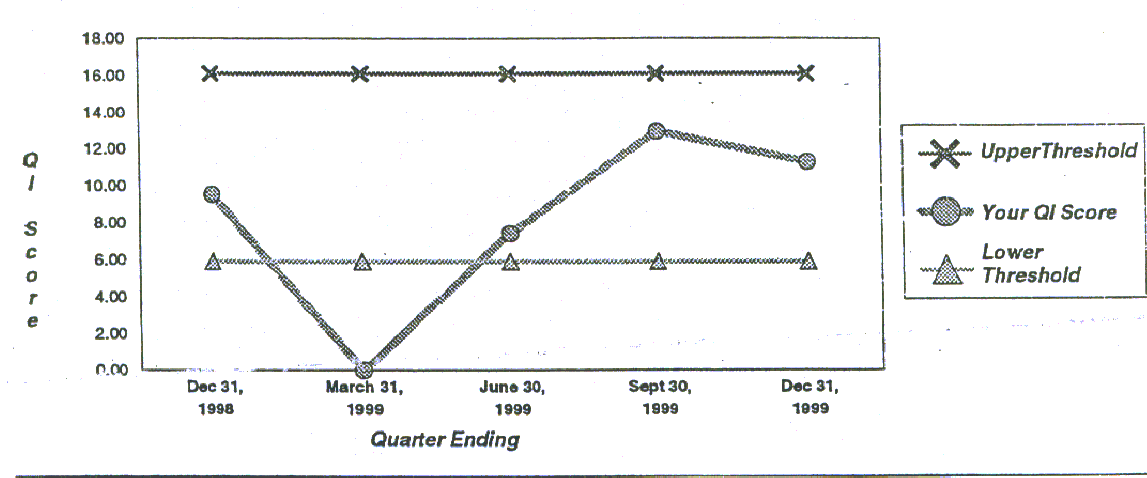
Summary Table for Quality Indicator #1
| Quarter Ending Date | Your Facility | Statewide Summary | ||||
|---|---|---|---|---|---|---|
| Your QI Score | # of Residents with this QI | # of Residents in this Calculation | # of Residents Not in this Calculation | Tenth Percentile Score | Your Percentile Rank in Missouri | |
| Dec 31, 1998 | 9.52 | 2 | 21 | 0 | 1.79% | 48.07% |
| March 31, 1999 | 0.00 | 0 | 50 | 0 | 1.61% | 0.00% |
| June 30, 1999 | 7.41 | 6 | 81 | 0 | 1.52% | 36.53% |
| Sept 30, 1999 | 12.94 | 11 | 85 | 1 | 1.67% | 59.76% |
| Dec 31, 1999 | 11.29 | 7 | 62 | 0 | 1.54% | 58.16% |
Appendix D. Best Practices
Florida
Steering Committee's Consensus Document of Core Competencies for Dementia Training of Licensed Practical Nurses (LPNs) in Long-Term Care
As one of the key professionals in LTC, the LPN performs important duties while serving as a mentor/role model for the CNAs and other staff providing direct care to persons with Alzheimer's disease and related disorders, which we designated in this document as dementia. Some less-common dementias may differ in their presentation and clinical course from Alzheimer's disease; we have emphasized as core competencies in dementia those pertaining to recognition and management of persons with advancing Alzheimer's disease.
Under the supervision of the registered nurse, the supervising, teaching, and mentoring roles of the LPN, in concert with their central role in providing direct care to persons with dementia, prompted our initial focus on specifying the competencies for this pivotal position in the care continuum. Acknowledging that core competencies will change as knowledge and skills in dementia care advance, the following listing represents the current consensus of the Steering Committee's workgroup and leadership. Our proposed phases of training for LPN competencies is organized to reflect training that might occur in 1- and 3-hour sessions in compliance with the dementia training mandate of SB1202.
Phase 1 (first hour of training)
Competency 1.1 -- Understanding the characteristics of dementia and the special needs of the person with dementia
Knowledge, skills, attitudes:
- Defines dementia as decreasing brain function including memory problems, loss of some thinking and communication skills, and changes in personality
- Contrasts dementia with cognitive changes of normal aging and delirium
- Describes the early, middle, and late phases of dementia
- Recognizes and incorporates into the dementia care plan that quality of life is a realistic goal
- Interprets individual responses, mood, and other feedback as meaningful
- Seeks to create a homelike and comfortable environment
- Seeks a wide range of resources, such as community volunteers in daily care, whenever possible
- Uses individual's preferences and social history in daily practice
Competency 1.2 -- Adapts communication to cognitive/emotional needs of the person with dementia
Knowledge, skills, attitudes:
- Explains changes in communication skills that occur during progression of dementia
- Describes the relationship between communication and distress behaviors
- Demonstrates strategies for effective verbal and nonverbal communication
- Uses touch to gain person's attention
- Uses simple sentences
- Presents one idea at a time
- Asks one question at a time
- Avoids negatively worded statements
- Breaks task down
- Gives simple choices
- Identifies nonverbal expressions of physical discomfort and pain
- Identifies verbal and nonverbal pain and discomfort, reports changes in cognitive function, anticipates individual's needs to prevent pain, fatigue, dehydration, and hunger and assists with plan to address same
- Demonstrates communication skills/strategies for managing disruptive, aggressive, and other problem behavior
- Listens and responds to emotional message
- Uses verbal redirection
- Uses written and visual cues
- Allow time to respond
- Avoids asking "why," arguing, correcting misinformation, confrontation
- Avoids raising voice
- Avoids sarcasm with person with dementia
- Demonstrates desired action
- Reacts appropriately to negative communication by individual with dementia
- Avoids responding to negative language by individual with dementia
- Uses redirection
- Reinforces own positive self-image using techniques such as positive self-talk
- Discusses cultural differences in individuals with dementia and how to appropriately adapt communication strategies
- Includes emotion-focused communication strategies in interactions with individuals
- Gives recognition
- Expresses positive regard
- Uses verbal encouragers
- Explores incomplete expressions of ideas
- Adopts an attitude of respect for individuality and dignity of the person with dementia
- Uses individual's name in communication
- Approaches individual in a calm, unhurried manner
- Avoids confrontation and arguments in communication
Phase 2 (hours 2-4 of training)
Competency 2.1 -- Demonstrates a working knowledge of dementia
Knowledge, skills, attitudes:
- Lists several diseases or conditions that may cause dementia
- Identifies polypharmacy, depression, and other conditions that may result in symptoms of dementia
- Describes how the disease progresses, as well as symptoms, behaviors, and challenges associated with each stage.
- Discusses current research findings, including the research on cause, prevention, cure, and the recommended diagnostic process
Competency 2.2 -- Recognizes, prevents, and manages distress behaviors including agitation, pacing, exit-seeking, combativeness, withdrawal, and repetitive vocalizations
Knowledge, skills, attitudes:
- Recognizes antecedents and consequences for distress behaviors
- Monitors, documents, and reports to team the time, place, and circumstances accompanying distress behaviors
- Looks for patterns that reveal potential causes (correlates vs. triggers) of distress
- Monitors, documents, and reports to team staff responses to residents' distress behaviors and residents' responses to consequences
- In collaboration with interdisciplinary team and family, plans prevention or modification strategies and addresses residents' needs
- Under the direction of a registered nurse, teaches and supervises nursing assistants regarding their responses to dementia-related behaviors
- Assists in the design and implementation of care plan
- Cooperates in modification of care plan
- Teaches and supervises nursing assistants in reporting behaviors
- Under the direction of a registered nurse, teaches and implements recommended staff stress-relieving strategies such as social support
- Promotes quality of life and mental health consistent with resident's individual history and preferences through:
- pet therapy
- music therapy
- structured activities
- family photos and/or tape recordings
- physical exercise
- Describes the risks associated with wandering, pacing, and exit seeking
- Identifies and addresses mental health issues appropriately
- Identifies and reports symptoms of psychological distress, acute confusion, or depression
- Describes the effects of pain, illness, limited mobility, and sensory loss on behavior
- Discusses the use, positive effects as well as side effects, and undesirable effects of medications used in memory loss
- Discusses the use, positive effects as well as side effects, and undesirable effects of medications used to manage symptoms of dementia
- Understands the use and misuse of restraints
Competency 2.3 -- Understands special needs of family and friends of persons with dementia
Knowledge, skills, attitudes:
- Discusses the psychological needs and stress of family members including:
- Stages of grief, anger, concern, and guilt
- Cultural differences in expressions of grief, anger, concern, guilt
- How to respond to family expression of above
- Identifies and reports family member needs, problems, and concerns to the team
- Plans with team strategies to address family issues and includes family input
- Supervises nursing assistants regarding their responses to families' concerns
- Includes family members in planning care and devising strategies
- Incorporates resident's philosophy and values in an individualized care plan
Competency 2.4 -- Promotes independence in activities of daily living
Knowledge, skills, attitudes:
- Incorporates an approach to remaining capabilities and capitalizes on individual's potential for rehabilitation:
- Breaks tasks down to manageable components
- Promotes independence in activities of daily living
- Looks for appropriate process as outcome in chosen activities rather than successful product
- Encourages direct care staff in a "doing with" rather than "doing for" approach to activities of daily living
- Allows for personal choices and preferences using past history and other family information
Competency 2.5 -- Promotes an optimal environment that will support resident autonomy and enhance capabilities
Knowledge, skills, attitudes:
- Maintains safety and security of residents in a supportive environment
- Monitors and modifies environmental stimuli, such as noise, lighting, reflective surfaces, distractions
- Provides information as to date, day, season, and weather
- Ensures residents' access to prostheses and appliances, such as eyeglasses, hearing aids, walkers, canes
- Encourages socialization through group activities, such as family, friend, and community visits, as well as intergenerational experiences
- Promotes the use of simple designs/colors to maintain resident orientation
- Monitors reflective surfaces such as mirrors in hallways or common rooms
- Initiates appropriate conversation to maintain participation
- Provides opportunity for productive activity
- Decreases background noise -- TV, radio
- Uses written cues as reminders, such as posting signs, labeling photos
- Promotes constancy and predictability through an established routine, familiar caregivers, and appropriate activities
Competency 2.6 -- Recognizes ethical issues that arise in dementia care and incorporates these into care approaches
Knowledge, skills, attitudes:
- Articulates an awareness of issues such as privacy, honesty, and autonomy in the daily care of persons with dementia
- Identifies common ethical conflicts that may arise when caring for residents with dementia
- Discusses ethical decision-making process using problem-based learning
- Recognizes varying family and cultural values and their effect on ethical decisions
- Identifies the resources available for resolving ethical dilemmas
Advanced Competencies (important, but not to be covered in the 1- and 3-hour initial dementia training sessions)
In order to prevent excess disability, incorporates an approach to remaining capabilities and capitalizes on potential for rehabilitation
- Understands the end-of-life issues facing residents, staff, families, and guardians related to dementing illness
- Explains the complex and terminal nature of providing care for persons with advanced, progressive dementia
- Incorporates palliative care principles into planning, supervision, and delivery of care
- Discusses the concept and implementation of an Advance Directive
Iowa
Principles of Best Practices1
STRATEGY
A best practices strategy should be developed, articulated, and incorporated into many of the services managed by organizations. Opportunities for collaboration should be used to help establish such program-level strategies.
IDENTIFYING PRACTICES
Focus on proven sources of best practices. Promote "leading edge" practices. Residents and their families are excellent resources. Also, use innovative methods to help identify new and emerging practices.
SOURCES
Examine practices in programs that have a reputation of excellence, especially those where resources have not been plentiful. Also, focus on Administrators or DONs recognized for special expertise to help identify best practices.
METHODS
Other suggestions for soliciting and identifying practices include having a competition among service functions, information exchange forums, mentors, speakers, soliciting electronic submissions, and old-fashioned bulletin boards.
EVALUATING PRACTICES
The concept is to establish criteria, up front, to benchmark and determine which practices are effective, or best, and have the greatest usefulness for residents and families.
CRITERIA
Use residents and families to help identify pertinent and consistent criteria, up front. Use criteria such as cost effectiveness, time savings, proven performance, satisfactions surveys and ease of implementation.
Please send all Best Practices questions/comments to Best.Practices@dia.state.ia.us
Best Practices Program Disclaimer
Participation in the Best Practices Program is strictly voluntary on the part of Iowa long-term care facilities. The identification of a best practice at an Iowa long-term care facility is not an endorsement or recommendation of the practice by the Iowa Department of Inspections and Appeals or the Health Facilities Division. Nor does the identification of a best practice create a new standard used during the survey process. The identification of a best practice is solely designed to make available to other long-term care facilities in Iowa information about new or innovative methods positively impacting resident care and quality of life.
Procedures of Best Practices2
-
Participation in Best Practices is voluntary.
-
The Best Practice designation is neither an endorsement nor the establishment of a standard.
-
The identification of a Best Practice does not preclude other deficiencies.
-
Participation in Best Practices does not alter the survey or complaint investigation process.
-
The Iowa Department of Inspections and Appeals (DIA) reserves the right to remove a facility from Best Practices list for reasons dealing with the quality of services for residents.
-
DIA will acknowledge in writing when a surveyor confirms a Best Practice.
-
The DIA Administrator and Bureau Chiefs will assess Best Practices for inclusion on the agency's web page.
-
Best Practices on the DIA web page will be changed or updated once every six months.
Please send all Best Practices questions/comments to Best.Practices@dia.state.ia.us
Best Practices Program Disclaimer
Participation in the Best Practices Program is strictly voluntary on the part of Iowa long-term care facilities. The identification of a best practice at an Iowa long-term care facility is not an endorsement or recommendation of the practice by the Iowa Department of Inspections and Appeals or the Health Facilities Division. Nor does the identification of a best practice create a new standard used during the survey process. The identification of a best practice is solely designed to make available to other long-term care facilities in Iowa information about new or innovative methods positively impacting resident care and quality of life.
-
Source: http://www.dia-hfd.state.ia.us/bestpractices/Principles.asp, 4/1/2003.
-
Source: http://www.dia-hfd.state.ia.us/bestpractices/procedures.asp, 4/1/2003.
Maryland
Clinical Alert #1 -- Warfarin3
The Office of Health Care Quality has, in recent months, noted an increase in clinical problems related to the use of anticoagulants, especially Warfarin. Undesirable outcomes resulting from inappropriate prescribing, dispensing, administration and monitoring of these drugs are encountered frequently by our surveyors. A common theme in these cases is the systemic failure on the part of certain facilities to anticipate and address well-known complications associated with the use of these potent medications. The following case presentation highlights areas of concern:
Resident #1 was a 78 year-old female with numerous diagnoses including hypertension, diabetes mellitus, osteoporosis and glaucoma. She was living at home independently until March 1, 2001 when she was admitted to the hospital with sudden onset of slurred speech and right-sided weakness. She was diagnosed with an embolic CVA and new onset atrial fibrillation. Treatment included the administration of IV Heparin, then Coumadin and active rehabilitation. She was transferred to a long-term care facility on March 6, 2001 for continued therapy.
When admitted to the LTC facility she remained in atrial fibrillation. Coumadin was continued at a dose of 5 milligrams each evening. One day after admission, an INR was obtained and noted to be 1.44. The physician increased the dose of Coumadin to 7.5 milligrams each evening and ordered a repeat INR obtained in 2 weeks. The nursing staff administered the increased dose of Coumadin but failed to obtain the follow-up INR. As there were no standing orders or facility policy regarding the frequency of laboratory testing of residents on Coumadin, no further INRs were obtained.
On April 12, 2001 (Day 35 in the nursing home), the attending physician examined the resident, noted limited progress in therapy but gave no new orders. On April 16, 2001 (Day 39) the consultant pharmacist reviewed this resident's care and recognized the lack of INR monitoring. However, the pharmacist simply left a written recommendation, in the medical record, for the physician to "consider monthly INRs while the resident is receiving Coumadin". As the facility had no system to promptly inform physicians of pharmacy recommendations, this information remained isolated in the medical record.
On April 22, 2001 (Day 45) the resident complained of dysuria, which prompted the nursing staff to contact the attending physician. By phone, the physician ordered Bactrim to be administered twice daily for ten days. As of April 24, 2001 (Day 47) the resident's dysuria had resolved but gross hematuria had developed. The attending physician was again called and ordered the Bactrim discontinued and Cipro started for a presumed resistant urinary tract infection. The nursing staff despite the development of hematuria, continued to administer 7.5 milligrams of Coumadin nightly to this resident.
On April 25 (Day 48), the resident complained of progressive weakness and "dizziness. The nursing staff told her that she needed to give the new antibiotic "time to work" and that she would eventually feel better. Later that day, in the absence of any trauma, bruising was observed on the resident's chest and left arm. The nursing staff failed to notify the physician of either the resident's complaints or the appearance of bruising. Coumadin was administered as ordered.
Over the next 24 hours the resident remained in bed and became progressively more lethargic. Routine vital signs obtained by a nursing assistant on the morning of April 27, 2001 (Day 50) revealed a blood pressure of 84/48 and a pulse of 114 beats per minutes. The nursing assistant documented these results on the vital signs flow sheet, which was not seen by the nurse until later that afternoon. When the nurse went to evaluate the resident she was found to be obtunded, tachycardia, and hypotensive and found with diffuse bruising over her entire body. She was sent to the emergency room where her prothrombin time, the first one obtained in over six weeks, was found to be greater than 100 seconds. She was profoundly anemic with a hematocrit of 15.8%. A CAT scan revealed a large subdural hematoma and despite aggressive interventions the resident expired on hospital day number 2.
The problems in the management of this case are many; some of the ones we noted include:
-
The staff didn't know which residents in the facility are on anticoagulants.
-
The physician apparently did not know the proper way to begin and maintain Coumadin treatment in an elderly patient.
-
There was no understanding by the physician and nursing staff on when to order INRs and the proper monitoring of Coumadin.
-
There was failure of communication between nursing staff and the physician.
-
Failure of nursing staff and physician to recognize side effects of Coumadin.
-
There was no policy or system to require facility staff to obtain timely INRs before Coumadin can be administered.
-
The pharmacist failed to intervene aggressively in assuring the proper administration of Coumadin.
You can probably easily add to this list.
Does someone in your facility know who is on anticoagulant medications?
Does your facility have a policy to monitor residents on anti-coagulant therapy?
When was your last in-service on anticoagulant therapy?
For more information, please read:
Warfarin Therapy: Evolving strategies in anticoagulation. American Family Physician, Feb 1, 1999. www.aafp.org/afp/990201ap/635.html
Questions and/or comments regarding this clinical alert should be directed to:
Joseph I. Berman MD
Medical Director, Office of Health Care Quality
Phone: (410) 402-8016
E-mail: Jberman@dhmh.state.md.us
William Vaughan R.N., B.S.N.
Chief Nurse, Office of Health Care Quality
Phone: (410) 402-8140
E-mail: Wvaughan@dhmh.state.md.us
Advance Healthcare Decisions4
"We have no simple problems or easy decisions after kindergarten."
-- John Turk
The right of a patient to accept or refuse medical intervention is a well-established principle in healthcare. In a setting that involves an alert, oriented and clearly competent individual, the process by which medical decisions are made is relatively straightforward. However, when disease or injury precludes the patient from actively participating in healthcare decisions, the situation becomes increasingly more complex. At these times, advance healthcare decisions are pivotal in preserving a patient's ability to direct his/her own care.
Advance healthcare decisions generally involve choices made by competent individuals concerning their own desired end of life care if they should become terminally ill, have an end-stage condition, or be in a persistent vegetative state. The individual determines, while fully able, whether he/she wishes such interventions as the insertion or continued use of a feeding tube, the initial or continued use of a ventilator, the initiation or continuation of renal dialysis and/or the administration of antibiotics. While occasionally difficult for families and even those healthcare workers caring for patients to accept, these "advance directives" should be followed in the same manner that one would in the case of a competent and communicative patient speaking directly to them.
The Office of Heath Care Quality frequently discovers situations in which healthcare providers do not honor the advance directives of patients in their care. The following deficiencies, which occurred in an area nursing home and hospital during 2001, are examples of such situations.
COMAR 10.07.02.07 A (2)
The administrator shall be responsible for the implementation and enforcement of all provisions of the Resident's Bill of Rights under COMAR 10.07.09
COMAR 10.07.09.08 C (11)
A resident has the right to consent to or refuse treatment, including the right to accept or reject artificially administered sustenance in accordance with State law.
COMAR 10.07.09.08 C (3)
'A resident has the right to a dignified existence, self-determination, and communication with and access to individuals and services inside and outside the nursing facility.
Jane Doe was an 83 year old female when she was admitted to [a local nursing home] on February 26, 1998. Almost a year prior to her admission, while still living in the community, this resident wrote certain instructions related to her healthcare. These instructions were contained in a document entitled "Advance Health Care Directive for [resident's name]". The resident signed this document on March 19, 1997, and two individuals witnessed this signing.
The creation of an advance directive is an important and proactive step in preserving one's autonomy as it relates to health care. An advance directive "speaks" for a resident at a time when she is unable, due to her medical condition, to communicate her wishes. End of life issues, such as withholding or removing life-sustaining interventions, are often the focus of advance directives. The Maryland statute governing advance directives, the Health Care Decisions Act, is found in the Code's Health General Article, §5-601 et seq.
Mrs. Doe's advance directive instructed her healthcare providers to withhold or withdraw life-sustaining procedures if she met any one of the following criteria:
- "If I am suffering from a terminal condition and if my death is imminent ...".
- "If I am in a persistent vegetative state ...".
- "If I have an end-stage condition ...".
Mrs. Doe, in her advance directive, specifically addressed the issue of artificial nutrition as follows:
"I direct that no nutrition or sustenance be administered to me artificially, such as the insertion of a feeding tube; and, I direct that upon finding that I am as described [as either terminal, in a persistent vegetative state or in an end-stage condition] that any such artificial administration be terminated immediately ...".
Mrs. Doe had been at [a local nursing home] for 18 months when on August 23 and September 20, 1999, two physicians certified that her medical condition was end-stage due to dementia. On July 17, 2000, two physicians again certified that her condition was end-stage secondary to dementia. At that time, the physicians also noted that tube feeding this resident, i.e. providing nutrition via a tube placed into the stomach, would be "medically ineffective".
Mrs. Doe experienced a gradual decline in her overall condition and during the first several months of 2001, it became apparent that her oral intake of food and fluids was becoming inadequate. Her capacity to make medical decisions and her ability to communicate had become severely impaired, and she was no longer able to participate in decisions related to her healthcare due to her dementia. On April 5, 2001, she was admitted to (a local hospital) for the third time in the preceding six months due to dehydration. Despite Mrs. Doe's clear advance directives to the contrary, a feeding tube was surgically placed into her stomach during this hospitalization at the insistence of her son. Fluids and tube feeding formula were then administered to her at the hospital.
She returned to [a local nursing home] on April 13, 2001. The clinical staff at the nursing center, including the attending physician, medical director, numerous members of the nursing staff, the administrator, the social worker and a corporate nurse who was a member of the facility's patient care advisory committee, all agreed that administering tube feeding to this resident would be against her wishes. Therefore, Mrs. Doe received only water and medications through the feeding tube. The facility's decision not to administer nutritional tube feeding per the resident's advance directive was communicated to the resident's family.
On April 14, 2001, the attending physician visited the resident and wrote the following progress note: "... G tube [feeding tube] is placed against living will ..."
The attending physician next visited Mrs. Doe on April 16, 2001, and wrote: "Pt [patient] had PEG [feeding tube] placed for nutritional purposes against the wishes of the patient. I personal [sic] do not recommend G tube [feeding tube] placement, I want to respect patient's wishes à continue G-tube [feeding tube] flushes [water only] no nutrition ..."
Three days later, on April 19, 2001, the attending physician again came to the nursing facility and wrote: "Tried for family discussion with her son and daughter-in-law. Looks like they have contacted the attorney and made the decision if patient is not fed they will sue us ..."
From the time Mrs. Doe was readmitted to the nursing facility on April 13, 2001, until the physician wrote her last note on April 19, 2001, all the resident had received was water and medications through her feeding tube. As she had on two previous occasions been declared in an endstage condition (due to dementia) and her own physician had deemed that providing nutrition via a feeding tube would be "medically ineffective", the decision to withhold nutrition was completely in accordance with her advance directive.
However, after the resident's family made threats of legal action, the physician, on April 20, 2001, ordered the nursing staff to begin administering nutrition via Mrs. Doe's feeding tube. The nursing staff of the facility complied with this order and from April 20, 2001, through May 2, 2001, the resident was administered tube feeding formula daily. On May 2, 2001, the resident became acutely ill, was hospitalized, and did not return to the facility.
In summary, it is clear that the staff at the nursing facility was not responsible for the placement of the feeding tube. That act, in direct contrast to the expressed wishes of the resident, was performed at the hospital. The staff at the nursing facility was, however, required to honor the instructions set forth by Mrs. Doe in her advance directive. Those instructions carried the same weight as if Mrs. Doe had spoken them herself during April and May of 2001. Despite clear misgivings on the part of the nursing and clinical staff, who were personally familiar with Mrs. Doe's wishes, the facility failed to allow this resident to exercise her right to refuse treatment, specifically the right to reject the artificial administration of sustenance. Instead of honoring the very clear and concise directives of Mrs. Doe, the facility inappropriately followed the wishes of the family, which were in absolute contradiction to the expressed wishes of the resident.
Note: The nursing home appealed the above deficiency and sanction ($10,000.00 fine) to the Maryland Office of Administrative Hearings. A redacted version of the judge's decision in this case is available online at http://www.dhmh.state.md.us/ohcq/download/alj/pdf .
The staff of OHCQ also conducted an investigation into the care Mrs. Doe received at the hospital where the feeding tube was inserted. The hospital was seemingly unaware that a feeding tube had been placed in this patient against her will. The Office of Health Care Quality wrote and forwarded the following deficiency to the hospital.
A76 482.13(b)(3) Exercise of Rights
The patient has the right to formulate advance directives and to have hospital staff and practitioners who provide care in the hospital comply with these directives, in accordance with 489.100 of this part (Definition), 489.102 of this part (Requirements for providers), and 489.104 of this part (Effective dates).
Based on a review of Jane Doe's medical record, the patient's advance directives and the hospital's policies and procedures, it was determined that the hospital failed to comply with the patient's advance directives that clearly indicated her desire to not be fed by artificial means.
Jane Doe was an 83 year old female who had lived at a nursing home for about 4 years. She was diagnosed with advanced dementia, with severe brain atrophy. While still capable of making her own decisions, Jane Doe had executed an advance health care directive in March of 1997. Her son was appointed her health care agent and she also spelled out detailed health care instructions.
Per the patient's instructions in her advance directives, which were to be acted upon when she was "incapable of making an informed decision," two physicians certified (July 17, 2000) that the patient had become "end-stage." The certifications specified that CPR (cardiopulmonary resuscitation) and G-tube feeding would not change patient's deteriorating health or prevent impending death. The patient's advance health care directive instructed "that no nutrition or sustenance be administered to me artificially, such as by the insertion of a feeding tube..." and upon finding that she has an end-stage condition "... that any such artificial administration be terminated immediately." Finally, she had directed, "... that such life-sustaining procedures be withheld or withdrawn, and that I be permitted to die naturally." The patient's son was appointed as health care agent but only to the extent the patient's wishes were unknown or unclear.
On April 4, 2001, Jane Doe was found to be unresponsive at the nursing home and intravenous fluids were started. She was sent from the nursing home to this hospital for dehydration with related abnormal laboratory findings. At the time of admission to the hospital, the patient's medical record indicated that she underwent testing and observation to rule out a heart attack. "Aggressive intravenous hydration" was started to address her dehydration. The patient did not recover sufficiently to take food or liquids by mouth. The attending physician had stated in his admitting history and physical for Jane Doe, dated April 5, 2001, that "The patient is do not resuscitate with no ventilator or tube feedings. Orders are already in place."
On April 7, 2001, the patient's attending physician wrote a progress note in the patient's chart saying, "Discussed with patient's son (who had medical power of attorney) and daughter-in-law about options. They have agreed to placement of a feeding tube. Reiterated patient is DNR/DNI (do not resuscitate/ do not intubate). Will insert NG-tube and start feeds today. Cardiac arrhythmias noted, am hesitant to treat in view of hypotension (low blood pressure); will monitor. Dr. _ _ called for GI (gastroenterology) consult."
On April 9, 2001, the GI surgeon wrote his/her signature on the patient's informed consent, for placement of the G-tube. The son's name is printed, not signed, in the space for (Patient, Nearest Relative, Legal Guardian) signature. The surgeon's signature attests that the physician has explained to the son the surgical procedure, the alternatives, and possible complications and risks.
On April 10, 2001, surgery to insert a feeding tube (G-tube) into Jane Doe's stomach was performed. Fluids and food were administered first through the NG-tube then through the G-tube for approximately a week, until her discharge on April 13, 2001, despite the patient's written directive that she should not be fed by artificial means.
The attending physician stated in Jane Doe's hospital "Transfer Summary -- AMENDED REPORT" dated April 13, 2001, that "However, after discussion with the patient's daughter-in-law, she agreed to a placement at discharge of a feeding tube."
The patient was discharged from this hospital to her previous nursing home placement, then to another acute care hospital and finally to a new nursing home placement. About one month after discharge from this hospital, the patient died with possible aspiration pneumonia, infections in her urinary tract, several decubitus ulcers and hypotension.
The patient's attending physician and her daughter-in-law are the documented decision makers for the patient. The attending and the patient's daughter-in-law chose to institute treatments that would be medically ineffective as previously determined by the two physician certifications, i.e. treatment that would not alter the patient's deteriorating health status nor prevent her impending death.
A review of hospital policies revealed that Hospital Policy Number RI10 was enacted in order to "foster respect for the inherent dignity of each person." This policy defines medically ineffective treatment and end-stage condition and allows a health care provider to withhold or withdraw life-sustaining procedures provided that the patient's attending and a second physician have certified the patient as having a terminal condition. The certifications (noted above) predated this hospital admission by nearly one year and certified that the patient's condition was "severe and permanent deterioration indicated by incompetence and complete physical dependency ... [and] treatment of the irreversible condition would be medically ineffective." Despite this fact, the G-tube was inserted.
A review of Hospital Policy Number RI8 revealed that this hospital policy states to "Avoid conflicts of interest and/or the appearance of conflict." This policy stated that the hospital "assure that the care provided each patient is appropriate" and "ensure the integrity of clinical decision-making..." This policy states that it is in place to "promote employee and medical staff sensitivity to the full range of such needs and practices [physical, psychological, social and spiritual needs and cultural beliefs and practices]." There was no documentation to indicate that the physician, surgeon, anesthe-siologist or other healthcare providers or administrative staff voiced the conflict between the patient's advance directive and the insertion of a feeding tube by invoking the hospital's "specific mechanisms or procedures to resolve conflicting values and ethical dilemmas among patients, their families, medical staff, employees, the institution and the community" as identified in Policy RI8.
A review of the hospital's Ethics Committee meeting minutes revealed that the hospital has a functioning system for the review of cases where there are conflicts regarding a patient's treatment, family wishes or advance directives. However, there was no documented evidence that the conflict between this family, the provider and the patient's advance directives had been referred to the hospital's Ethics Committee or for an ethics consult. Hospital staff interviewed on October 10, 2001, indicated that neither the physician nor the family referred this patient's case for an Ethics Consult.
In response, the hospital revised its policies and implemented staff training to ensure that advance directives are followed.
Discussion:
Researchers Morrison and Sin compared the treatment of patients with acute illness and end-stage dementia to another group with acute illness and without end-stage dementia. They found that patients with end-stage dementia received as many burdensome procedures as cognitively intact patients and that only 7% had a documented decision made to forego a life-sustaining treatment other than cardiopulmonary resuscitation. In the case of patient #1, even though she had clearly indicated her desires through advance directives to forego life-sustaining treatment, she was unable to avoid the imposition of unwanted and medically ineffective therapy.
- Does your facility have a case like Mrs. Doe's waiting to happen?
- Has it happened already? If so, what changes were made as a result?
- Does your staff understand that an advance directive is in fact the patient "speaking" to them in the only way left available?
- Will your staff honor the wishes of the demented patient who lies dying in her bed ... or will unwanted care be inflicted upon her?
- Do you coordinate care when a patient is transferred between a hospital and nursing home?
- Does your facility just talk about the right of residents to direct their care, or is it part of the philosophy of your institution?
The Office of Health Care Quality considers the rights of patients to be paramount in any healthcare institution and will continue to monitor the response of facilities to this issue.
For additional information, please read:
Summary of Maryland Healthcare Decisions Act: http://www.oag.state.md.us/Healthpol/HCDA.pdf
Morrison, R and Sin, A. "Survival in End-Stage Dementia Following Acute Illness." JAMA. 2000; 47-52.
Administrative Law Judge's decision on the facility's appeal of this deficiency and civil money penalty:http://www.dhmh.state.md.us/ohcq/download/alj.pdf
Questions or comments regarding this Clinical Alert should be directed to:
Joseph I. Berman MD
Medical Director, Office of Health Care Quality
Phone: (410) 402-8016
E-mail: Jberman@dhmh.state.md.us
William Vaughan R.N., B.S.N.
Chief Nurse, Office of Health Care Quality
Phone: (410) 402-8140
E-mail: Wvaughan@dhmh.state.md.us
Wendy A. Kronmiller
Assistant Attorney General
Phone: (410) 767-5469
E-mail: wkronmiller@dhmh.state.md.us
-
Source: Clinical Alert, Volume 1, Number 1, 2001. (Published periodically by the Office of Health Care Quality, Maryland Department of Health and Mental Hygiene.)
-
Source: Clinical Alert, Volume 1, Number 1, Summer 2002. (Published periodically by the Office of Health Care Quality, Maryland Department of Health and Mental Hygiene.)
Texas
Problem-Oriented Best Practices5
February 2003 Spotlight on new resources
Long Term Care is a multi-disciplinary endeavor with the care of the resident as its central focus. Because all disciplines must work coherently toward a common goal, each of the following topics addresses multiple aspects of LTC practice including resident evaluation, nursing care, facility administration and medical care. The Overview section in each topic includes findings from DHS Medical Quality Assurance (MQA) studies as well as a statement of performance expectations - a DHS MQA vision of high quality care.
The accompanying bibliographies and resources are representative rather than exhaustive collections of current clinical thinking and research. Similarly, the regulatory tags that may be cited for deficient practices are representative rather than exhaustive. The accompanying Geriatric Symposium presentations represent the expert perspectives of the presenters rather than those of DHS.
Where well-designed clinical trials permit defining evidence-based best practices, these have been used in the problem-oriented best practicesummaries. Where such evidence is lacking, expert consensus statements, clinical practice guidelines, case studies and regulatory requirements all offer some insight into what may constitute best practice. Every best practice framework in QMWeb is submitted to one or more clinical peer reviewers for comment. Where there are unresolved differences between MQA and a reviewer, these are noted in the Reviewers section of the page itself. Where opposing viewpoints each have some support in evidence and literature, the goal of QMWeb is to provide a balanced presentation.
It is important to note that even when there is a sound basis for evidence-based best practice, the specific details of implementation (the more common and less strict meaning of best practice) may vary from one venue to the next simply because resident needs, staff expertise and other resources vary from one venue to the next. Therefore, the following pages serve best as frameworks or toolkits from which to design facility-specific care systems rather than as simple cookbook recipes for deficiency-free (let alone, optimal) care.
This section of QMWeb is a work in progress. Only the topics in bold represent completed frameworks. The remaining pages are either preliminary frameworks that have not yet undergone peer review or simply resource pages whose corresponding best practice frameworks remain to be completed. Expect the number of completed best practice frameworks to grow steadily over the next two years in response to provider needs identified through the Quality Monitoring Program, the Statewide Quality Review Process, and the DHS Geriatrics Symposium Series.
Ethical Issues
- End-of-Life Care
- Ethics Committees
- Medical Futility
- Gender, Ethnic and Age Group Health Outcomes Disparities
- Advance Care Planning & Palliative Care
- Restraint Reduction
- Tube Feeding
Geriatric Syndromes
- Congestive Heart Failure
- Falls
- Incontinence
- Toileting for Incontinence
- Indwelling Bladder Catheters
- Constipation, Fecal Impaction and Dual Incontinence
- Neurological Syndromes
- Delirium
- Dementia
- Behavioral and Environmental Interventions
- Stroke
- Pain
- Pressure Ulcers
- Prediction & Prevention
- Treatment
Organizational & Administrative Practices
- Medical Direction & Medical Staff Bylaws
- Implementing Quality Improvement
- Staffing
Prescribing Practices
- Antibiotic Selection, Use and Resistance
- Medication Regimen Simplification - Medication Review
- Missed Therapeutic Opportunities
- Psychotropic Drug Use
Prevention Practices
- Burns
- Environment Injuries
- Accidents
- Immunization Recommendations
- Infection Control
Last updated: May 6, 2003
Restraint Reduction6
Overview
The DHS Medical Quality Assurance vision for restraint reduction in Texas LTC is
Resident-centered evaluation and care planning for restraint-free environments.
Definitions and Scope
In this framework, the term restraints focuses exclusively on devices applied to a resident's wrists, trunk or waist that limit the resident's normal access to the environment or self and that the resident cannot remove at will without assistance. While the use of other devices that achieve these same ends is also discouraged, the findings described below apply only to these three general classes of devices.
According to MDS Quality Indicator statistics, Texas has ranked among the four states with the highest prevalence of restraint use during 2000-2002.[1] An independent assessment of 1972 Texas nursing facility residents conducted for DHS by the Texas Nurses Foundation during FY2002 showed that 19.5% (n=385) of the residents had spent some time in restraints during the preceding 7 days.[2] The majority of these residents, 368/385 (95.6%), had spent time in restraints each and every day during the last 7 days. Among restrained residents, fewer than 10% (n=34) had a clinical problem that an expert panel deemed unlikely to be properly addressed without the use of restraints.
Based on structured assessment, the prevalence of necessary restraints was 2.3% rather than the observed 19.5%. This is consistent with the results of restraint reduction trials that show restraint prevalence can be decreased to 5% or less.[9, 16, 17]
In the Texas cohort, no resident appeared to be in restraints for punishment or for facility convenience. Rather, the majority was in restraints because caregivers believed that they were appropriately addressing a resident safety issue. The following proportions describe the 351 residents who were restrained without a compelling clinical indication:
- 95.7% - falling or fall risk assessment was a reason considered in the decision to use restraints.
- 76.4% - falling or fall risk assessment was the only reason that led to the use of restraints.
- 17.9% - wandering was a reason considered in the decision to use restraints, and in the majority falling was also a consideration.
- 19.1% - the family had initiated the request for restraint use.
- ~1% - the presence of a non-critical medical device such as a peripheral IV or the presence of symptoms of inappropriate sexual behavior were factors in the decision to use restraints.
Thus, the dominant reasons for using restraints in Texas nursing homes appear to be concern for two common geriatric syndromes - falling and wandering.[2] In the Texas cohort, more severe resident ADL and cognitive impairment are associated with the application of restraints. These findings are consistent with findings of multiple research studies [3, 4, 5, 6] It also appears that families, concerned for resident safety and not knowing what best to do, ask for the use of restraints in a significant number of instances where they are inappropriate.
Considerations for Avoiding and Reducing Restraint Use
Beyond the ethical issues of resident's rights (the principles of individual dignity and self-determination) and quality of life issues, there are compelling clinical reasons to use the least restrictive intervention to deal with the problems that are commonly given as reasons for using restraints. The first clinical reason is to preserve resident function - to prevent loss of independence and ADL capacity and thus avert greater care-giving burden.
The restraint reduction literature identifies the adverse effects of restraint use including the following:[19, 24]
- Loss of physical independence
- Loss of cardiovascular tone
- Decreased respiratory efficiency
- Loss of muscle tone and strength
- Increased risk of falls and injuries
- Depression and aggressive behaviors
- New-onset cognitive impairment
- Urinary incontinence
- Pressure sores
The second clinical reason is to ensure resident safety. Although commonly viewed as an intervention to promote resident safety, restraints actually compromise safety. The complications of restraints can be serious and include injuries and death.[7, 8]
Common reasons for restraints include assisting resident posture, keeping residents from dislodging feeding tubes or other medical devices, limiting resident access to wounds, preventing scratching injuries, and preventing inappropriate disrobing among others. All of these hypothetical scenarios can be managed with less restrictive interventions. Cushions, bolsters and other physical therapy devices can be used to support posture. Various binders and dressings can be used to limit resident access to tubes, devices and wounds. Proper nail care can minimize or eliminate scratching injuries. And, special clothing adaptations can make disrobing very difficult without resorting to restraints. However, every one of these interventions requires individualized care planning, and no one intervention will meet the needs of every resident that has a particular problem. That is, restraint reduction often requires an individualized, resident-centered approach rather than a generic, problem-centered approach.[9, 10]
Myths and Misconceptions
MYTH: Restraints Protect Residents from Falls and Injuries. Some restraint reduction studies show an increase in falls but to levels no greater than seen in control groups; other studies show that with appropriate care planning this increase is minimal to negligible.[11, 12, 13, 14] All of the studies show no increase in serious injuries as a result of restraint reduction; and, other studies show an increase in serious injuries when restraints are used.[7, 8]
MYTH: Restraints Decrease Staff Time. Restraint reduction research shows that there is no increase in the staff time needed to meet the needs of residents in whom restraint use is discontinued.[13, 15]
MYTH: Restraint Use Decreases Cost of Care. Restraint reduction research shows that there is little or no increase in costs required to meet the needs of residents in whom restraint use is discontinued. The increased cost attributable to special devices needed to accomplish restraint removal has been measured at 3 cents per day per resident released from restraints, and this is comparable to the cost of restraint devices themselves.[14, 17]
MYTH: Restraint Reduction Requires Increased Psychoactive Medication Use. Research shows that this belief is common and erroneous.[13,16]
MYTH: Restraint Use Decreases Facility Liability. There is no evidence that facility liability cases have ever been lost solely on the basis that the facility had failed to apply restraints.[17, 18] There is no literature that shows that the application of restraints constitutes best practice for managing fall risk or wandering. In fact, the lost liability cases due to injuries related to restraint use serve as a reservoir of evidence against the argument that restraints constitute best practice.
The Texas Department of Insurance recognizes restraint use as a key facility liability risk-management issue because of liability claims arising from the use of restraints.
Resident Evaluation
The minimum evaluation prior to using restraints consists of the following:
Clear Identification and Understanding of the Clinical Problems, Goals and Risks
Why are restraints being considered? What are the clinical problems that restraints are supposed to address? Is there an evidence basis that supports restraints as best practice in addressing these problems? What clinical outcome or end-point is desired? Are the potential untoward outcomes associated with restraint use acceptable to the resident and family? Some successful restraint reduction programs use a formal physician's order form that includes these and other elements such as informed consent.[16]
Trial and Evaluation of Less Restrictive Alternatives
With the possible exception of the circumstances described in the DHS structured assessment for restraint use, every other clinical problem can and probably should be addressed with less restrictive interventions.
To proceed directly from problem identification to the use of restraints without a trial of individualized and less restrictive alternatives does not constitute best clinical practice. Yet, in 28.5% of the cases of inappropriate restraint use in the Texas cohort, there was no evidence that less restrictive alternatives had been tried.[2] Since this figure was based on record reviews requiring minimal documentation that alternatives were tried, the 28.5% rate is a conservative.
Structured Resident Assessment and Care Planning
DHS recognizes that there are occasional clinical situations in which the use of restraints may simply be unavoidable because there is no alternative that has an acceptable risk-to-benefit ratio for the resident or others. These rare circumstances include the following:
- The presence of a medical device that if disrupted would create an immediate jeopardy to the resident's health - specifically in a resident who is at high risk for unintentionally disrupting that device (examples: endotracheal tube, central venous line, or an interruptible arterio-venous shunt in a delirious resident).
- Unprovoked or uncontrollable physically violent/injurious behavior toward self or others. Note: resisting care is not considered an instance of this type of behavior; patient-to-patient assault or intentional self-injury is. Restraint use in this context must be a temporary measure rather than a permanent strategy.
- Hip fracture with either no repair or an ORIF procedure in the preceding six weeks - specifically in a resident that cannot otherwise be kept from arising without assistance.
- Traumatic self-removal of an indwelling catheter in a resident who has performed it and who continues to demonstrate a tendency to repeat it.
While there may be other circumstances that are compelling reasons for restraint use in nursing facilities; they are expected to be variations of these four indications, and they appear to be rare.
The DHS Quality Monitoring Program uses this structured resident assessment to evaluate the appropriateness of resident assessment, care planning and care for residents who are restrained.
Practical Guide to Quality Improvement
Key Components of Successful Restraint Reductions Programs
Successful restraint reduction initiatives require changes in facility policy, staff and family attitudes, beliefs and care practices.[25] The following structural and process elements contribute to success:[9, 10, 13, 14, 19, 20, 21, 22, 23]
- Unequivocal support from facility owners and administrators
- Restraint reduction education for all levels of direct care staff on every shift
- Restraint reduction education for medical staff and family members
- Use of a multidisciplinary restraint reduction team (a Restraint Review Committee that includes a physician, nurse, CNA staff, Administrator, housekeeping, others)
- Use of a consultative, resident-centered, problem-solving approach
- Allocation of staff time specifically for restraint reduction
- Implementation of restraint reduction one unit or floor at a time
- Restraint reduction in the easiest residents first
- Use of restraint-free intervals to gradually reduce restraints in the most difficult residents
- Use of multiple interventions to solve individual clinical problems (average of three interventions per resident)
- Long-term commitment to achieving a restraint-free environment (6-12 months to succeed)
- On-going, scheduled reevaluation of all residents who remain restrained
Part I. Prepare to Succeed (education)
- Identify any staff and family concerns or misconceptions about restraint use and restraint reduction.
- Develop and distribute a restraint reduction education handout for family and staff to address concerns and false beliefs.
- Use DHS Joint Trainings, handouts and QMWeb presentations and resources to provide in-service and family education on restraint reduction.
- Develop a plan for methodical restraint reduction, and present it to staff, family and resident council.
- Work with DHS Quality Monitors to test, evaluate and refine your restraint reduction program.
- Create a Restraint Review Committee to evaluate all residents in restraints and all new orders for restraints.
Part II. Implement Restraint Reduction - Eliminate Inappropriate Restraints (routine process)
Appropriate care planning for restraint reduction is only the beginning of the elimination of inappropriate restraints.
- Begin with the MDS Resident-Level QI Report to identify residents who are in restraints.
- Visually identify additional residents that not identified as being restrained by the MDS report.
- Evaluate every one of these residents for appropriateness of restraints using the accompanying structured assessment instrument or a comparable instrument to evaluate each resident. Leave the completed assessment on the chart for future reference.
- Use the results of structured assessment to identify residents who are not candidates for restraint reduction. Note the reason(s) in the resident's care plan. Ensure that in every instance there is a specific physician order for restraints and that the care plan addresses how the use of restraints will be monitored as well as when and how restraint reduction will be attempted.
- In every instance where restraint use is medically justifiable, schedule each such resident for periodic restraint use reevaluation. Evaluate the need for restraints justified as a temporary intervention for behavioral symptoms within a short time such as 24-48 hours that allows time for evaluation of causes and alternative interventions without permitting temporary restraint use to become on-going restraint use.
- For every remaining resident, identify the clinical problems for which restraints are currently being used.
- Engage PT/OT in the evaluation of the resident for restraint alternatives.
- Develop a resident-specific care plan that addresses each problem with the least restrictive intervention(s) possible.
- Involve the resident's family in the design of the plan.
- Provide family education on the risks of restraint use, the expected negative effects of continued restraint use and anticipated benefits of restraint elimination.
- Repeat this process monthly as part of your facility's Quality Improvement Plan.
- Review each chart to identify instances in which care plans and actual care giving are not congruent.
Part III. Implement Restraint Prevention - Eliminate the Initiation of Inappropriate Restraints (event-driven process)
- Require the use of structured assessment for restraint use before restraints can be ordered.
- Create a Restraint Review Committee that includes the facility Medical Director, an RN, physical therapist, other direct care staff and housekeeping.
- Engage PT/OT in the evaluation of the resident for restraint alternatives.
- Require that your Restraint Review Committee approve all orders for restraints within 24 hours of the order.
- Use the Restraint Review Committee to develop care plan alternatives when structured assessment shows that there is no valid indication for the use of restraints.
Related Technologies
There are a variety of technologies related to restraint reduction. These technologies afford solutions to the clinical problems that lead to restraint use - falls, wandering, self-removal of medical devices, among others. These include various types of alarms, beds, devices to assist ambulation, positioning devices, wheelchair modifications, special clothing, dressings and environmental modifications. The presentations and resources sections in this framework provide examples of such technologies.
Related Licensure and Certification Tags
The following deficiencies may be cited for the inappropriate use of restraints. Tags that might be cited as evidence that restraints were used inappropriately are also listed. The deficiency list is representative rather than exhaustive.
| Program | Licensure Tags (State) | Certification Tags (Federal) |
|---|---|---|
| Nursing Facilities | 19.402(c) 19.403(g)(1) 19.403(k) 19.601(a) 19.701(1) 19.701(2) 19.801(2)(A)(B) 19.801(2)(C) 19.802(a)(1)(2) 19.802(b) 19.901(1)(A)(B)(C) 19.901(3)(A)(B) 19.901(5(A) 19.901(6)(A) 19.901(10) 19.901(8)(A) 19.901(8)(B) |
F152 Resident competency F155 Right to refuse treatment F157 Notification of changes F221 Physical restraints F241 Dignity F242 Self Determination/participation F272 Assessment F274 Assessment F279 Care plan F280 Participate in/revise care plan F310 ADLs F314 Pressure sores F317 Range of Motion F319 Mental and Psychosocial adjustment F327 Hydration F323 Accidents F324 Supervision |
| ICFs/MR | M0015 90.42 (c) M0015 90.42 (c) M0015 90.42 (c) M0015 90.42 (c) M0015 90.42 (c) M0015 90.42 (c) M0015 90.42 (c) M0015 90.42 (c) M0015 90.42 (c) M0015 90.42 (c) M0015 90.42 (c) M0015 90.42 (c) M0015 90.42 (c) M0015 90.42 (c) M0015 90.42 (c) M0015 90.42 (c) M0015 90.42 (c) M0015 90.42 (c) M0015 90.42 (c) M0015 90.42 (c) M0015 90.42 (c) M0015 90.42 (c) M0015 90.42 (c) M0015 90.42 (c) M0015 90.42 (c) M0022 90.42 (e)(3) M0022 90.42 (e)(3) M0015 90.42 (c) M0023 90.(e)(4) (A) M0023 90.(e)(4) (B) M0015 90.42 (c) M0015 90.42 (c) M0015 90.42 (c) M0015 90.42 (c) M0015 90.42 (c) M0015 90.42 (c) M0015 90.42 (c) M0015 90.42 (c) M0015 90.42 (c) M0015 90.42 (c) M0015 90.42 (c) M0022 90.42 (e) (3) M0022 90.42 (e) (3) M0015 90.42 (c) M0015 90.42 (c) M0015 90.42 (c) |
W124 Right to refuse treatment W128 Unnecessary drugs and physical restraints W191 Behavioral management training W193 Behavioral management skills W194 Skills to implement program plans W186 Adequate staffing W214 Identify behavioral management needs W238 Identify inappropriate behavior W239 Replacement of inappropriate behavior W263 Informed consent to program W263 Informed consent to program W264 Monitor drug and physical restraints in behavior programs W276 Behavioral interventions W277 Hierarchy of intervention W278 Documentation of less intrusive methods W279 Use of time out rooms W280 Use of physical restraints W283 Staff who may authorize interventions W284 Monitor and control interventions W285 Safeguards for interventions W286 Protection from punishment W287 Interventions not for staff convenience W288 Interventions are not a substitute for programming W289 Interventions must be part of the program plan W290 No PRN behavior programs W292 Duration of time out W293 Protections in time out W294 Recording time out W295 Use of restraints in behavior plan W296 Emergency use of restraints W297 Restraints for health protection W298 Duration of emergency restraint use W299 Authorization for restraints W300 No PRN restraint use W301 Periodic checks on restraints W302 Release from restraints W303 Restraint records W304 Protection from restraint injuries W305 Comfort of restrained person W306 Opportunity for motion and exercise W307 Activity record W308 Dimensions of cribs W309 Characteristics of cribs W322 Preventive and general care W329 Physician participation in care planning W330 Physician review and revision of care plan |
| Assisted Living | 92.125(a)(3)(A) Right to be free from physical restraints 92.125(a)(3)(E) Dignity 92.125(a)(3)(O) Participation in service plan development 92.125(a)(3)(P) Right to refuse treatment or services |
Related DHS Presentations
All presentations on the Quality Matters web can only be viewed with Microsoft Internet Explorer 5.0 or later. No other browser is currently supported. However, you can follow this link to obtain the same presentations on CDROM for offline use with other browsers. Note that optimal viewing requires broadband internet access such as DSL line or cable modem. Although slow modem connections (down to 28.8 KB) are also supported, download times are much longer and the audio quality is phone-like rather than CD-quality.
| Presentation | View |
|---|---|
| Restraint Literature Review; DHS Joint Training 2002; Leslie L. Cortés, MD |  |
| Restraint Reduction; DHS Texas Geriatrics Symposium 2001; Debbie Wiegand, LNFA; Lynne Smith, LMSW; Drew Hofstad, PT | |
Additional Resources (including online resources)
Online
A Values-Based Approach to Restraint Reduction (Journal for Healthcare Quality, 2001)
Colorado Foundation for Medical Care (Resident Assessment Guide and Tools)
HCFA Restraint Reduction Newsletters
Untie the Elderly (Restraint Reduction Training Program)
A Restraint Reduction Letter to Families (This sample was graciously provided by Mr. Kinny Pack of Azle Manor. This is not a mandated form; it is simply a resource.)
In Print
Toward a Restraint-Free Environment Book. Edited by Judith V. Braun, Ph.D., Associate Administrator of the Hebrew Home of Greater Washington, Rockville, Maryland, and Steven Lipson, M.D., M.P.H., Medical Director of the Hebrew Home of Greater Washington and Associate Professor at the Georgetown University School of Medicine, Washington, DC.
Bibliography
[1] Centers for Medicare and Medicaid Services; MDS Quality Indicator Report. (2000-2001). online.
[2] Cortes, L. Restraint Use in Texas Nursing Facilities - Preliminary Findings of the 2002 Statewide Review of Quality of Care in Texas Nursing Facilities.
[3] Burton,LC., German, PS., Rovner, BW., Brant, L; & Clark, R. Mental illness and the use of restraints in nursing homes. The Gerontologists 1992;32(2):164-70.
[4] Karlsson S, Bucht G, Eriksson S et al. Physical restraint in geriatric care in Sweden: Prevalence and patient characteristics. Journal of American Geriatrics Society 1996;4411:1348-54.
[5] Phillips CD, Hawes C, Mor V et al. Facility and area variation affecting the use of physical restraints in nursing homes. Medical Care 1996;3411:1149-62.
[6] Karlsson S, Bucht G, Eriksson S et al. Factors related to the use of physical restraints in geriatric care settings. Journal of American Geriatric Society 2001;49:1722-8.
[7] Miles S, Irvine P. Deaths caused by physical restraints. The Gerontologist 1992;32(6):762-6.
[8] Tinetti M, LieW, and Ginter S. Mechanical restraint use and fall related injuries among patients of skilled nursing facilities. Annals of Internal Medicine 1992;16:369-74.
[9] Cohen C, Neufeld R, Dunbar J, et al. Old problem, different approach: alternatives to physical restraints. Journal of Gerontological Nursing 1996;22(2):23-9.
[10] Werner P, Koroknay V, Braun J et al. Individualized care alternatives used in the process of removing physical restraints in the nursing home. Journal of American Geriatrics Society 1994;42:321-5.
[11] Ejaz FK, Jones JA, Rose MS. Falls among nursing home residents: An examination of incident reports before and after restraint reduction programs. Journal of American Geriatrics Society 1994;42:960-4.
[12] Capezuti E, Evans L, Strumpf N et al. Physical restraint use and falls in nursing home residents. Journal of the American Geriatric Society, 1996; 44:627-33.
[13] Evans LK, Stumpf NE, Allen-Taylor SL et al. A clinical trial to reduce restraints in nursing homes. Journal of the American Geriatric Society 1997;45:675-81.
[14] Stratmann D, Vinson MH, Magee R, Hardin SB. The effects of research on clinical practice: The use of restraints. Applied Nursing Research 1997;10(1):39-43.
[15] Phillips CD, Hawes C, Fries BE. Reducing the use of physical restraints in nursing homes: Will it increase the costs? American Journal of Public Health 1993;83(3):342-8.
[16] Levine, JM, Marcello, V, Totolos, E. Progress Toward a Restraint-Free Environment in a Large Academic Nursing Facility. Journal of the American Geriatric Society 1995, 43(8):914-8.
[17] Dunbar JM et al. Taking charge: The role of nursing administrators in removing restraints. Journal of Nursing Administration 1997;27(3):42-8.
[18] Kapp MB. Restraint reduction and legal risk management. Journal of the American Geriatric Society 1999, 47(3):375-6
[19] Terpstra T, Terpstra T,L., Elaine VD., Reducing restraints: Where to start. The Journal of Continuing Education in Nursing 1998;29(1):10-16.
[20] Stilwell, EM. Nurses' education related to the use of restraints. Journal of Gerontological Nursing 1991;17(2):23-6.
[21] Neary, MA et. al. Restraints as Nurse's Aides See Them: What do the people who most often apply restraints know about the alternatives? Geriatric Nursing 1991;12(4):191-2
[22] Strumpf NE, Evans LK, Wagner J et al. Reducing physical restraints: Developing an education program. Journal of Gerontological Nursing 1992;18:21-7.
[23] Bradley L, Siddique CM, Dufton B. Reducing the use of physical restraints in long-term care facilities. Journal of Gerontological Nursing 1995;21(9):21-34.
[24] Morse, JM, McHutchion, E. Releasing Restraints: Providing Safe Care for the Elderly. Research in Nursing & Health 1991, 14:187-96.
[25] Janelli LM, Kanski, GW, Neary MA. Physical restraints: Has OBRA made a difference? Journal of Gerontological Nursing 1994;20:17-21.
Literature Review Evidence Table
Table of Additional References
Reviewers
Peer Reviewer: David A. Smith, MD, CMD
Review Date: June 7, 2002
Dr. Smith practices Long Term Care Geriatrics in his private practice in Brownwood, Texas. He is a Professor in Family Medicine at the Texas A&M School of Medicine and is also currently President of the Texas Medical Director's Association.
Your Feedback
You may use this link to submit an anonymous evaluation of this page. DHS Medical Quality Assurance is interested in your comments regarding this page, whether you found it helpful, and your suggestions as to how we can make the QM Web more responsive to your needs as a provider of Long Term Care services. While we will use your ideas to improve the content of this site, please be aware that because this feedback is anonymous, MQA will not be able to respond to questions.
Any question that requires a reply should be sent using this QM Webmaster link.
Last updated: September 19, 2002
-
Source: http://mqa.dhs.state.tx.us/QMWeb/POR.htm, 5/14/2003.
-
Source: http://mqa.dhs.state.tx.us/QMWeb/RestraintReduction.htm, 2/20/2003.
Appendix E. Provider Training Programs
Florida
Florida's Teaching Nursing Home Program1
Florida's Teaching Nursing Home (TNH) Program was created in 1999 via legislative House Bill 1971 and was funded in 2000 to establish an integrated long term care (LTC) training curriculum for physicians and initiate an online geriatrics university. The TNH program is under the direction of Bernard Roos, MD, Director of the Stein Gerontological Institute at the Miami Jewish Home & Hospital for the Aged.
The TNH program is committed to integrated systems and to linking LTC resources and other community-based healthcare assets with professional and academic talents throughout our state. The TNH program has already established productive working relationships with several major nursing homes, with each of Florida's medical schools, and with several nursing schools.
Mission: Forging a more integrated and patient-centered LTC system through a comprehensive multidisciplinary statewide program of excellence in geriatrics training and research related to best practices and standards of care.
Goals:
-
Create and promote multidisciplinary education and research in LTC.
-
Research, implement, and disseminate "best practices" for targeted LTC concerns.
-
Enhance awareness and image of the LTC continuum, including community-based services.
-
Initiate a dynamic process of statewide standardization of LTC that promotes and protects the interests of care recipients and providers.
Strategy: Provide forums, initiative, and core resources for identification and prioritization of LTC issues promote research and training in relevant best LTC practices and their adoption by communities and their entire range of health-care providers.
-
Promote synergistic quality improvement in LTC through linking the concerns and activities of academia, industry, professional organizations, and public interest and advocacy groups.
-
Create online forum resources and networks to promote needs assessments and to support training and best practices that address LTC concerns raised in communities throughout our state.
-
Assist in care and training initiatives/models for community-identified LTC needs.
-
Respond to LTC training and research needs of professionals, regulators, and emerging legislation.
-
Develop multidisciplinary models to support quality improvement across LTC's continuum.
1. Source: http://www.gate.net/~sgi/page%205.htm, 5/12/2003.
Missouri
Educational Materials2
Below are several educational materials developed by the MU MDS and Quality Research Team, the Statewide Planning Committee for Improving MDS Assessment and Use, and the Quality Improvement Program for Missouri. All of these documents are in Adobe Portable Document Format (PDF), therefore you will need Adobe Acrobat Reader to view and print the documents. You can download the free Adobe Acrobat Reader at http://get.adobe.com/reader/. We hope you put these materials to good use.
The Resident Assessment Instrument
-
Item by Item
The MDS Version 2.0 Item by Item Quick Reference and Self Study Guide interprets each item on the MDS by giving a written detailed description along side many of the MDS items. The Item by Item guide also explains the standard coding conventions, timetables for submission, and other valuable information you will need when completing the MDS. In addition, the PPS supplement illuminates the mysteries of PPS. The appendix gives you additional resources and contact information.
The Item by Item can be downloaded in 3 parts.
Item by Item
PPS Supplement
Appendix -
Case Study
The Case Study is a two-part scenario that takes you through the MDS, RAP triggers, RAP documentation, and care plans for a sample nursing home resident. Part One is a resident's initial admission to the nursing home while Part Two is a significant change in status resulting in a hospital stay and Medicare return admission. The Case Study is a valuable document for anyone practicing in Long-Term Care.
Download the Case Study
-
Self-Study Modules
The Self-Study Modules present an overview of the entire Resident Assessment Process (RAI) with emphasis on the Resident Assessment Protocols (RAPs) and care planning process based on the RAI. The modules are organized so that you can learn at your own pace. If you are struggling with care plan or RAP issues, or are working with staff in need of RAI education, the Self-Study Modules can help.
Download the Self-Study Modules
Quality Indicator (QI) Reports
-
Show-Me QI Report User's Guide
The "Show-Me" QI Reports are available to all nursing homes in Missouri submitting MDS data to the state database. These QI reports differ from the federal reports that facilities have access to nationwide. The "Show-Me" QI Reports show 5 quarters of data, allowing facilities to track their QIs over time. In addition, the "Show-Me" Reports have expert set thresholds for use to compare your specific facility QI data. The "Show-Me" QI Report User's Guide explains how to download and use your Missouri "Show-Me" QI reports.
Download the Show-Me QI Report User's Guide
-
Sample "Show-Me" QI Report
Download a sample page from a "Show-Me" QI Report to see how it looks
Download the Sample "Show-Me" QI Report
-
List of Thresholds
Here is a complete listing of the expert set QI thresholds used on the "Show-Me" Reports. We hope these thresholds help you determinepotential problem areas when compared with your facility QI scores so that improvement in resident care and outcomes may occur.
Download the complete List of Thresholds
Other Educational Tools
-
Video Post-Test
Mary Zwygart-Stauffacher, PhD, RN, CS, GNP/GCNS presented a workshop entitled "Prevention and Detection of Acute Clinical Problems in Older Adults" in the fall of 2001. The workshop was videotaped, professionally edited and distributed FREE to long-term care facilities in Missouri. Unfortunately, there are no more videos. However, for those facilities that did receive a video, the Quality Improvement Program for Missouri has developed a post-test to test your knowledge after viewing the video.
Download the Video Post-Test
Copyright (c) 2003
MU MDS and Quality Research Team & the Curators of the University of Missouri
DMCA and other copyright information
Published by: Susan Farrell and Steven Miller
2. Source: http://www.nursinghomehelp.org/edmat.html, 4/1/2003.
Texas
Conference Calendar3
Jan | Feb | Mar | Apr | May | Jun | Jul | Aug | Sep | Oct | Nov | Dec
Organizations that sponsor LTC educational events and that wish to have their scheduled conferences listed in this calendar should send an email to the QM Webmaster. Please include the title of your conference, a link to your conference web page if you have one, the name of the sponsoring organization, and the date and the location of the conference.
A separate calendar of DHS Joint Training events for providers and surveyors is available on the LTC-R Web.
January 2003
- January 29 - TAHSA Seminar: Second Best Way to Keep From Being Sued | Presbyterian Village North | Dallas, TX
February 2003
- February 2-3 - 2003 TAHSA Day at the Capitol & Public Policy Boot Camp | Omni Austin Hotel | Austin, TX
- February 5 - TAHSA Seminar: Second Best Way to Keep From Being Sued | St. Dominic Village Nursing Home | Houston, TX
- February 19-21 - TAHSA Seminar: Advancing Organizational Excellence | T Bar M Ranch | New Braunfels, TX
- February 25 - TAHSA Seminar: MDS 2.0 | Hilton Houston Hobby Airport | Houston, TX
- February 26 - TAHSA Seminar: RAPs, Care Plans, & QI's | Hilton Houston Hobby Airport | Houston, TX
March 2003
- March 6-9 - AMDA Annual Symposium | Orlando, FL
- March 26 - TAHSA Seminar: Intermediate MDS, RAPs, and Care Plans | Watson Sysco Food Services | Lubbock, TX
- March 27 - TAHSA Seminar: Intermediate MDS, RAPs, and Care Plans | Manor Park | Midland, TX
April 2003
- April 3-5 - TEXMED 2003 | Henry B. Gonzalez Convention Center and Hyatt Riverwalk | San Antonio, TX
- April 3-5 - TDA Annual Food and Nutrition Conference | Marriott Waterway Hotel and Convention Center | The Woodlands, Texas
- April 8 - TAHSA Seminar: MDS 2.0 | Crowne Plaza Market Center | Dallas, TX
- April 9 - TAHSA Seminar: RAPs, Care Plans, & QI's | Crowne Plaza Market Center | Dallas, TX
- April 10 - TAHSA Seminar: PPS Medicare Regulations and Compliance | Crowne Plaza Market Center | Dallas, TX
- April 26 - TAHSA Seminar: Assisted Living Facilities Licensing Standards | TAHSA/EIA office, 2205 Hancock Drive | Austin, TX
- April 26-29 - American College of Health Care Administration | Charleston Area Convention Center | Charleston, SC
May 2003
- May 18-21 - TAHSA 44th Annual Meeting | Renaissance Hotel Austin | Austin, TX
June 2003
- June 6 - TAHSA Seminar: Intermediate MDS, RAPs, and Care Plans | Golden Palms Retirement | Harlingen, TX
- June 14-19 - AMA Annual Meeting | Hyatt Regency | Chicago, IL
- June 27 - TAHSA Seminar: MDS Coding: QI's vs. QM's | Hilton Houston Hobby Airport | Houston, TX
July 2003
- July 26 - TAHSA Seminar: Assisted Living Facilities Licensing Standards | TAHSA/EIA office, 2205 Hancock Drive | Austin, TX
- July 29 - TAHSA Seminar: MDS 2.0 | Holiday Inn Town Lake | Austin, TX
- July 30 - TAHSA Seminar: RAPs, Care Plans, & QI's | Holiday Inn Town Lake | Austin, TX
- July 31 - TAHSA Seminar: PPS Medicare Regulations and Compliance | Holiday Inn Town Lake | Austin, TX
August 2003
- August 17-24 - AMDA Core Curriculum Modules: Summer Conference: A, B, C | Cambridge, MD
September 2003
- September 20 - TMA Fall Summit | Renaissance Austin Hotel | Austin, TX
- September 25 - TAHSA Seminar: Intermediate MDS, RAPs, and Care Plans | Sheraton | Tyler, TX
October 2003
- October 8-9 - NGNA Preconference: Best Practices Nursing Care of Older Adults: Innovations in Academic & Health Care Partnerships | JW Marriott on Westheimer by the Galleria | Houston, TX
- October 10-12 - NGNA Annual Convention: Gerontological Nursing: United in the Art of Caring | JW Marriott on Westheimer by the Galleria | Houston, TX
- October 14 - TAHSA Seminar: MDS Coding: QI's vs. QM's | Crowne Plaza Market Center | Dallas, TX
- October 25 - TAHSA Seminar: Assisted Living Facilities Licensing Standards | TAHSA/EIA office, 2205 Hancock Drive | Austin, TX
- October 25-28 - ADA 2003 Food & Nutrition Conference & Expo | Marriott Rivercenter and Riverwalk | San Antonio, TX
November 2003
- November 3-6 - Texas Health Care Association (THCA): Convention | Austin, TX
December 2003
- December 6-9 - AMA Interim Meeting | Honolulu
Last updated: January 27, 2003
3. Source: http://mqa.dhs.state.tx.us/QMWeb/calendar.htm, 4/23/2003.
Appendix F. Facility Recognition Programs
Florida
Application for Nursing Home Gold Seal1
Refer to sections 400.235, Florida Statutes and 59A-4.200, Florida Administrative Code for regulations. Attach additional pages as necessary to respond to information requested.
| Please send letter of recommendation and completed application to: Agency for Health Care Administration Long-Term Care Unit 2727 Mahan Drive, MS 33 Tallahassee, FL 32308 Phone (850) 488-5861 Fax (850) 410-1512 |
Office Use Only Perm ID: _____________ Area: ________________ Date received: _________ |
A. Nursing Home Information
Please complete this section for the nursing home being recommended for the Gold Seal Award.
| Facility Name: ______________________________________________________________________ | |||
| Address: __________________________________________________________________________ | |||
| Telephone: _____/_________________________ | Web Site: _______________________________ | ||
| Facility Licensee Name: _______________________________________________________________ | |||
| Parent Company: _________________________ | Chief Executive Officer: ____________________ | ||
Facility Contact Person for Gold Seal Information
| Name: __________________________________ | Title: ___________________________________ |
| Telephone: _____/_________________________ | E-mail: __________________________________ |
B. Recommending Person or Organization
| Name: ____________________________________________________________________________ | |
| Profession / Type of Organization: ______________________________________________________ | |
| Relationship to Facility: _______________________________________________________________ | |
| Mailing Address: ___________________________________________________________________ | |
| Contact Person: __________________________ | Title: ___________________________________ |
| Telephone: _____/_________________________ | E-mail: __________________________________ |
C. Regulatory History
The information provided and the quality of care requirements in rule will be verified by the Agency for Health Care Administration prior to proceeding with application review.
1. Section 400.235(7), Florida Statutes -- A facility must be licensed and operating for 30 months before it is eligible to apply for the Gold Seal Program. The agency shall establish by rule the frequency of review for designation as a Gold Seal Program facility and under what circumstances a facility may be denied the privilege of using this designation. The designation of a facility as a Gold Seal Program facility is not transferable to another license, except when an existing facility is being relicensed in the name of an entity related to the current licenseholder by common ownership or control, and there will be no change in the management, operation, or programs at the facility as a result of the relicensure.
a. Has the facility been licensed and operating for the past 30 months? Yes No
b. Date the current licensee became licensed to operate this facility: _________________________
2. Section 400.235(5)(a), Florida Statutes -- Facilities must have no class I or class II deficiencies within the 30 months preceding application for the program.
a. Has the applicant facility been cited for any Class I or Class II deficiencies within the 30 months preceding this application? Yes No
b. If yes, please describe why the facility should be eligible for the Gold Seal Award:
_____________________________________________________________________
_____________________________________________________________________
_____________________________________________________________________
3. Section 400.235(5), Florida Statutes -- A facility assigned a conditional licensure status may not qualify for consideration for the Gold Seal Program until after it has operated for 30 months with no class I or class II deficiencies and has completed a regularly scheduled relicensure survey.
a. Has the facility been issued a Conditional license in the preceding 30 months? Yes No
b. If yes, please describe why the facility should be eligible for the Gold Seal Award:
_____________________________________________________________________
_____________________________________________________________________
_____________________________________________________________________
_____________________________________________________________________
D. Financial Soundness and Stability -- Section 400.235(5)(b), Florida Statutes and 59A-4.203, Florida Administrative Code
Attach evidence of financial soundness and stability in accordance with the protocol contained in agency rule 59A-4.203.
E. Consumer Satisfaction -- Section 400.235(5)(c), Florida Statutes
Facility must participate consistently in the required consumer satisfaction process as prescribed by the agency, and demonstrate that information is elicited from residents, family members, and guardians about satisfaction with the nursing facility, its environment, the services and care provided, the staff's skills and interactions with residents, attention to resident's needs, and the facility's efforts to act on information gathered from the consumer satisfaction measures.
a. Describe the approach to assessing consumer satisfaction in the facility.
_____________________________________________________________________
_____________________________________________________________________
_____________________________________________________________________
b. Once AHCA has initiated a consumer satisfaction survey in the facility, describe the facility's participation in the AHCA survey process, refer to section 400.0225, F.S. and applicable rules.
_____________________________________________________________________
_____________________________________________________________________
F. Community / Family Involvement -- Section 400.235(5)(d), Florida Statutes
Present evidence of the regular involvement of families and members of the community in the facility.
_____________________________________________________________________
_____________________________________________________________________
_____________________________________________________________________
G. Stable Workforce -- Section 400.235(5)(e), Florida Statutes and 59A-4.204, Florida Administrative Code
Facility must have a stable workforce, as evidence by a relatively low rate of turnover among certified nursing assistants and registered nurses within the 30 months preceding application for the Gold Seal Program, and demonstrate a continuing effort to maintain a stable workforce and to reduce turnover of licensed nurses and certified nursing assistants. Include the following staff for information requested in this section: certified nursing assistants, licensed nurses (registered nurses and licensed practical nurses), director of nursing and administrator.
Present evidence of meeting at least one of the following to demonstrate a stable workforce: have a turnover rate no greater than 85 percent for the most recent 12-month period ending on the last workday of the most recent calendar quarter prior to submission of an application (turnover rate will be computed in accordance with s. 400.141 (15)(b), Florida Statutes); or have a stability rate indicating that at least 50 percent of its staff have been employed at the facility for at least one year (stability rate will be computed in accordance with s. 400.141 (15)(c), Florida Statutes).
_____________________________________________________________________
_____________________________________________________________________
H. Targeted In-service -- Section 400.23(5)(g), Florida Statutes
Facility must have targeted in-service training provided to meet training needs identified by internal or external quality assurance efforts.
Describe how in-service training meets the training needs identified by internal or external quality assurance efforts.
_____________________________________________________________________
_____________________________________________________________________
_____________________________________________________________________
I. State Long Term Care Ombudsman Council Review -- Section 400.23(5)(f), Florida Statutes
In accordance with s. 400.23(5)(g), Florida Statutes and 59A-4.205, Florida Administrative Code, the State Long-Term Care Ombudsman Council will also review this application.
J. Best Practices
Describe the facility's best practices and the resulting positive resident outcomes.
_____________________________________________________________________
_____________________________________________________________________
_____________________________________________________________________
K. Letters of Recommendation
Please attach relevant letters of recommendation for the Gold Seal Award.
L. Presentation to the Governor's Panel on Excellence in Long Term Care
a. Would you like an opportunity to make a presentation to the Governor's Panel on Excellence in Long Term Care regarding this facility? Yes No
b. Person(s) who will present this recommendation to Gold Seal Panel:
| __________________________ Name |
__________________________ Title |
__________________________ Affiliation with Facility |
| __________________________ Name |
__________________________ Title |
__________________________ Affiliation with Facility |
M. Site Visit by Panel Members -- Preferable time frame for site visit: _________________________
| ______________________________________________________ Signature of Person Completing Application |
__________________________ Date |
| ______________________________________________________ Printed Name |
__________________________ Title |
-
AHCA Form 3110-0007 (August 01). AHCA LTC, 2727 Mahan Dr MS 33, Tallahassee, FL 32308 (850)488-5861
Appendix G. Funding of Quality Improvement Programs
Centers for Medicare and Medicaid Services
CMS Program Memorandum
DEPARTMENT OF HEALTH & HUMAN SERVICES
Centers for Medicare & Medicaid Services
7500 Security Boulevard, Mail Stop S2-26-12
Baltimore, Maryland 21244-1850
Ref: S&C-03-08
DATE: December 12, 2002
FROM: Director, Survey and Certification Group
SUBJECT: Information Exchange by Surveyors During the Nursing Home Survey Process
TO: Associate Regional Administrators, DMSO, State Survey Agency Directors
Purpose
The purpose of this policy letter is to reiterate the role and function of surveyors during the survey process on the issue of consultation, technical assistance, and sharing best practice information.
Policy
In accordance with State Operations Manual (SOM), Section 9, Appendix P, page 77, Information Transfer, "the State should provide information to the facility about care and regulatory topics that would be useful to the facility for understanding and applying best practices in the care and treatment of the long term care residents. This information exchange is not a consultation with the facility, but is a means of disseminating information that may be of assistance to the facility in meeting long term care requirements." The intent is to allow surveyors to provide reference information regarding best practices to assist facilities in developing additional sources and networking tools for program enhancement. State Health Facility Surveyors, however, should not act as consultants to nursing homes.
The nursing home is responsible for correcting its deficiencies. State Operations Manual, §2727, provides direction regarding Limitations on Technical Assistance Afforded by Surveyors. It is not the surveyors responsible to delve into the facility's policies and procedures to determine the root cause of the deficiency or to sift through various alternatives to suggest an acceptable remedy. When the State Agency conducts a revisit, it is to confirm that the facility is in compliance with the cited deficiencies, not whether it implemented the suggested best practices, and has the ability to remain in compliance.
Effective Date: N/A
Training: The information contained in this announcement should be shared with all survey and certification staff, their managers and the state/RO training coordinator.
/s/
Steven A. Pelovitz
Survey and Certification Regulations: Staffing and Training Expenditures (432.50)
Subpart C--Staffing and Training Expenditures1
§ 432.45 Applicability of provisions in subpart.
The rates of FFP specified in this subpart C do not apply to State personnel who conduct survey activities and certify facilities for participation in Medicaid, as provided for under section 1902(a)(33)(B) of the Act.
[50 FR 46663, Nov. 12, 1985; 50 FR 49389, Dec. 2, 1985]
§ 432.50 FFP: Staffing and training costs.
(a) Availability of FFP. FFP is available in expenditures for salary or other compensation, fringe benefits, travel, per diem, and training, at rates determined on the basis of the individual's position, as specified in paragraph (b) of this section.
(b) Rates of FFP. (1) For skilled professional medical personnel and directly supporting staff of the Medicaid agency or of other public agencies (as defined in § 432.2), the rate is 75 percent.
(2) For personnel engaged directly in the operation of mechanized claims processing and information retrieval systems, the rate is 75 percent.
(3) For personnel engaged in the design, development, or installation of mechanized claims processing and information retrieval systems, the rate is 50 percent for training and 90 percent for all other costs specified in paragraph(a) of this section.
(4) [Reserved]
(5) For personnel administering family planning services and supplies, the rate is 90 percent.
(6) For all other staff of the Medicaid agency or other public agencies providing services to the Medicaid agency, and for training and other expenses of volunteers, the rate is 50 percent.
(c) Application of rates. (1) FFP is prorated for staff time that is split among functions reimbursed at different rates.
(2) Rates of FFP in excess of 50 percent apply only to those portions of the individual's working time that are spent carrying out duties in the specified areas for which the higher rate is authorized.
(3) The allocation of personnel and staff costs must be based on either the actual percentages of time spent carrying out duties in the specified areas, or another methodology approved by HCFA.
(d) Other limitations for FFP rate for skilled professional medical personnel and directly supporting staff--(1) Medicaid agency personnel and staff. The rate of 75 percent FFP is available for skilled professional medical personnel and directly supporting staff of the Medicaid agency if the following criteria, as applicable, are met:
(i) The expenditures are for activities that are directly related to the administration of the Medicaid program, and as such do not include expenditures for medical assistance;
(ii) The skilled professional medical personnel have professional education and training in the field of medical care or appropriate medical practice. ''Professional education and training'' means the completion of a 2-year or longer program leading to an academic degree or certificate in a medically related profession. This is demonstrated by possession of a medical license, certificate, or other document issued by a recognized National or State medical licensure or certifying organization or a degree in a medical field issued by a college or university certified by a professional medical organization. Experience in the administration, direction, or implementation of the Medicaid program is not considered the equivalent of professional training in a field of medical care.
(iii) The skilled professional medical personnel are in positions that have duties and responsibilities that require those professional medical knowledge and skills.
(iv) A State-documented employer-employee relationship exists between the Medicaid agency and the skilled professional medical personnel and directly supporting staff; and
(v) The directly supporting staff are secretarial, stenographic, and copying personnel and file and records clerks who provide clerical services that are directly necessary for the completion of the professional medical responsibilities and functions of the skilled professional medical staff. The skilled professional medical staff must directly supervise the supporting staff and the performance of the supporting staff's work.
(2) Staff of other public agencies. The rate of 75 percent FFP is available for staff of other public agencies if the requirements specified in paragraph (d)(1) of this section are met and the public agency has a written agreement with the Medicaid agency to verify that these requirements are met.
(e) Limitations on FFP rates for staff in mechanized claims processing and information retrieval systems. The special matching rates for persons working on mechanized claims processing and information retrieval systems (paragraphs (b)(2) and (3) of this section) are applicable only if the design, development and installation, or the operation, have been approved by the Administrator in accordance with part 433, subchapter C, of this chapter.
[43 FR 45199, Sept. 29, 1978, as amended at 46 FR 48566, Oct. 1, 1981; 50 FR 46663, Nov. 12, 1985]
§ 432.55 Reporting training and administrative costs.
(a) Scope. This section identifies activities and costs to be reported as training or administrative costs on quarterly estimate and expenditure reports to HCFA.
(b) Activities and costs to be reported on training expenditures. (1) For fulltime training (with no assigned agency duties): Salaries, fringe benefits, dependency allowances, travel, tuition, books, and educational supplies.
(2) For part-time training: Travel, per diem, tuition, books and educational supplies.
(3) For State and local Medicaid agency staff development personnel (including supporting staff) assigned fulltime training functions: Salaries, fringe benefits, travel, and per diem. Costs for staff spending less than full time on training for the Medicaid program must be allocated between training and administration in accordance with § 433.34 of this subchapter.
(4) For experts engaged to develop or conduct special programs: Salary, fringe benefits, travel, and per diem.
(5) For agency training activities directly related to the program: Use of space, postage, teaching supplies, and purchase or development of teaching materials and equipment, for example, books and audiovisual aids.
(6) For field instruction in Medicaid: Instructors' salaries and fringe benefits, rental of space, travel, clerical assistance, teaching materials and equipment such as books and audiovisual aids.
(c) Activities and costs not to be reported as training expenditures. The following activities are to be reported as administrative costs:
(1) Salaries of supervisors (day-to-day supervision of staff is not a training activity); and
(2) Cost of employing students on a temporary basis, for instance, during summer vacation.
[43 FR 45199, Sept. 29, 1978, as amended at 44 FR 17935, Mar. 23, 1979]
CMS Program Memorandum
DEPARTMENT OF HEALTH & HUMAN SERVICES
Centers for Medicare & Medicaid Services
7500 Security Boulevard
Baltimore, MD 21244-1850
Ref: S&C-02-42
DATE: August 8, 2002
FROM: Director, Survey and Certification Group, Center for Medicaid and State Operations
SUBJECT: Use of Civil Money Penalty (CMP) Funds by States
TO: Associate Regional Administrator, Divisions of Medicaid & State Operations, Regions I - X, State Survey Agency Directors
The purpose of this memorandum is to provide information regarding how states may use CMP funds collected from nursing homes that have been out of compliance with Federal requirements. It has come to our attention that guidance is needed to ensure that states use CMP funds in accordance with the law and in a consistent manner, while maintaining some flexibility in the use of those funds.
Background -- States collect CMP funds from Medicaid nursing facilities and from the Medicaid part of dually-participating skilled nursing facilities (SNFs) that have failed to maintain compliance with Federal conditions of participation. These CMP funds are state, not Federal funds. CMP funds collected from Medicare-participating SNFs and the Medicare part of dually-participating SNFs are Federal funds and are returned to the Medicare Trust Fund.
Section 1919(h)(2)(A)(ii) of the Social Security Act (the Act) provides that CMP funds collected by a state as a result of certain actions by nursing facilities or individuals must be applied to the protection of the health or property of residents of nursing facilities that the state or the Secretary finds deficient. These actions include CMPs assessed against:
- A nursing facility that is not in compliance with Federal requirements in sections 1919(b), (c), (d) of the Act;
- An individual who willfully and knowingly certifies a material and false statement in a resident assessment (section 1919(b)(3)(B)(ii)(I) of the Act);
- An individual who willfully and knowingly causes another individual to certify a material and false statement in a resident assessment (section 1919(b)(3)(B)(ii)(II) of the Act); and
- An individual who notifies ( or causes to be notified) a nursing facility of the time or date on which a standard survey is scheduled to be conducted (section 1919(g)(2)(A)(i) of the Act).
The Act cites three examples of uses for CMPs:
- Payment for the costs of relocation of residents to other facilities;
- Maintenance of operation of a facility pending correction of deficiencies or closure; and
- Reimbursement of residents for personal funds lost.
The regulations, at 42 CFR 488.442(g), contain similar language, with some very minor wording changes that make it clear that the costs of relocation of residents to other facilities are for state costs. The regulations also indicate that the personal funds lost at a facility are the result of actions by the facility or by individuals used by the facility to provide services to residents. Section 7534B of the State Operations Manual (SOM) contains similar language, but specifies that the funds must be used to protect the health or property of residents of deficient facilities.
In the preamble to the final enforcement regulations published on November 10, 1994, we indicated that the law suggests that CMP revenues be applied to administrative expenses rather than direct care costs, although it is clear that states have broad latitude to determine which of these types of expenses best meet the needs of their residents (page 56210 of the Federal Register, Volume 59, No. 217). Further, the preamble is very clear that the Act permits each state to implement its own procedures with respect to the use of CMPs. Our previous direction to CMS regional offices has been that the specified uses of CMP funds in the Act and section 488.442(g) are not exhaustive, that states need flexibility in determining the appropriate use of funds, and that regional offices have some oversight responsibility. Beyond this, we have not provided general guidance to all states and regional offices on what is considered appropriate use of these funds within the scope of the law and regulations. Due to the lack of guidance, a number of states have been reluctant to use a majority of the money. As a result, some states have a significant amount of money on deposit and this amount is continuously growing.
Flexibility in Use of CMP Funds -- While the Act provides states with much flexibility to be creative in the use of CMP funds, this flexibility is limited by the requirement that CMP funds are to be focused on facilities that have been found to be deficient. However, the law does not specify when a facility must have been determined to be deficient to qualify for benefits under a state project funded by CMPs. Most nursing facilities have had one or more deficiencies either recently or in the past. Rather than setting forth rigid criteria on when it is that a facility must have been deficient to be an eligible target for the application of CMP revenues, we believe that the best course is to offer states maximum flexibility to make this determination. Apart from this, we believe that projects funded by CMP collections should be limited to funding on hand and should be relatively short-term projects.
Each state is responsible for ensuring that CMP funds are applied in accordance with the law. Regional oversight should be general in nature, responding to questions from states or commenting on the occasional project proposal submitted for regional office input, but there is no requirement that a regional office review and approve each state project before it is implemented.
Appropriate CMP Fund Use --As we stated in the preamble to the 1994 final enforcement regulations, CMP revenues should be spent on administrative expenses, rather than direct care costs, as applied to deficient facilities. If the purpose of the state project is related to deficient practice, the CMP funds could be used to prevent continued noncompliance by nursing facilities through educational or other means. For example, to address particular areas of noncompliance, a state could develop videos, pamphlets, or other publications providing best practices, with these educational materials being distributed to all deficient nursing facilities. Other uses could include, for example, the development of public service announcements on issues directly related to the identified deficient area, and employment of consultants to provide expert training to deficient facilities. North Carolina and other states have issued grants to several nursing facilities to fund Eden Alternative Projects, which provide training and other services necessary to support the use of animals in nursing facilities for therapeutic purposes. Because CMP funds collected by a state are state funds, the state may use the money for any project that directly benefits facility residents, in accordance with section 1919(h)(2)(A)(ii) of the Act, including funding an increase in ombudsman services.
Inappropriate CMP Fund Use -- We believe that it is not appropriate for states to use CMP funds for a loan to a deficient facility that is having financial difficulty meeting payroll or paying vendors. As pointed out in the preamble, if the CMP is used by the facility to correct the noncompliance that led to its imposition, it is, in effect, not a remedy.
If you believe that a state is not spending collected CMPs in accordance with the law or regulations, or not at all, you should refer this matter to your regional office account representative so that he or she may discuss this matter with the state.
Effective Date: This guidance is effective on the date of issuance.
Training: This policy should be shared with all survey and certification staff, surveyors, their managers and the state/regional training coordinator.
/s/
Steven A. Pelovitz
- Excerpt from 42 CFR Ch. IV (10-1-99 Edition), pages 63-64.