


Vulnerable Youth and the Transition to Adulthood
Youth with Depression/Anxiety
July 2009
This Research Brief is part of a larger project:Vulnerable Youth and the Transistion to Adulthood
This Research Brief is available on the Internet at:http://aspe.hhs.gov/hsp/09/VulnerableYouth/5/index.shtml
Printer friendly version in PDF format (5 pages)Free PDF reader 
The author acknowledges the comments of Olivia Golden and Michael Pergamit of the Urban Institute. Also from the Urban Institute, Tracy Vericker helped conceptualize the project and Daniel Kuehn performed the data work and provided technical assistance. Additional information regarding this study can be obtained from the Federal Project Officers: Flavio Menasce (202-260-0384, Flavio.Menasce@hhs.gov), Susan Hauan (202-690-8698, Susan.Hauan@hhs.gov), and Annette Rogers (202-690-7882, Annette.Rogers@hhs.gov).
The transition to adulthood can be particularly challenging when a young adult experiences mental health problems. This fact sheet uses data from the National Longitudinal Survey of Youth 1997 to explore the young adult outcomes and adolescent risk behaviors of youth suffering from depression and anxiety as they make this transition. Depression and anxiety are captured using the MHI-5 scale, a validated measure collected from the youth when they were ages 18 or 19.[1] We designate the 8 percent of youth at the bottom of the scale distribution as experiencing depression/anxiety and compare them to all other youth, which we refer to as youth with less or no depression/anxiety.[2] All differences discussed below are significantly different at the 95 percent confidence level or above.
- Youth with depression/anxiety engage in more risk behaviors during adolescence (4.2 mean cumulative risks) than youth experiencing less or no depression/anxiety (3.2 mean cumulative risks).[3] Specifically, they are more likely to use marijuana and have sex by age 16; and use other drugs, get into a fight, steal, and run away from home by age 18.
- Over a third (35 percent) of youth with depression/anxiety do not earn a high school diploma, which is more than double the 15 percent of youth experiencing less or no depression/anxiety.[4] Youth with depression/anxiety are also less likely to obtain a degree from a four-year college (13 versus 27 percent).
- As young adults, less than half (43 percent) of youth with depression/anxiety consistently connect to school and/or the labor market between the ages of 18 and 24, which is substantially lower than the 61 percent of youth who experience less or no depression/anxiety (see Figure 1).[5]
- At age 23, youth who experienced depression/anxiety have median annual earnings of $15,506, considerably less than the $22,875 median earnings of youth who experienced less or no depression/anxiety.[6]
- By age 24, over a quarter (27 percent) of youth who experienced depression/anxiety have been charged with an adult crime, compared with just 16 percent of their peers who experienced less or no depression/anxiety.
- Nearly one in four (24 percent of) female youth with depression/anxiety have a biological child at age 18, which is more than double the portion of female youth experiencing less or no depression/anxiety who have a child at age 18 (9 percent). By age 24, almost half (47 percent) of youth who experienced depression/anxiety have a biological child.
- At age 24, 63 percent of youth who experienced depression/anxiety have health insurance.[7]
FIGURE 1. Youth Consistently-Connected to School or Work between Ages 18 and 24
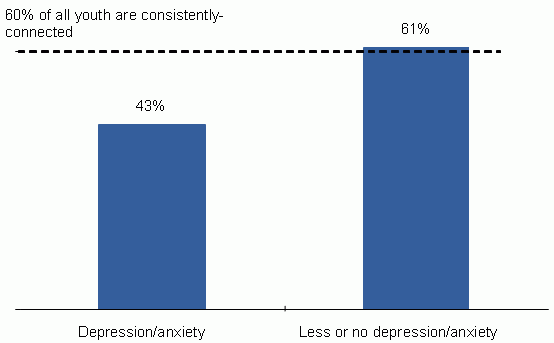
Source: Urban Institute estimates of the National Longitudinal Survey of Youth 1997.Notes: Sample sizes: youth with depression / anxiety, n = 167; youth with less or no depression / anxiety, n = 1,874. Consistently-connected youth are in school or working most of the time between ages 18 and 24. Estimates are significantly different at the 95% confidence level.
| Youth with depression/anxiety | Youth with less or no depression/anxiety | All youth | |
| n = 167 | n = 1,874 | n = 2,041 | |
| Adolescent Risk Behaviors | |||
| Cumulative risky behaviors (mean) | 4.2* | 3.2 | 3.3 |
| Alcohol by age 13 | 15% | 15% | 15% |
| Marijuana by age 16 | 46%* | 34% | 35% |
| Used other drugs | 39%* | 26% | 27% |
| Sex by age 16 | 62%* | 50% | 51% |
| Attack someone/get into a fight | 41%* | 27% | 28% |
| Member of a gang | 14% | 8% | 9% |
| Sell drugs | 22% | 19% | 19% |
| Destroy property | 43% | 36% | 36% |
| Steal something worth less than $50 | 56%* | 45% | 46% |
| Steal something worth more than $50 | 23%* | 14% | 15% |
| Other property crime | 17% | 14% | 14% |
| Carry a gun | 15% | 16% | 16% |
| Ever run away | 30%* | 17% | 18% |
| Highest Degree Completed by Age 23-24 | |||
| None | 35%* | 15% | 17% |
| High school diploma | 46% | 51% | 51% |
| Associate's degree | 6% | 6% | 6% |
| Four-year college degree or higher | 13%* | 27% | 26% |
| Median Annual Earnings (among Earners) | |||
| Age 18 | $9,886 | $10,162 | $10,139 |
| Age 19 | $11,187 | $12,810 | $12,637 |
| Age 20 | $13,516 | $13,886 | $13,876 |
| Age 21 | $13,634* | $17,645 | $17,384 |
| Age 22 | $16,701* | $21,766 | $21,430 |
| Age 23 | $15,506* | $22,875 | $22,411 |
| Employment | |||
| Employed on 24th birthday | 66% | 79% | 77% |
| Connectedness to School or Work between Ages 18 and 24 | |||
| Consistently-connected | 43%* | 61% | 60% |
| Initially-connected | 19% | 14% | 15% |
| Later-connected | 21% | 15% | 15% |
| Never-connected | 17%* | 10% | 10% |
| Charged with a Crime | |||
| Charged with an adult crime by age 24 | 27%* | 16% | 17% |
| Parenting | |||
| Has a biological child at age 18 (among female youth) | 24%* | 9% | 11% |
| Has a biological child at age 24 (among female youth) | 47% | 38% | 38% |
| Health Insurance Coverage | |||
| Has health insurance on 24th birthday | 63% | 72% | 71% |
| Source: Urban Institute estimates of the National Longitudinal Survey of Youth 1997.Notes: Some youth who did not complete high school may have earned a General Equivalency Diploma. Median earnings exclude youth who did not work and therefore had zero earnings. Health insurance coverage is asked about a point in time and therefore does not capture a youths coverage throughout the year. The cumulative risk behavior score is based on the 13 risk behaviors listed beneath it. Adolescent risk behaviors are measured up to age 18, except where otherwise noted. Never-connected youth may make extremely short connections to school or the labor market. * Estimates for youth with depression/anxiety are significantly different from youth with less or no depression/anxiety at the 95% confidence level or above. | |||
Endnotes
[1] Depression / anxiety are measured using the Mental Health Inventory five-item short version (MHI-5) developed in the late 1970s. This measure asks respondents how often they felt certain ways during the month before the interview date. Using a four-point scale, respondents were asked to rate how frequently they felt nervous, calm and peaceful, downhearted and blue, happy, and so down in the dumps that nothing could cheer them up. This particular analysis captures depression/anxiety at ages 18 or 19, which does not indicate whether these youth also experienced depression during adolescence when risk behaviors are captured or continue to experience depression/anxiety in early adulthood when adult outcomes are measured.
[2] Prior research on the MHI-5 scale designated different cut points that indicated a clinical case of mental health concern at 76, 68, and 60 depending on the classification method used (Kelly et al. 2008). Using any of these cut points would classify a large percentage of our sample as having a mental disorder. The MHI-5 scale used in the NLSY97, however, used one fewer response categories than other studies. Hence, we suspect the high prevalence rates in the NLSY97 sample using these cut points may result from this different categorization and cannot be compared. A review of the literature indicates that 15 to 20 percent of youth suffer a bout of depression at some point in their lives, and 0.4 percent to 8.3 percent of adolescents suffer from depression at a given time (Birmaher et al. 1996). More recently, another review of the literature suggests that one in five adolescents experience significant symptoms of emotional distress and nearly one in ten are emotionally impaired. Estimates from the National Health Interview Survey indicate that 5 percent of young adults age 18 to 24 reported experiencing two or more symptoms of depression in the past 30 days (Child Trends Databank, downloaded October 2008). To be consistent with these findings, we designated the bottom 8 percent of the distribution to be youth with depression/anxiety disorders.
[3] Cumulative risky behaviors include consuming alcohol before age 13, using marijuana before age 16, using other drugs before age 18, selling illegal drugs before age 18, engaging in sex before age 16, stealing something worth less than $50 before age 18, stealing something worth more than $50 before age 18, destroying property before age 18, committing other property crime before age 18, being a member of a gang before age 18, getting into a fight before age 18, carrying a gun before age 18, and running away from home before age 18.
[4]Youth who did not obtain a high school degree may have obtained a General Equivalency Diploma.
[5] Results of a trajectory analyses conducted using the National Longitudinal Survey of Youth 1997 identify four pathways for youth connectedness to employment or school between ages 18 and 24: consistently-connected, initially-connected, later-connected, and never-connected. For more information see Kuehn, D., Pergamit, M., Macomber, J., and Vericker, T. (2009). Multiple Pathways Connecting to School and Work. Washington, D.C.: U.S. Department of Health and Human Services, Office of the Assistant Secretary for Planning and Evaluation.
[6] Median earnings exclude youth who did not work and therefore had zero earnings.
[7] Health insurance coverage is asked about at a point in time and therefore does not capture a youths coverage throughout the year.
References
Birmaher, Boris, Neal Ryan, Douglas Williamson, David Brent, Joan Kaufman, Ronald Dahl, James Perel, and Beverley Nelson. 1996. Childhood and Adolescent Depression: A Review of the Past 10 Years. Part I. Journal of the American Academy of Child and Adolescent Psychiatry 35(11): 1427-39.
Child Trends Databank. Depressive Symptoms among Young Adults. Washington, D.C. downloaded from http://www.childtrendsdatabank.org/pdf/101_PDF.pdf on October 28, 2008.
Kelly, Mark, Frank Dunstan, Keith Lloyd, and David Fone. 2008. Evaluating Cutpoints for the MHI-5 and MCS Using the GHQ-12: A Comparison of Five Different Methods. BMC Psychiatry 8:10.