


KEY POINTS
- After initial implementation, there is an opportunity to increase the kinds of prevention programs and services for which jurisdictions can receive federal support by using the full flexibility Congress provided in the Family First Prevention Services Act (FFPSA).
- There is a potential gap between statutory requirements and requirements in the Title IV-E Prevention Services Clearinghouse handbook. The handbook is more restrictive on study eligibility, study design and execution, and service eligibility
BACKGROUND
FFPSA created a new legal and financial pathway for foster care prevention services
The Family First Prevention Services Act (FFPSA) marked a shift in federal child welfare policy by expanding services intended to prevent children from entering foster care. FFPSA was enacted by Congress in 2018 as part of Division E of the Bipartisan Budget Act (P.L. 115-123) in response to criticism that most federal child welfare dollars are available only after a child has entered foster care.1 Under FFPSA, jurisdictions can receive federal funding for certain prevention services through the Title IV-E program; these services can be provided to eligible children, parents, and kinship care providers.[i] Funding is available for prevention services regardless of whether families meet the income eligibility required for other Title IV-E reimbursement purposes.
The Secretary of the U.S. Department of Health and Human Services was directed to establish a public clearinghouse that would systematically evaluate evidence and identify practices intended to prevent foster care placements that meet the FFPSA evidence standards for federal reimbursement.2 To adhere to this statutory requirement, in 2019, the Administration for Children and Families (ACF) established the Title IV-E Prevention Services Clearinghouse, in this brief referred to interchangeably as the Clearinghouse.
Jurisdictions can be reimbursed for programs and services rated by the Title IV-E Prevention Services Clearinghouse
Clearinghouse reviewers assess studies and assign one of the following four evidence ratings to each prevention program or service: 1) well-supported, 2) supported, 3) promising, or 4) does not currently meet criteria. To determine ratings, reviewers utilize the Clearinghouse's Handbook of Standards and Procedures, Version 2.0ii (hereafter referred to as the Clearinghouse handbook or just handbook), which explains the process for determining a program or service s eligibility and rating.3 Ratings are contingent on a number of factors, including the number of studies with favorable effects, the length of sustained effects, and the quality of evidence.
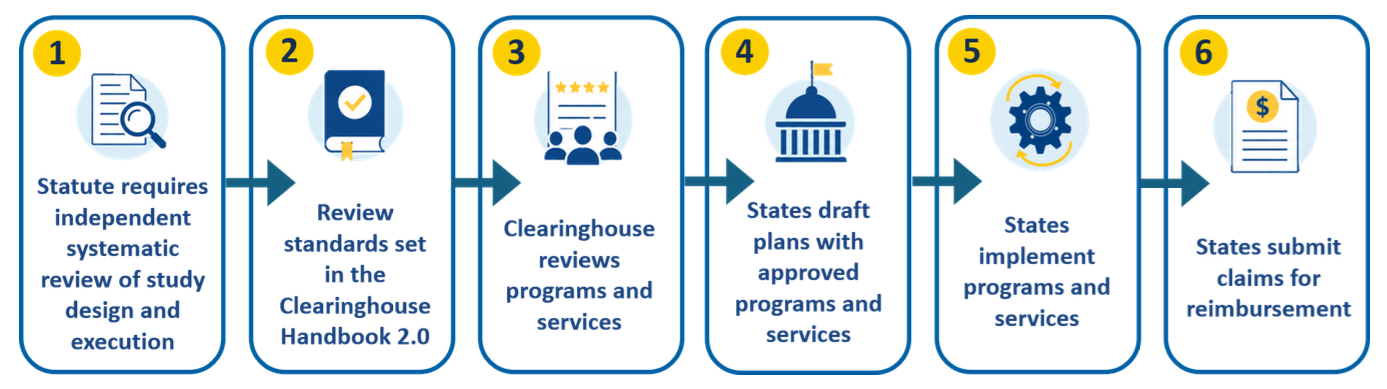
To receive Title IV-E federal funding for prevention services, jurisdictions must submit a five-year prevention plan to CB for approval. This plan must include a summary of which prevention service(s) the jurisdiction will provide.4 To obtain approval, the prevention service(s) listed in the five-year plan must be rated by the Title IV-E Prevention Services Clearinghouse as well-supported, supported, or promising; at least 50 percent of the amounts expended must meet the well-supported criteria. Jurisdictions must also ensure that their five-year plan is accompanied by a well-designed and rigorous evaluation strategy; jurisdictions can seek an evaluation waiver for programs rated as well-supported.5
Jurisdictions have faced implementation challenges that have limited uptake and provided key lessons on potential opportunities moving forward
Since implementation began, there has been growing evidence that jurisdictions are experiencing challenges implementing Title IV-E prevention services. While it is not the purpose of this brief to provide an exhaustive description of the challenges and barriers jurisdictions may be facing, it is noteworthy that despite 48 jurisdictions having approved Title IV-E prevention plans at the end of FY23 (52 by December 2025), 29 of them (60%) had not yet submitted claims for federal reimbursements as of FY23.iii,6 Currently, only one-fifth of programs are rated as well-supported, which may limit options for how at least 50 percent of funds are spent.7 Challenges may go beyond differences in claiming practices across states and may include but are not limited to administrative burden related to reporting requirements and documentation processes, limited state funding for evaluation studies, mismatches between programs rated as well-supported in the Clearinghouse and programs that best fit the needs of communities, and staffing challenges.8,9,10
The Title IV-E Prevention Services Clearinghouse operates as an independent review as required by statute, and there may be opportunities to revise the sub-regulatory guidance provided via the handbook to improve the availability of Title IV-E prevention services
In implementing FFPSA and establishing the Clearinghouse, ACF faced the challenging task of determining the rigor of standards to use for evaluating and rating prevention programs and services, factoring in established best practices from the research field, while also ensuring adherence to statutory requirements. This task was further complicated by the lack of a directly similar precedent to follow, as many other clearinghouses do not directly affect what services are eligible for federal reimbursements.
The Clearinghouse s primary goal is to systematically review evidence on programs and services that may be eligible for Title IV-E funding as quickly as possible and to make those findings available for jurisdictions. Statute requires that studies be rated by an independent systematic review for the quality of study design and execution. Consistent with other federal clearinghouses processes, requirements must be operationalized to ensure that the review is conducted systematically. To operationalize, ACF created a handbook currently Handbook 2.0 and contracts out reviews to an independent firm. This firm applies standards laid out in the handbook to determine if a program or service is well-supported, supported, or promising. Increasing the availability of evidence-based prevention programs and services for states, territories, and Tribes is important for strengthening the field over time. The handbook s focus on reviewing evidence, and the specific processes required by it, may have inadvertently created a tension between examining the quality of the evaluation versus the quality of the underlying program or service, which may unintentionally impact the number of programs and services available to child welfare agencies serving children and families in the shorter term.
FFPSA may allow additional programs and services to be made available to be implemented in states, territories, or with Tribes that do not currently meet handbook s evaluation requirements. For example, some factors make evaluations difficult to translate to other populations without adaptations and challenging to implement rigorous evaluation design (e.g., size of locality, rural versus urban, serving hard-to-reach populations); this may affect what is currently found to be rated as well-supported, supported, or promising under handbook standards and thus what may be included in prevention plans potentially limiting local flexibility and innovation.
Now that a few years have passed since implementation began, and more information is available on challenges and lessons learned, there are opportunities to revisit federal processes surrounding Title IV-E prevention services. This brief will analyze what is statutorily required through FFPSA and how the Clearinghouse is currently evaluating programs and services under the handbook. It aims to identify potential opportunities to improve Title IV-E prevention services availability at the federal level to ultimately reduce the number of children entering foster care at the state and local levels.
DIFFERENCES BETWEEN STATUTE AND THE CLEARINGHOUSE
When federal agencies must attempt to implement Congressional requirements designed to provide high-level guidelines, there are notable differences between what is in statute and how it's operationalized by a given clearinghouse. The potential gap between statutory requirements and the Clearinghouse handbook is discussed below, organized under central themes related to study eligibility, study design and execution, and service eligibility. For more information on statutory citations and Clearinghouse handbook text, please see the Appendix.iv,11,12
Below, we present a non-exhaustive list of some areas where the handbook may be narrower than statute. It is important to note that some challenges related to program adaptation may not apply to Tribes. Tribes have flexibility under the Title IV-E prevention program. Specifically, a Tribe with a 472 agreement with a state or Tribal Title IV-E agency can 1) use Title IV-E prevention services Clearinghouse-rated interventions adapted to the culture and context of Tribal communities, and; 2) determine the practice criteria for services that are adapted to the culture and context of the Tribal communities served. For more information, see ACF Program Instruction for states and Tribes.
STUDY ELIGIBILITY
Certain factors make a study ineligible for Clearinghouse review.
Manual adaptation and availability. The statute requires programs and services reviewed by the Clearinghouse to have a manual or other documentation that specifies the program or service and describes how to implement it. The Clearinghouse handbook requires that manuals be publicly available (downloadable, purchasable, or obtainable) a requirement not explicitly discussed in statute. Furthermore, the Clearinghouse currently limits the extent of adaptations that can be made to practice manuals, as evaluation criteria are tied to the focal manual. Adaptation constraints may therefore unintentionally treat culturally- or developmentally specific adaptations, population-based adaptations, or adaptations aimed at treating clients with multiple diagnoses or challenges, as separate or ineligible, despite Congressional direction to evaluate such practices. While the manual-adaptation limit seeks to preserve the integrity of programs or services, it may limit flexibility in adjusting models to fit the needs of populations that child welfare agencies serve.
Publication restrictions. The Clearinghouse handbook excludes certain studies based on publication date, public availability, document type, and English-language availability requirements not found in the statute. Publication requirements are included to facilitate the ability of the Clearinghouse to review programs and services as quickly as possible and to complete reviews of as many programs as possible within existing resources. Publication restrictions, particularly those surrounding the publication date, may have limited the availability of certain programs, as their initial randomized controlled trials (RCT) or quasi-experimental design (QED) studies were completed prior to 1990 with limited replication. This may present challenges for drug abuse treatment services that may be offered to parents and other behavioral health services.
STUDY DESIGN AND EXECUTION
Study design choices may impact a study s inclusion in Clearinghouse review under the handbook and affect the resulting evidence rating determined for a practice. Statute requires that studies be rated for the quality of the study design and its execution and determined to be well-designed and well-executed. To contribute to a supported or well-supported rating, FFPSA requires rigorous RCTs or, if not available, studies using a rigorous QED. While some standards implemented by the Clearinghouse handbook are not directly specified in statute, they reflect practices adopted by other federal clearinghouses, including research best practices. However, many research practices that are considered acceptable when conducting evaluation research in the field may not meet the standards of best practice.
Control design. The statute permits studies using some form of control, such as an untreated group, placebo group, or wait list study, for helping establish that a program or service meets the standards of a promising practice. The Clearinghouse handbook specifies reviews of RCTs and QEDs across all evidence rating categories, rather than just well-supported or supported ratings, which may limit studies that qualify a program or service as a promising practice. Promising practice study design requirements may further limit innovation in jurisdictions interested in adopting newer prevention programs that show initial positive evaluation results. These initial evaluation studies contribute to larger studies that may help generate evidence toward programs or services rated by the Clearinghouse. However, as noted in the handbook, the Clearinghouse is planning to develop and pilot standards for reviewing studies that use single case designs and determine how such designs may contribute to promising ratings.
Non-overlapping samples requirement. For RCT or QED studies to achieve well-supported status, the Clearinghouse handbook requires studies to have two separate contrasts that each have non-overlapping samples, while the statute refers to the need for at least two qualifying studies. The non-overlapping samples requirement addresses sample overlap at a high level, ensuring that all publications that result from the same study are reviewed as one study by the Clearinghouse. ACF s Home Visiting Evidence of Effectiveness (HomVEE) applies a similar requirement.13
Attrition standards. Attrition, or the loss of individuals from a study sample over time, is one of the main determinants of whether estimates from a study are free of bias. There are no attrition standards specified in statute, but the standards currently used by the Clearinghouse align with other federal clearinghouse practices. The Clearinghouse handbook s attrition standards are based on those developed by the What Works Clearinghouse (WWC). WWC review teams assess individual-level attrition for each study against either an optimistic boundary or a cautious boundary.14 The Clearinghouse handbook applies the cautious boundary for all study reviews. ACF s Pathways to Work Evidence Clearinghouse and HomVEE also apply the cautious boundary to all attrition assessments.15,16
Baseline equivalence standards. Baseline equivalence is important for identifying the comparability of the program or service and control groups before an intervention begins. The statute does not specify any standard for baseline equivalence. The Clearinghouse handbook operationalizes baseline equivalence in terms of effect sizes rather than statistical significance.. Assessing baseline equivalence using statistical significance is an accepted method in the field. The effect size thresholds currently used by the Clearinghouse align with the approach used by the WWC.17
Missing data standards. The statute does not specify any requirements for handling missing data. The Clearinghouse handbook requires specific methods for handling missing data, including complete case analysis, regression imputation, maximum likelihood, non-response weights, and constant replacement. While these are all commonly accepted methods used in peer-reviewed studies, there are other accepted methods that could be included in the handbook. The Clearinghouse handbook s current missing data standards align with the approach used by the WWC.18
Design confounds. There is no reference to design confounds in statute. The Clearinghouse handbook adds confound standards related to the n=1 person-provider or administrative unit confound that could potentially exclude foundational studies. The n=1 confound refers to when individuals in both intervention and control conditions receive services from a single site or provider, reflecting generalizability concerns. This may exclude studies where there were no other available providers at a site, such as a shortage of highly specialized providers. This may also exclude studies where a single administrative unit tests an intervention as part of its foundational efficacy trial, using a different source for the comparison group (e.g., services as usual in the community).
Measurement restrictions. The statute broadly references the need for studies to demonstrate programs or services that result in meaningful improvements in validated measures of important child and parent outcomes for well-supported, supported, and promising practices. The statute has a general practice requirement ensuring outcome measures are reliable and valid and are administered consistently and accurately across all those receiving the practice. The Clearinghouse handbook may unintentionally exclude validated measures and outcome categories based on face validity, reliability, and consistency, aligning this general practice requirement and research best practice.
SERVICE ELIGIBILITY
Certain programs or services are not eligible for Clearinghouse review.
Service exclusions. The Clearinghouse handbook generally excludes medication-, referral-, and screening-only services (with some exceptions, e.g., methadone maintenance therapy, which uses an FDA-approved medication for opioid use disorder, was initially rated as promising in July 2019), even though the statute does not expressly exclude them. In February 2026, buprenorphine, methadone, and naltrexone, three FDA-approved medications for opioid use disorder, received well-supported ratings in the Clearinghouse. This was accomplished through fast-track evidence review by leveraging the FDA approval process.
CONCLUSION
This brief explores potential gaps between statute and the Title IV-E Prevention Services Clearinghouse handbook, highlighting select opportunities to leverage flexibility and expand the universe of programs and services that may meet Clearinghouse handbook standards. Increasing program and service availability, along with the potential resulting increase in claiming, may increase costs for the federal government. However, there are also cost savings associated with preventing children from entering foster care.
There may be opportunities to address gaps between the statute and the handbook, for example by revising the handbook to more closely reflect statutory language or by exploring alternative approaches to how evidence is reviewed altogether. A modified process might eliminate the use of a handbook as sub-regulatory guidance and replace the guidance required by statute with a more simplified version while also discussing the potential limitations of each service reviewed. Expanding reimbursable prevention services may promote flexibility, increase cost-effectiveness, and encourage innovation for states, territories, and Tribes in serving children and families.
*This content is in the process of Section 508 review. If you need immediate assistance accessing this content, please submit a request to Amanda Benton, Amanda.Benton@hhs.gov. Content will be updated pending the outcome of the Section 508 review.
REFERENCES
[1] Family First Prevention Services Act of 2018, Pub. L. No. 115-123, 50701 50712, 132 Stat. 64 (2018). https://www.congress.gov/115/plaws/publ123/PLAW-115publ123.pdf
[2] 42 U.S.C. 676(d)(2)
[3] Wilson, S. J., Brown, S. R., Kerns, S. E. U. et al. (2024). Title IV-E Prevention Services Clearinghouse Handbook of Standards and Procedures, Version 2.0, OPRE Report # 2024-127, Washington, DC: Office of Planning, Research, and Evaluation, Administration for Children and Families, U.S. Department of Health and Human Services. Available from: https://preventionservices.acf.hhs.gov/sites/default/files/attachments/ psc_handbook_v2_508c.pdf
[4] U.S. Department of Health and Human Services, Administration for Children and Families. Program Instruction ACFACYF-CB-PI-24-10. Available from: https://acf.gov/sites/default/files/documents/cb/pi-24-10.pdf
[5] U.S. Department of Health and Human Services, Administration for Children and Families. Program Instruction ACFACYF-CB-PI-24-10. Available from: https://acf.gov/sites/default/files/documents/cb/pi-24-10.pdf
[6] Oberlander, S., Allen, K., and Benton, A. Title IV-E Prevention Services Make Up Less Than Two Percent of Overall Program Expenditure Reimbursement Claims: Many States Do Not Claim Expenses at All. Office of the Assistant Secretary for Planning and Evaluation, U.S. Department of Health and Human Services. February 2026. https://aspe.hhs.gov/reports/title-iv-e-prevention-services-make-less-t…
[7] Oberlander, S., Allen, K., and Benton, A. Title IV-E Prevention Services Make Up Less Than Two Percent of Overall Program Expenditure Reimbursement Claims: Many States Do Not Claim Expenses at All. Office of the Assistant Secretary for Planning and Evaluation, U.S. Department of Health and Human Services. February 2026. https://aspe.hhs.gov/reports/title-iv-e-prevention-services-make-less-t…
[8] Heaton, L., Creavey, K., Green-Rogers, Y. et al. (2025). Family first policy to practice: Using implementation science and CQI to advance prevention focused practice. Child and Youth Services Review, 176, 108403. Available from: https://www.sciencedirect.com/science/article/pii/S0190740925002865
[9] Child Welfare League of America. (2024). Written Comments for Hearing, The Family First Prevention Services Act: Successes, Roadblocks, and Opportunities for Improvement Available from: https://www.cwla.org/wpcontent/uploads/2024/06/CWLA-Final-Comments-for-…
[10] Chapin Hall Center for Children. (2024). Family First Prevention Services Act: Successes, Roadblocks, & Opportunities for Improvement May 22, 2024 Hearing of the United States Senate Committee on Finance. Available from: https://www.chapinhall.org/wp-content/uploads/Chapin-Hall-Statement-Fam…
[11] Family First Prevention Services Act of 2018, Pub. L. No. 115-123, 50701 50712, 132 Stat. 64 (2018). https://www.congress.gov/115/plaws/publ123/PLAW-115publ123.pdf
[12] Wilson, S. J., Brown, S. R., Kerns, S. E. U. et al. (2024). Title IV-E Prevention Services Clearinghouse Handbook of Standards and Procedures, Version 2.0, OPRE Report # 2024-127, Washington, DC: Office of Planning, Research, and Evaluation, Administration for Children and Families, U.S. Department of Health and Human Services. Available from: https://preventionservices.acf.hhs.gov/sites/default/files/attachments/ psc_handbook_v2_508c.pdf
[13] Sama-Miller, E., Lugo-Gil, J., Akers, L., Coughlin, R., & Dunn, A. (2025). Home Visiting Evidence of Effectiveness (HomVEE) Systematic Review Handbook of Procedures and Evidence Standards: Version 2.3, OPRE Report No. 2025-058, Washington, DC: Office of Planning, Research, and Evaluation, Administration for Children and Families, U.S. Department of Health and Human Services. Available from: https://homvee.acf.gov/sites/default/files/2025-06/HomVEE-Version-2.3-h…
[14] What Works Clearinghouse. (2022). What Works Clearinghouse procedures and standards handbook, version 5.0. U.S. Department of Education, Institute of Education Sciences, National Center for Education Evaluation and Regional Assistance (NCEE). Available from: https://ies.ed.gov/ncee/wwc/Handbooks
[15] Brown, S., Porowski, A., Swan, D., Levin, J., & Danks, A. (2025). Protocol for the Pathways to Work Evidence Clearinghouse: Methods and Standards, Version 2.0, OPRE Report No. 2025-150, Washington, DC: Office of Planning, Research, and Evaluation, Administration for Children and Families, U.S. Department of Health and Human Services. Available from: https://pathwaystowork.acf.gov/sites/default/files/2026-02/Pathways%20t…
[16] Sama-Miller, E., Lugo-Gil, J., Akers, L., Coughlin, R., & Dunn, A. (2025). Home Visiting Evidence of Effectiveness (HomVEE) Systematic Review Handbook of Procedures and Evidence Standards: Version 2.3, OPRE Report No. 2025-058, Washington, DC: Office of Planning, Research, and Evaluation, Administration for Children and Families, U.S. Department of Health and Human Services. Available from: https://homvee.acf.gov/sites/default/files/2025-06/HomVEE-Version-2.3-h…
[17] What Works Clearinghouse. (2022). What Works Clearinghouse procedures and standards handbook, version 5.0. U.S. Department of Education, Institute of Education Sciences, National Center for Education Evaluation and Regional Assistance (NCEE). Available from: https://ies.ed.gov/ncee/wwc/Handbooks
[18] What Works Clearinghouse. (2022). What Works Clearinghouse procedures and standards handbook, version 5.0. U.S. Department of Education, Institute of Education Sciences, National Center for Education Evaluation and Regional Assistance (NCEE). Available from: https://ies.ed.gov/ncee/wwc/Handbooks
FOOTNOTES
[i] Federal funding for Title IV-E prevention services is available for up to 12 months for 1) any child a state determines is a candidate for foster care, 2) pregnant or parenting youth in foster care, and 3) the parents and kin caregivers of those children and youth, if the service would enable the child to remain safely in that home.
[ii] Version 2.0 of the handbook was released in July 2024. Prior to that Version 1.0 of the handbook was used.
[iii] Jurisdictions have up to two years to submit claims.
[iv] The content provided in this section of the brief and in the Appendix reflects the information provided in the Bipartisan Budget Act of 2018 and the Title IV-E Prevention Services Clearinghouse s Handbook of Standards and Procedures, Version 2.0.
Appendix.
Alignment of FFPSA Statutory Requirements with the Clearinghouse Handbook 2.0
Theme | Differences Between Statute and the Clearinghouse Handbook | Statute | Clearinghouse Handbook |
Study Eligibility | Manual adaptation and availability | 42 U.S.C. 671(e)(4)(C)(ii)(I): "The practice has a book, manual, or other available writings that specify the components of the practice protocol and describe how to administer the practice."
42 U.S.C. 676(d)(2): The Secretary shall, directly or through grants, contracts, or interagency agreements, evaluate research on the practices specified in clauses (iii), (iv), and (v), respectively, of section 471(e)(4)(C), and programs that meet the requirements described in section 427(a)(1), including culturally specific, or location- or population-based adaptations of the practices, to identify and establish a public clearinghouse of the practices that satisfy each category described by such clauses. | Chapter 2.1.2: There must be affirmative, documented evidence that the materials that satisfy this requirement exist and are available to the public to download, request, or purchase.
Chapter 2.3.2: If more than one manual variant of a program or service exists, the Prevention Services Clearinghouse will generally attempt to identify a focal manual that represents the standard or most comprehensive or complete version of the program or service under review.
|
Publication restrictions | N/A | Chapter 4.1.1: Studies must be published or prepared in or after 1990.
Chapter 4.1.2: Dissertations, theses, and conference papers are not eligible.
Chapter 4.1.3: Studies must be available in English. This can include studies originally published in English or English-language translations of studies originally published in another language. | |
Study Design and Execution
| Control design | 42 U.S.C. 671(e)(4)(C)(iii)(II): "...utilized some form of control (such as an untreated group, a placebo group, or a wait list study)." 42 U.S.C. 671(e)(4)(C)(iv)(I)(bb): "...a rigorous random-controlled trial (or, if not available, a study using a rigorous quasi-experimental research design);"
42 U.S.C. 671(e)(4)(C)(iii): "...an appropriate comparison practice...
| Chapter 4.1.5: The Prevention Services Clearinghouse currently reviews randomized controlled trials and quasi-experimental designs The Prevention Services Clearinghouse is planning to develop and pilot standards for reviewing studies that use single case designs (SCDs). Chapter 4.1.7: Comparison conditions composed entirely of individuals who were offered the intervention condition but refused the offer or dropped out of the intervention after being offered the intervention are not eligible.
Chapter 4.1.7: Comparison conditions constructed from population norms or statistics derived from other studies, surveys, censuses, or similar sources are not eligible. |
Non-overlapping samples requirement
| 42 U.S.C. 671(e)(4)(C): was rated by an independent systematic review for the quality of the study design and execution and determined to be well-designed and well-executed;
42 U.S.C. 671(e)(4)(C): was a rigorous random-controlled trial (or, if not available, a study using a rigorous quasi-experimental research design); | Chapter 7.1: A program or service is rated as a well-supported practice if it has at least two contrasts with non-overlapping samples in RCT or QED studies | |
Attrition standards | 42 U.S.C. 671(e)(4)(C): was rated by an independent systematic review for the quality of the study design and execution and determined to be well-designed and well-executed;
42 U.S.C. 671(e)(4)(C): was a rigorous random-controlled trial (or, if not available, a study using a rigorous quasi-experimental research design); | Chapter 5.6: The Prevention Services Clearinghouse bases its standards for attrition on those developed by the WWC, which applies optimistic boundaries for attrition for use with studies where it is less likely that attrition is related to the outcomes, and cautious boundaries for use with studies where there is reason to believe that attrition may be more strongly related to the outcomes the Prevention Services Clearinghouse uses the WWC s cautious boundary for all studies for each contrast in a study for which attrition must be assessed, reviewers determine both overall and differential attrition at the individual level | |
Baseline equivalence standards | 42 U.S.C. 671(e)(4)(C): was rated by an independent systematic review for the quality of the study design and execution and determined to be well-designed and well-executed;
42 U.S.C. 671(e)(4)(C): was a rigorous random-controlled trial (or, if not available, a study using a rigorous quasi-experimental research design); | Chapter 5.7: All contrasts that are QEDs or RCTs that have compromised randomization (including high risk of joiner bias) or high attrition are assessed for baseline equivalence.
Chapter 5.7.2: Baseline effect sizes greater than 0.25 are considered non-equivalent, and the contrast receives a low rating.
| |
Missing data standards | 42 U.S.C. 671(e)(4)(C): was rated by an independent systematic review for the quality of the study design and execution and determined to be well-designed and well-executed;
42 U.S.C. 671(e)(4)(C): was a rigorous random-controlled trial (or, if not available, a study using a rigorous quasi-experimental research design); | Chapter 5.9.4: The Prevention Services Clearinghouse missing data standards are based on those used by the WWC...and are applied only to posttests on eligible outcome measures, pretests, correlated pretests, and pretest alternatives."
Chapter 5.9.4: The following are examples of acceptable approaches for addressing missing data: Complete Case Analysis Regression Imputation Maximum Likelihood Non-Response Weights [and] Constant Replacement | |
Design confounds | 42 U.S.C. 671(e)(4)(C): was rated by an independent systematic review for the quality of the study design and execution and determined to be well-designed and well-executed;
42 U.S.C. 671(e)(4)(C): was a rigorous random-controlled trial (or, if not available, a study using a rigorous quasi-experimental research design); | Chapter 5.9.3: The Prevention Services Clearinghouse defines two types of confounds: the substantially different characteristics confound, and the n=1 person-provider or administrative unit confound The Prevention Services Clearinghouse determines a substantially different characteristics confound to be present if a characteristic of one condition, or a characteristic of the service provider for one condition, is systematically different from that of the other condition...When all individuals in the intervention condition or all individuals in the comparison condition receive intervention or comparison services from a single provider (e.g., a single therapist or a single doctor) the treatment effect is confounded with the skills of the provider. The Prevention Services Clearinghouse calls this type of confound an n=1 person-provider confound | |
Measurement restrictions
| 42 U.S.C. 671(e)(4)(C)(v)(I): "...meaningful improvements in validated measures of important child and parent outcomes, such as mental health, substance abuse, and child safety and well-being..." | Appendix Chapter 4: The Handbook Version 2.0 also indicates that biomarkers are not currently eligible for review.
Chapter 4.1.8: Measures that do not directly index substance use or misuse (e.g., drug-related criminal or delinquency activity such as selling drugs, drug knowledge, behavioral intentions to use or not, attitudes towards substance use, etc.) are not eligible as measures of substance use or misuse but may meet the requirements for other outcomes. | |
Service Eligibility
| Service exclusions
| 42 U.S.C. 671(e)(1)(A): "MENTAL HEALTH AND SUBSTANCE ABUSE PREVENTION AND TREATMENT SERVICES" 42 U.S.C. 671(e)(1)(B): "IN-HOME PARENT SKILL-BASED PROGRAMS" 42 U.S.C. 671(e)(4)(C)(iii): "superior to an appropriate comparison practice..." | Chapter 2.1.1: Programs and services may include use of pharmacological treatment approaches, but those that rely solely on pharmacological interventions are not eligible (e.g., a treatment that uses only methadone for the treatment of opioid use disorder).
Chapter 4.1.7: comparison conditions that are a variant of the intervention under review are not eligible for Prevention Services Clearinghouse review. Examples of such comparisons include: Dismantling studies, which compare a full version of an intervention to a version lacking one or more components of the same intervention; Bundled intervention studies, which compare a full version of an intervention to a version with a second intervention added; Studies that compare different delivery modes (e.g., group vs. individual), provider types (e.g., ethnically matched therapists vs. non-matched therapists), or dosage or fidelity levels for the same intervention; Sequencing studies in which the same intervention is delivered to participants in both conditions but in a different order . Comparison conditions constructed from population norms or statistics derived from other studies, surveys, censuses, or similar sources are not eligible. *This content is in the process of Section 508 review. If you need immediate assistance accessing this content, please submit a request to Amanda Benton, Amanda.Benton@hhs.gov. Content will be updated pending the outcome of the Section 508 review.
|