


KEY POINTS
- Average out-of-pocket spending for insulin has declined across commercial insurance, Medicare, and cash/assistance channels in recent years.
- Competition among manufacturers and retailers, combined with consumer-empowerment tools such as TrumpRx, has substantially improved insulin affordability.
- Across every major payer category—Medicare, Medicaid, private insurance, and the uninsured—multiple pathways exist to access insulin products at or below $35 per month.
INTRODUCTION
The insulin affordability landscape has changed dramatically over the past decade. Insulin affordability is a pertinent prescription drug policy issue because insulin is clinically essential for many Americans with diabetes, yet in the past some insulin users have faced high and unpredictable out-of-pocket costs when acquiring their insulin prescriptions. Those costs have varied substantially by insurance status, benefit design, product type, pharmacy channel, and eligibility for manufacturer or safety-net assistance. Individuals with Medicare and private insurance have generally faced similar average out-of-pocket costs. Medicaid beneficiaries typically have nominal costs, while uninsured or cash-paying insulin users often depend on a more fragmented set of manufacturer programs, pharmacy discount channels, safety-net providers, and lower-price previous generation insulin products.
This report examines the current landscape of insulin affordability for people in the United States who use insulin. It focuses on the prices and cost-sharing amounts that individuals may face at the point of sale, while distinguishing those out-of-pocket costs from broader measures of total drug spending, manufacturer net prices, plan liability, premiums, rebates, and taxpayer costs.
Available evidence indicates that average out-of-pocket spending for insulin has declined substantially since 2018. The vast majority of insulin prescriptions are purchased through health insurance coverage—commercial, Medicare, or Medicaid. In the claims data summarized in Figure 1, average out-of-pocket spending for a one-month supply of insulin declined from $39.13 to $18.26 for commercially insured insulin users between 2018 and 2025, and from $42.79 to $12.04 for Medicare insulin users. Approximately only 2 percent of insulin prescriptions are paid for in cash;1 the average out-of-pocket for a one-month supply of insulin paid for using cash and/or through patient assistance programs declined from $212.81 in 2018 to $70.93 in 2025—prior to the introduction of TrumpRx.gov in 2026. These trends suggest meaningful improvements in affordability.
Figure 1 – Average Out-of-Pocket Cost for a Month’s Supply of Insulin (Adj. to 2025 Dec. Dollars)
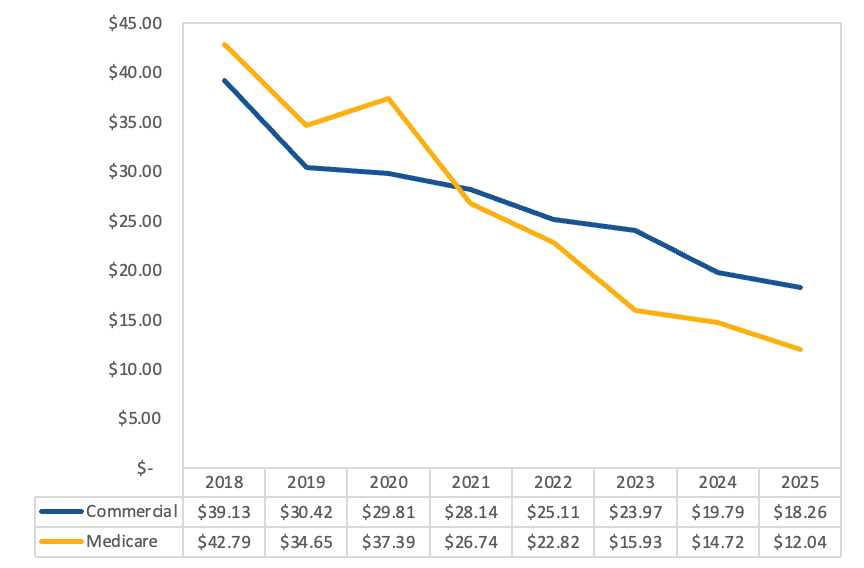
Figure 1 – Average Out-of-Pocket Cost for a Month’s Supply of Insulin (Adj. to 2025 Dec. Dollars)
This report therefore evaluates insulin affordability as a set of payer-specific and channel-specific pathways rather than as a single national out-of-pocket price. It describes the principal mechanisms available to reduce patient out-of-pocket exposure and assesses the limits of those mechanisms, such as where affordability protections remain conditional on eligibility rules, formulary placement, product selection, pharmacy routing, quantity limits, clinical appropriateness, and the cost of related diabetes supplies. The central finding is that insulin affordability has improved materially in recent years.
Individuals now have many market-based channels—including TrumpRx, generic and non-branded insulin, and competitive retail channels such as Amazon Pharmacy and Costco—to access insulin at or below $35 per month regardless of insurance status. Federally Qualified Health Centers provide additional safety-net access. Across every major payer category—Medicare, Medicaid, private insurance, and the uninsured—multiple pathways exist to access select insulin products at or below $35 per month.
AFFORDABILITY THROUGH RETAIL CHANNELS
For individuals who are uninsured, underinsured, enrolled in high-deductible plans, or otherwise purchase insulin outside a comprehensive insurance benefit, retail and direct-to-consumer channels empower insulin users to secure lower prices at the pharmacy counter. These channels include the new TrumpRx portal, manufacturer savings card and patient-assistance programs, cash-price platforms, warehouse and mail-order pharmacies, and lower-cost, often over-the-counter (OTC), human and analogue insulin products when clinically appropriate. These channels can reduce search costs, improve price transparency, and help individuals identify or redeem available discounts—directly imposing downward pressure on cash prices and causing increased competition among insulin manufacturers and pharmacies. The observed decline in cash/assistance out-of-pocket spending from $212.81 in 2018 to $70.93 in 2025 is consistent with a market in which cash-paying individuals have more affordability pathways than they had only a few years ago, even before accounting for the launch of TrumpRx in 2026. The subsections below describe the major retail and direct-to-consumer pathways improving affordability for cash paying insulin users.
TrumpRx
One route to affordability is the new TrumpRx platform, which launched in February 2026. While TrumpRx began was initially created as a means to effectuate discounts on branded drugs negotiated as part of the Most-Favored-Nation drug pricing initiative, it has since expanded to more than 600 generic medications, and now partners with Amazon Pharmacy, GoodRx, and Mark Cuban Cost Plus Drugs.2 For these competitive generic drugs, TrumpRx is a channel-discovery platform that helps uninsured or high-deductible consumers find better deals. It serves as a patient empowerment tool that enables active consumer choice across competing manufacturers and, at times, pharmacies. Searching the current discounted listings3 on TrumpRx for insulin products we currently find one Lilly insulin listing, several Sanofi listings, and several Novo Nordisk listings (Table 1).4
For Sanofi products, the terms state that eligible individuals can pay $35 per 30-day supply, and that to get that price for multiple products, the patient must fill all Sanofi insulin prescriptions together each month.5 For Lilly’s insulin lispro, the TrumpRx catalog displays a monthly price of $25 for a single 10 mL vial and $35 for 2 to 4 vials.6 For Novo Nordisk, Novolog, Tresiba, Novolog Mix 70/30, and Fiasp are listed at $35 per month supply and link to Novo Nordisk’s NovoCare myinsulinRx savings program.7 In contrast, Novo Nordisk’s insulin aspart product listing on TrumpRx appears to be its standard cash price without an additional discount.8
Table 1 – TrumpRx Discounted Insulin Products
Product | Manufacturer / Program Channel | Molecule | Insulin Type | Forms Shown | Price Shown |
Insulin Lispro | Lilly / Lilly Insulin Lispro Vial Self-Pay Savings Card | Insulin Lispro | Analog: Rapid-Acting | Vial | $25/vial for the first vial and $35 for 2-4 vials in a month |
Admelog® | Sanofi Patient Connection / Insulins Valyou | Insulin Lispro | Analog: Rapid-Acting | Vial; SoloStar pen | $35 per 30-day supply |
Apidra® | Sanofi Patient Connection / Insulins Valyou | Insulin Glulisine | Analog: Rapid-Acting | Vial; SoloStar pen | $35 per 30-day supply |
Merilog™ | Sanofi Patient Connection / Insulins Valyou | Insulin Aspart-szjj | Analog: Rapid-Acting | Vial; SoloStar pen | $35 per 30-day supply |
Lantus® | Sanofi Patient Connection / Insulins Valyou | Insulin Glargine | Analog: Long-/Ultra-Long-Acting | Vial; SoloStar pen | $35 per 30-day supply |
Toujeo® | Sanofi Patient Connection / Insulins Valyou | Insulin Glargine | Analog: Long-/Ultra-Long-Acting | SoloStar pen; Max SoloStar pen | $35 per 30-day supply |
Insulin Glargine | Sanofi Patient Connection / Insulins Valyou | Insulin Glargine | Analog: Long-/Ultra-Long-Acting | SoloStar pen; Max SoloStar pen | $35 per 30-day supply |
Novolog® | Novo Nordisk NovoCare myinsulinRx | Insulin Aspart U-100 | Analog: | Flexpen; Penfill; Vial | $35 per month supply |
Tresiba® | Novo Nordisk NovoCare myinsulinRx | Insulin Degludec | Analog: Long-/Ultra-Long-Acting | Flextouch; Vial | $35 per month supply |
Novolog® | Novo Nordisk NovoCare myinsulinRx | Insulin Aspart Protamine / Insulin Aspart U-100 | Analog: Premixed | Flexpen; Vial | $35 per month supply |
Fiasp® | Novo Nordisk NovoCare myinsulinRx | Insulin Aspart U-100 | Analog: Rapid-Acting | Flexpouch; Penfill; Pumpcart; Vial | $35 per month supply |
Source: TrumpRx. “Browse Medications.” Accessed June 29, 2026. https://trumprx.gov/browse.
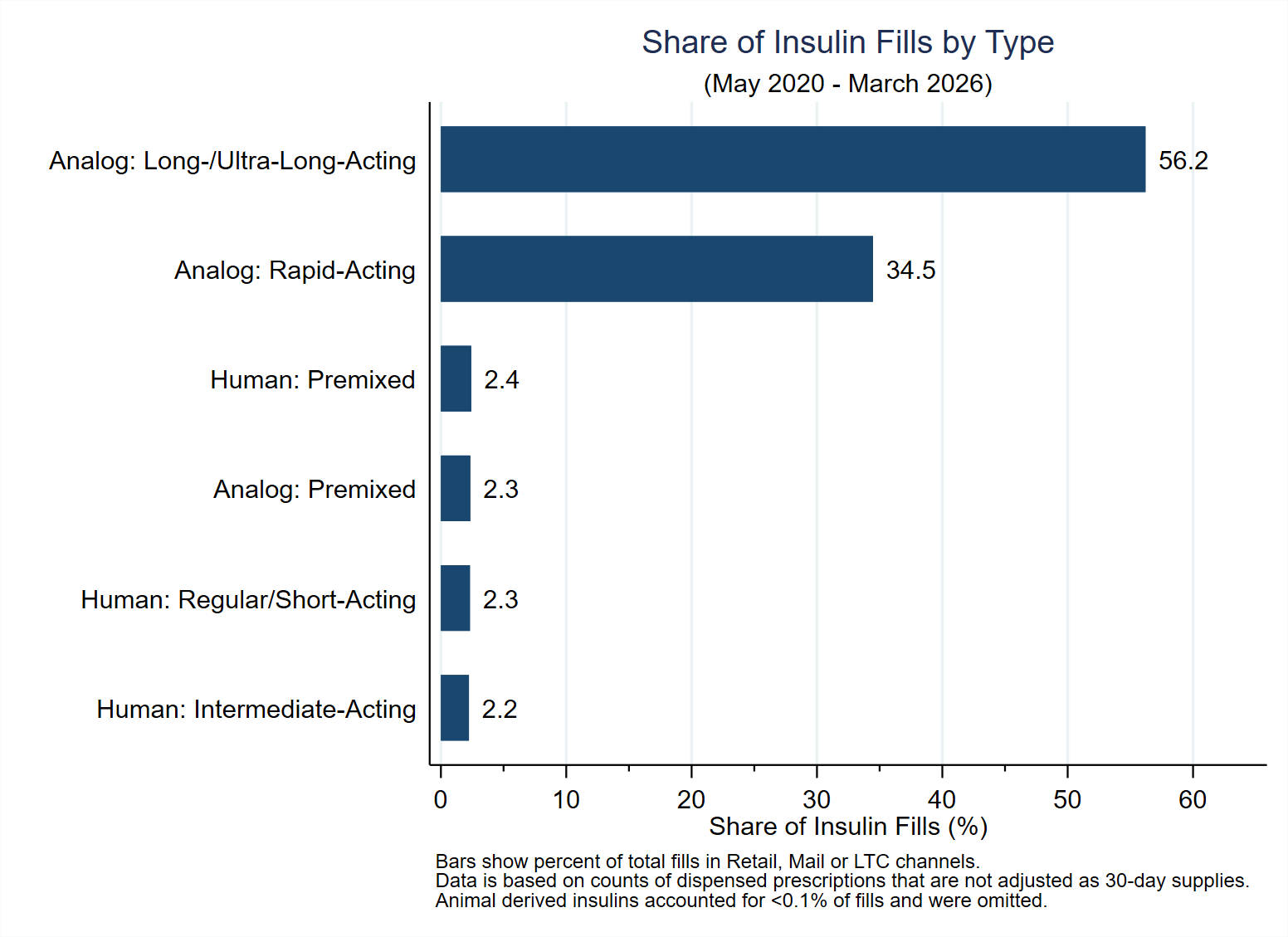
Figure 2 breaks down the distribution of prescription fills from retail, mail, and long-term care pharmacies by broad insulin type from May 2020 to March 2026. TrumpRx covers products in the two dominant insulin types including long/ultra-long analog and rapid-acting analog, as well as the less frequently used premixed analog which together make up 93.0 percent of prescriptions fills among all insulins. Since these are broad categories of insulin, it is useful to repeat this calculation on a finer level. When matching TrumpRx offers to insulin products on precise molecule, strength, and form, TrumpRx offers are relevant to 85.2 percent of insulin fills.
Figure 2 – Share of Insulin Fills by Type
(May 2020 - March 2026)
Note: Bars show percent of total fills in retail, mail, or long-term care channels. Data is based on counts of dispensed prescriptions regardless of days’ supply. Animal derived insulins accounted for <0.1% of fills and were omitted.
Source: Authors analysis of IQVIA National Prescription Audit of insulin prescription dispensing data from May 2020 through March 2026 across the retail, mail, and long-term care channels.
Direct-to-Consumer Platforms and Patient Assistance Programs from Drug Manufacturers
Another route for affordable access to insulins is from manufacturer direct-to-consumer purchasing, coupons, and patient-assistance programs. For example, Lilly’s program offers $35 per month access to all Lilly Insulin Value products for people with no insurance or with commercial insurance, subject to program terms.9 Sanofi’s similarly offers $35 for a 30-day supply for several insulin products and a separate Insulins Valyou pathway for uninsured or full-cash-paying users.10 GoodRx partners with Sanofi to make a $35 Lantus coupon available,11,12 which is an example of how GoodRx connects consumers with manufacturer coupons. Novo Nordisk’s official materials offer $35 per month for combinations of Novo products via MyInsulinRx.13 Manufacturers also offer direct-to-consumer purchasing options. Direct-to-consumer and manufacturer assistance programs convert what used to be highly variable cash prices into predictable $35 monthly access when insulin users select covered products and adhere to program terms.
Reduced Cash Prices at Retail Pharmacies
A third route for affordable insulin is broader direct-to-consumer pharmacy competition represented by Amazon Pharmacy, Costco Pharmacy, GoodRx pharmacy price transparency, and warehouse or mail-order pharmacies. Amazon Pharmacy, Costco Pharmacy, and other reduced cash price pharmacies are relevant insulin-affordability channels for the uninsured and individuals with HDHPs because they create lower cash price and coupon processing alternatives to ordinary retail list price exposure that they may otherwise face. Amazon lists various insulin products and automatically applies eligible manufacturer coupons, while Costco’s Member Prescription Program offers members cash discounts and third-party coupon prices that can be near $35 for some products. These channels are examples of an evolving marketplace dynamic of increasingly effective real-time price-search and coupon-processing options for insulin users.
Over-the-Counter Human Insulin and Reduced-Price Analog OptionsMedicare Parts B and D
Another route to affordable insulin access is through previous generation human insulin products, and one reduced-price analog option. Some human insulins have the advantage of being able to be sold OTC, which may also aid accessibility. OTC insulins available in the United States include regular (short-acting) human insulin,14 NPH/isophane human insulin (intermediate-acting),15 and premixed 70/30 human insulin.16 While these insulin products are allowed to be sold OTC, it is important to note that in practice they are pharmacy-counter refrigerated biologics rather than ordinary open-shelf OTC drugs. In product terms, Walmart’s ReliOn-branded Novolin human insulin (partnership with Novo Nordisk) products include regular, NPH/intermediate-acting, and premixed 70/30 options.17 Separately, Eli Lilly offers nonbranded insulin lispro, a commonly used modern rapid-acting prescription analog (that is not OTC), with a $25-per-vial list price announced in 2023.18 Novo Nordisk’s website states that human insulin can cost as low as $25 per vial through several national pharmacy programs for the uninsured when they determine with their clinician that human insulin is an appropriate option.19 Human insulins are clinically effective but imperfect substitutes for modern rapid-acting and long-acting analogs due to more rigid scheduling and greater risk of hypoglycemia. This OTC channel, however, gives insulin users and their clinicians greater flexibility to select lower-cost and temporary options when clinically suitable.
AFFORDABILITY FOR PUBLICLY INSURED INDIVIDUALS
For publicly insured individuals, both Medicare (Parts B and D) as well as Medicaid beneficiaries, have strong coverage options with low copays for insulin products as detailed separately below. In Medicare, the average monthly out-of-pocket cost for insulin dropped by 72 percent from $42.79 in 2018 to $12.04 in 2025 (Figure 1). Medicaid generally provides low or nominal beneficiary cost sharing.
Medicare Parts B and D
For Medicare beneficiaries, covered insulins are now capped pre-deductible at no more than $35 for a one-month supply under Parts B and D. This began through the Medicare Part D Senior Savings Model (“the Model”) for participating plans and was subsequently made mandatory in Medicare for covered insulin products through the Inflation Reduction Act of 2022 (IRA). The Model, run by the CMS Innovation Center from January 2021 through December 2023, tested predictable insulin cost sharing in participating enhanced Part D plans. Its core design was a maximum $35 copay for a one-month supply of select insulins during the deductible, initial coverage, and coverage-gap phases. Importantly, the Model paired predictable insulin cost sharing with a model-specific change in manufacturer discount treatment. Under Part D rules in place at the time of the Model, supplemental coverage that lowers beneficiary cost sharing in the coverage gap can increase plan liability because manufacturer discounts were calculated after the supplemental benefit is applied. The Model mitigated that plan disincentive by requiring participating manufacturers to continue paying the 70 percent coverage-gap discount before application of the plan’s supplemental insulin benefit.20 This design helped finance the lower beneficiary cost sharing through these manufacturer concessions and limited the upward premium pressure that could result from a copay cap funded primarily by plans. A RAND evaluation of the Model reported increased insulin access, utilization, and adherence and reduced beneficiary out-of-pocket spending, while also changing manufacturer payments, plan finances, enrollment selection, and Medicare Part D costs.21
Building on the Model, Congress later made $35 cost sharing mandatory through the IRA. For Part D, beginning January 2023, Medicare beneficiaries pay no deductible and no more than $35 for a one-month supply of each covered insulin product. The $35 monthly cap began July 2023 for Part B covered insulins used with covered pumps. From 2026 onward, the Part D cap is the lesser of $35, 25 percent of a negotiated maximum fair price (if applicable), or 25 percent of the plan’s negotiated price. Thus, for the insulin product itself, Medicare policy provides a genuine statutory out-of-pocket ceiling.22 Unlike the Model, however, the IRA insulin cap did not replicate the model’s insulin-specific 70 percent coverage-gap manufacturer-discount mechanism. The IRA cap, therefore, reduced beneficiary out-of-pocket costs by reallocating residual costs within Part D but likely contributed to upward pressure on premiums.
Medicaid
In Medicaid, affordable access to insulin is achieved through a collection of policies. Specifically, Medicaid’s cost-sharing rules generally limit drug cost sharing to nominal levels, impose a total out-of-pocket ceiling that may not exceed 5 percent of family income when states use alternative cost sharing, and restrict states’ ability to deny many services for failure to pay ordinary copays.23
It is also important to note that Medicaid policy potentially impacts the general insulin market by reducing the list prices of some insulin products, which then may decrease out-of-pocket costs for insulin users exposed to list prices through coinsurance or cash prices. Peer reviewed literature argues that one reason manufacturers cut insulin list prices in 2023 was the then-pending removal of the Medicaid rebate cap, which increased the fiscal penalty for maintaining inflated list prices.24,25
AFFORDABILITY FOR PRIVATELY INSURED INDIVIDUALS
For individuals covered by private health insurance, the policy and cost landscape is more nuanced, with many commercially insured individuals already paying less than $35 out-of-pocket. However, that out-of-pocket cost has not been universal—individuals in high-deductible plans, the deductible phase, or coinsurance arrangements could face much higher out-of-pocket charges when using their insurance. A useful benchmark for understanding out-of-pocket costs among the privately insured is Peterson-KFF’s 2018 claims analysis that found among those who had at least one fill of insulin (excluding those that abandoned their initial fill due to cost), 26 percent in the individual market, 31 percent in the small-group market, and 19 percent in the large-employer market had average out-of-pocket costs above $35 per month per insulin product.26 That implies most were already below that benchmark, but a meaningful minority was not. However, we have seen that the average monthly out-of-pocket cost for insulin for commercially insured individuals dropped by more than half from $39.13 in 2018 to $18.26 in 2025 (Figure 2), representing substantial progress on insulin affordability for this patient segment. This progress likely comes from several mechanisms, such as state insulin cost-sharing caps, policy changes allowing HDHPs to cover insulin products pre-deductible, the large 2023 list-price reductions, and recent biosimilar competition, each discussed below.
Biosimilar Pathways Enhanced Competition
On February 20, 2020, the Food and Drug Administration announced a new pathway for biosimilar insulins.27 Following this action, multiple biosimilar insulin products have launched, increasing competition and thus downward pricing pressure in the market at large. This pricing pressure may be most beneficial for the commercially insured, as private plans increasingly move to benefit designs where out-of-pocket exposure is strongly aligned with plan preference among similar products. So far, insulin product markets have seen multiple biosimilar entries for both insulin glargine (a long/ultra-long-acting analog insulin) and insulin aspart (a rapid acting analog insulin), two of the largest three insulin markets in the US measured by prescription fills. Moreover, insulin glargine (the largest insulin market) became the first molecule of any drug class to see a biosimilar competitor achieve interchangeable biosimilar status in 202128, and insulin aspart soon followed with its own interchangeable biosimilar competitor approval in 2025.29 This interchangeability designation permits pharmacists to substitute the biosimilar for the original product where allowed under state law and not otherwise restricted by prescriber or plan rules—enhancing competition due to the increased substitutability. Furthermore, many more biosimilar insulin products are in the drug development pipeline today.30 Publicly disclosed pipeline sources indicate that additional insulin biosimilar or interchangeable products are in development or pending regulatory review, especially for insulin glargine, insulin aspart, insulin lispro, and recombinant human insulin. Examples include Gan & Lee/Sandoz’s Basalin, Rapilin, and Prandilin programs and Amphastar’s AMP-004 insulin aspart and AMP-005 recombinant human insulin programs.31,32 These sources support the proposition that biosimilar insulin competition will continue to strengthen going forward, but not all major insulin molecules have a current or near-term biosimilar competitor.
High-deductible Health Plans and Pre-deductible Insulin Coverage
A separate private insurance affordability mechanism comes from a piece of 2019 IRS guidance for health savings account (HSA)-qualified HDHPs (Notice 2019-45). HDHPs can expose insulin users to high pharmacy costs before the deductible is met; in 2025, 33 percent of covered workers were enrolled in a HDHP with a savings option, and 34 percent were in a plan with a general annual deductible of at least $2,000 for single coverage.33 Before 2019, HSA-qualified HDHPs generally could not cover treatment for an existing condition before the deductible without risking HDHP/HSA status. Notice 2019-45 changed that by allowing HDHPs to cover select chronic disease medications, devices, and services as preventive care, including “insulin and other glucose lowering agents,” retinopathy screening, glucometers, hemoglobin A1c testing, and statins for diabetes. The practical effect was to allow plans to cover insulin pre-deductible while maintaining HSA-qualified HDHP status.
This policy is best understood as a value-based insurance design reform that gives employers greater flexibility to cover high-value care pre-deductible. Employer uptake suggests the 2019 guidance was meaningful: EBRI reported that about two-thirds of surveyed employers added pre-deductible coverage for insulin or other glucose-lowering agents by 2021, but many covered only some eligible services.34 Notice 2024-75 later clarified that continuous glucose monitors for individuals with diabetes generally may be treated as preventive care and that insulin products, including devices used to administer or deliver insulin, may be covered before the deductible.
State Copay Caps
The American Diabetes Association lists 29 states plus D.C. as having insulin cost-sharing caps for state-regulated commercial health insurance plans;35 many states do not have such caps. Additionally, these laws do not apply to most self-funded employer-sponsored health insurance plans.36 KFF reports self-funded plans covered 63 percent of workers with employer-sponsored coverage in 2024.37 Thus the majority of downward pressure on out-of-pocket insulin spending among those with employer-sponsored insurance is likely attributable to broad market factors.
Major List Price Reductions
Large voluntary insulin list-price reductions were announced by the three major insulin manufacturers in March 2023 and implemented largely in late 2023 or January 2024. Insulin users exercising choice at the pharmacy counter, especially those paying cash or in high-deductible or coinsurance driven plans, directly benefit from these manufacturer price reductions. Eli Lilly announced 70 percent list-price reductions for Humalog and Humulin, a $25-per-vial list price for non-branded insulin lispro, and a lower-priced Rezvoglar glargine product;38 Novo Nordisk announced WAC reductions of up to 75 percent for NovoLog and NovoLog Mix 70/30, 65 percent for Levemir and Novolin, and matching reductions for unbranded insulin aspart products;39 Sanofi announced a 78 percent list-price reduction for Lantus and a $35 commercial out-of-pocket cap for Lantus.40 These cuts are a partial unwind of the high-list-price/high-rebate insulin model; research published in JAMA Network Open estimates that for four leading insulin products gross sales rose from $13.0 billion in 2012 to $27.0 billion in 2019 while net sales fell from $8.1 billion to $5.0 billion.41 The literature generally attributes the timing to a confluence of forces rather than a single policy: public and political pressure over insulin affordability, Medicare and state cost-sharing caps, biosimilar or follow-on insulin competition, pharmacy benefit manager rebate dynamics, and especially the American Rescue Plan Act’s removal of the Medicaid rebate cap effective January 1, 2024. KFF explains that removal of the 100 percent average manufacturer price (AMP) cap meant Medicaid rebates could exceed the drug’s AMP for products with large historical price increases; peer-reviewed commentaries by Dafny and by Socal and Bai identify this change as a central reason manufacturers had a strong financial incentive to lower list prices on legacy insulin products before 2024.42,43 For commercially insured individuals, these lower list prices can reduce out-of-pocket costs, but the effect depends on benefit design. The direct pass-through is strongest for those in HDHPs, still in the deductible phase, and/or subject to coinsurance, because their pharmacy-counter liability can be tied to a plan’s negotiated transaction price (post-discount/pre-rebate) or to the product’s list price (pre-discount/pre-rebate).
SAFETY-NET CHANNELS
Besides the numerous channels above that can reduce insulin costs to approximately $35 or less for eligible individuals, select products, and program-defined monthly supplies, low-income individuals can also access lower cost insulin through Federally Qualified Health Centers (FQHCs), which are safety-net primary-care clinics serving medically underserved populations. They must serve their patients regardless of ability to pay, use sliding-fee discounts based on income and family size, and often provide or arrange discounted pharmacy services.44 The 340B program is a federal drug discount program that lets eligible safety-net providers, including FQHCs and FQHC “look-alikes,” buy outpatient drugs at statutorily discounted prices.45 For insulin, the two interact as follows: an FQHC can diagnose, prescribe, educate, monitor, and help an uninsured or underinsured patient obtain insulin through an on-site or contract pharmacy at a lower acquisition cost than the retail list price. However, 340B is not an out-of-pocket cap, and an FQHC is not simply a discount pharmacy. The insulin user must be a patient of the health center, and pass-through of 340B reduced prices to the patient depends on the FQHC's pharmacy model, sliding-fee policies, payer contracts, and compliance constraints. The FQHC insulin affordability pathway is made stronger by Executive Order 14273, signed by President Trump on April 15, 2025, which directed HHS to condition Section 330(e) grants to health centers on establishing practices to make insulin and injectable epinephrine available at or below the 340B acquisition price plus a minimal administration fee for specified low-income patients with high-cost sharing, a high unmet deductible, or no insurance.46,47
CONCLUSION
The insulin affordability landscape has improved substantially. Average out-of-pocket spending for insulin has declined across commercial insurance, Medicare, and cash/assistance channels. These trends reflect a broader shift away from the prior pricing environment in which many insulin users were exposed to high and unpredictable insulin costs at the pharmacy counter.
Progress has come through many reinforcing mechanisms, such as stronger Medicare cost-sharing protections, Medicaid’s low cost-sharing structure for low-income beneficiaries, state commercial insurance caps, manufacturer affordability programs, reduced list prices for major insulin products, growing biosimilar and interchangeable competition, safety-net access through FQHCs, and more transparent retail and direct-to-consumer options. Competition among manufacturers and retailers, combined with tools such as TrumpRx, has substantially improved insulin affordability. Taken together, these developments have created numerous and more reliable pathways for individuals to obtain insulin at lower and more predictable out-of-pocket costs than existed only a few years ago.
The remaining policy challenge is to ensure that these affordability gains are durable, easy for insulin users to navigate, and expanded through patient agency, competition, and transparent retail channels. Continued monitoring should focus on realized out-of-pocket costs, adherence, prescription abandonment, product availability, and the affordability of related diabetes supplies. Today, Americans have many options to access low-cost insulin.
*This content is in the process of Section 508 review. If you need immediate assistance accessing this content, please submit a request to Stephen Murphy, Stephen.Murphy@hhs.gov. Content will be updated pending the outcome of the Section 508 review.
[1] IQVIA Institute for Human Data Science. The Use of Medicines in the U.S. 2024: Usage and Spending Trends and Outlook to 2028. April 2024, https://www.researchgate.net/publication/388221801_The_Use_of_Medicines….
[2] Swenson, Ali, and Darlene Superville. “Trump Touts a Major TrumpRx Expansion, Adding More Than 600 Generic Drugs.” Associated Press, May 18, 2026. https://apnews.com/article/trump-trumprx-drug-prices-health-2e4d20b1b78….
[3] Discounted listings included those products listed with “presidential deals” on TrumpRx.gov.
[4] TrumpRx. “Browse Medications.” Accessed May 22, 2026. https://trumprx.gov/browse.
[5] TrumpRx. “Lantus® on TrumpRx.” Accessed May 22, 2026. https://trumprx.gov/p/lantus.
[6] TrumpRx. “Insulin Lispro on TrumpRx.” Accessed May 22, 2026. https://trumprx.gov/p/insulin-lispro.
[7] Novo Nordisk, “myinsulinRx” Accessed June 26, 2026. https://www.novocare.com/diabetes/help-with-costs/help-with-insulin-cos….
[8] TrumpRx. “Insulin Aspart.” Accessed June 26, 2026. https://trumprx.gov/p/insulin-aspart.
[9] Eli Lilly and Company. “Lilly Insulin Value Program.” Lilly Insulins. Accessed May 22, 2026. https://insulins.lilly.com/lilly-insulin-value-program.
[10] Sanofi Patient Connection. “Savings and Support Options.” Accessed May 22, 2026. https://www.sanofipatientconnection.com/savings-registration?BrandName=….
[12] GoodRx. “GoodRx Announces New Way for Consumers to Access Sanofi’s Lantus for $35 at Over 70,000 Pharmacies Nationwide.” Press release, October 19, 2023. Accessed: https://investors.goodrx.com/news-releases/news-release-details/goodrx-….
[13] Morris MS. How the Inflation Reduction Act Is Lowering Insulin Prices. GoodRx. Accessed July 15, 2026. https://www.goodrx.com/classes/insulins/inflation-reduction-act-lowers-…
[14] Novo Nordisk. “MyInsulinRx™ Program Card Registration.” NovoCare. Accessed May 22, 2026. https://www.novocare.com/diabetes/help-with-costs/help-with-insulin-cos….
[15] National Library of Medicine. “NOVOLIN R—Human Insulin Injection, Solution.” DailyMed. Updated November 23, 2022. Accessed May 22, 2026. https://dailymed.nlm.nih.gov/dailymed/drugInfo.cfm?setid=aee7f1f3-612c-….
[16] National Library of Medicine. “HUMULIN N—Insulin Human Injection, Suspension.” DailyMed. Updated December 19, 2025. Accessed May 22, 2026. https://dailymed.nlm.nih.gov/dailymed/drugInfo.cfm?setid=f6edd793-440b-….
[17] National Library of Medicine. “NOVOLIN 70/30—Human Insulin Injection, Suspension.” DailyMed. Updated November 23, 2022. Accessed May 22, 2026. https://dailymed.nlm.nih.gov/dailymed/drugInfo.cfm?setid=508a2763-3cb7-….
[18] Novo Nordisk. “Find Programs to Receive Low-Cost Human Insulin.” NovoCare. Accessed May 22, 2026. https://www.novocare.com/diabetes/help-with-costs/help-with-insulin-cos….
[19] Eli Lilly and Company. “Lilly Cuts Insulin Prices by 70% and Caps Patient Insulin Out-of-Pocket Costs at $35 Per Month.” News release, March 1, 2023. https://investor.lilly.com/news-releases/news-release-details/lilly-cut….
[20] Help With Insulin Costs & Diabetes Prescription. NovoCare. Accessed July 15, 2026. https://www.novocare.com/diabetes/help-with-costs/help-with-insulin-cos…
[21] Cubanski, Juliette, Tricia Neuman, Sarah True, and Anthony Damico. “Insulin Costs and Coverage in Medicare Part D.” KFF. Published June 4, 2020. Accessed June 30, 2026. https://www.kff.org/medicare/insulin-costs-and-coverage-in-medicare-par….
[22] Taylor, Erin Audrey, Dmitry Khodyakov, Christine Buttorff, Preethi Rao, Zachary Predmore, Lane F. Burgette, Stacie B. Dusetzina, Asa Wilks, Shiyuan Zhang, Sarah Dalton, Alice Y. Kim, Catherine E. Cooke, and Monique Martineau. Part D Senior Savings Model Final Evaluation, 2021 to 2023. Project Report PR-A1716-5. RAND Health Care. Prepared for the Center for Medicare and Medicaid Innovation, Centers for Medicare & Medicaid Services. September 2025. https://www.cms.gov/priorities/innovation/data-and-reports/2025/pdss-fi…
[23] Centers for Medicare & Medicaid Services. “Insulin.” Medicare.gov. Accessed May 22, 2026. https://www.medicare.gov/coverage/insulin.
[24] Centers for Medicare & Medicaid Services, Department of Health and Human Services. “Medicaid and Children’s Health Insurance Programs: Essential Health Benefits in Alternative Benefit Plans, Eligibility Notices, Fair Hearing and Appeal Processes, and Premiums and Cost Sharing; Exchanges: Eligibility and Enrollment.” Final rule. Federal Register 78, no. 135 (July 15, 2013): 42160–42322. https://www.federalregister.gov/documents/2013/07/15/2013-16271/medicai….
[25] Socal, Mariana P., and Ge Bai. “Insulins and the Evolving Landscape of U.S. Prescription Drug Pricing.” Annals of Internal Medicine 176, no. 9 (2023): 1259–1260. https://doi.org/10.7326/M23-1105.
[26] L. S. Dafny, “Falling Insulin Prices — What Just Happened?” New England Journal of Medicine 388, no. 18 (2023): 1636–1639, https://doi.org/10.1056/NEJMp2303279.
[27] Amin K, Claxton G, Rae M, Cox C. Out-of-pocket spending on insulin among people with private insurance. Peterson-KFF Health System Tracker. Accessed July 15, 2026. https://www.healthsystemtracker.org/brief/out-of-pocket-spending-on-ins…
[28] https://www.fda.gov/news-events/press-announcements/fda-works-ensure-sm…
[29] U.S. Food and Drug Administration. BLA 761201 Approval Letter: Semglee (insulin glargine-yfgn) injection. July 28, 2021. https://www.accessdata.fda.gov/drugsatfda_docs/appletter/2021/761201Ori…
[30] U.S. Food and Drug Administration. BLA 761188 Approval Letter: Kirsty (insulin aspart-xjhz) injection. July 15, 2025. https://www.accessdata.fda.gov/drugsatfda_docs/appletter/2025/761188Ori…
[31] Biehn B, Nelson D. U.S. Biosimilar Landscape. Cencora; 2025. Accessed July 15, 2026. https://go.cencora.com/biosimilars-pipeline-report
[32] Fish & Richardson, Biologics and Biosimilars Landscape 2025: IP, Policy, and Market Developments. Accessed June 29, 2026. https://www.fr.com/insights/thought-leadership/blogs/biologics-and-bios…
[33] US SEC, Form 10-K: Amphastar Pharmaceuticals, Inc. Accessed June 29, 2026. https://www.sec.gov/Archives/edgar/data/1297184/000129718426000009/amph…
[34] KFF. 2025 Employer Health Benefits Survey. Published October 22, 2025. https://www.kff.org/health-costs/2025-employer-health-benefits-survey/
[35] Fronstin P, Fendrick MA. Employer Uptake of Pre-Deductible Coverage for Preventive Services in HSA-Eligible Health Plans. Accessed July 15, 2026. https://www.ebri.org/health/publications/issue-briefs/content/employer-…?
[36] American Diabetes Association. “State Insulin Copay Caps.” Accessed May 22, 2026. https://diabetes.org/tools-resources/affordable-insulin/state-insulin-c….
[37] Self-funded employer-sponsored health insurance plans regulated by the Employee Retirement Income Security Act of 1974 (ERISA) are generally exempt from state laws regulating health insurance plans.
[38] KFF. 2024 Employer Health Benefits Survey. Published October 9, 2024. https://www.kff.org/health-costs/2024-employer-health-benefits-survey/#….
[39] Lilly Cuts Insulin Prices by 70% and Caps Patient Insulin Out-of-Pocket Costs at $35 Per Month | Eli Lilly and Company. March 1, 2023. Accessed July 15, 2026. https://investor.lilly.com/news-releases/news-release-details/lilly-cut…
[40] Novo Nordisk to lower U.S. prices of several pre-filled insulin pens and vials up to 75% for people living with diabetes in January 2024. PR Newswire. March 14, 2023. Accessed July 15, 2026. https://www.prnewswire.com/news-releases/novo-nordisk-to-lower-us-price…
[41] Press Release: Sanofi cuts U.S. list price of Lantus®, its most-prescribed insulin, by 78% and caps out-of-pocket Lantus costs at $35 for all patients with commercial insurance. Sanofi. March 16, 2023. Accessed July 15, 2026. https://www.sanofi.com/en/media-room/press-releases/2023/2023-03-16-20-…
[42] Dickson SR, Gabriel N, Gellad WF, Hernandez I. Assessment of Commercial and Mandatory Discounts in the Gross-to-Net Bubble for the Top Insulin Products From 2012 to 2019. JAMA Netw Open. 2023;6(6):e2318145. doi:10.1001/jamanetworkopen.2023.18145
[43] Socal, Mariana P., and Ge Bai. “Insulins and the Evolving Landscape of U.S. Prescription Drug Pricing.” Annals of Internal Medicine 176, no. 9 (2023): 1259–1260. https://doi.org/10.7326/M23-1105.
[44] L. S. Dafny, “Falling Insulin Prices — What Just Happened?” New England Journal of Medicine 388, no. 18 (2023): 1636–1639, https://doi.org/10.1056/NEJMp2303279.
[45] Health Resources and Services Administration, Bureau of Primary Health Care. “What Is a Health Center?” Last reviewed November 2025. Accessed May 22, 2026. https://bphc.hrsa.gov/about-health-centers/what-health-center.
[46] Health Resources and Services Administration. “340B Drug Pricing Program.” Last reviewed May 2026. Accessed May 22, 2026. https://www.hrsa.gov/opa.
[47] The White House. "Lowering Drug Prices by Once Again Putting Americans First." Executive Order 14273, April 15, 2025. https://www.whitehouse.gov/presidential-actions/2025/04/lowering-drug-p….
[48] Health Resources and Services Administration, Bureau of Primary Health Care, “Health Center Program Compliance Frequently Asked Questions: What are the requirements of Executive Order 14273?” updated Sept. 9, 2025.